BrewPub Starboard Pizza in Chuo-ku, Kobe

As a part of our list of pizza restaurants in Kobe, we bring you this review of one of the best Chicago pizza restaurants in all of Japan, BrewPub Starboard Pizza in Chuo-ku, Kobe.

BrewPub Starboard in Kobe would also be included in the category of “craft beer in Kobe,” but for this review, we’re mostly focused on the pizza – which was excellent (and surprisingly original).
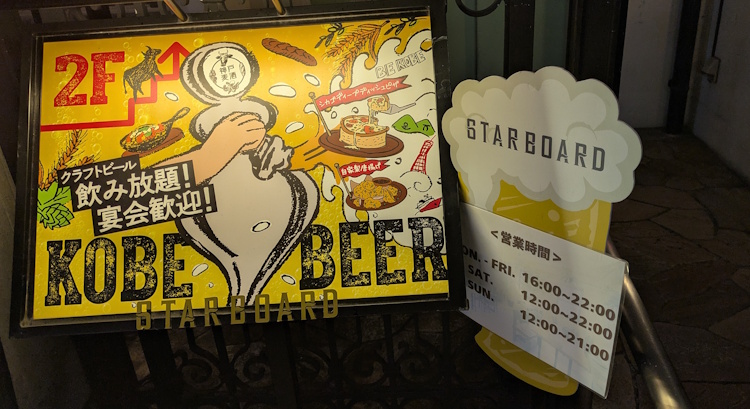
BrewPub Starboard in Kobe, may have a “second name”; it is possible this place is also called Craft Kobe. The full name listed online is BrewPub Starboard Craftkobe スターボード/神戸ビール, and you’ll see Craft Kobe on some of the pint glasses deeper into this review.

I originally found BrewPub Starboard when I was looking for a convenient place for an after-dinner beer (I already had plans to eat pizza that night, at Pizzeria Allocco).  When I saw they also made Chicago pizza, I knew I definitely needed to give this place a try.

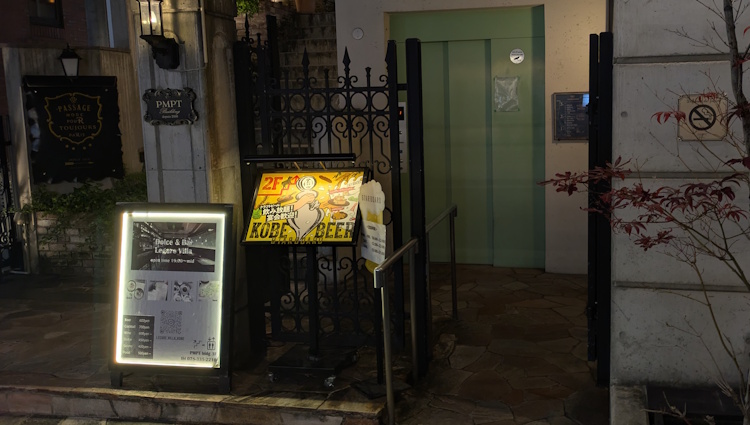
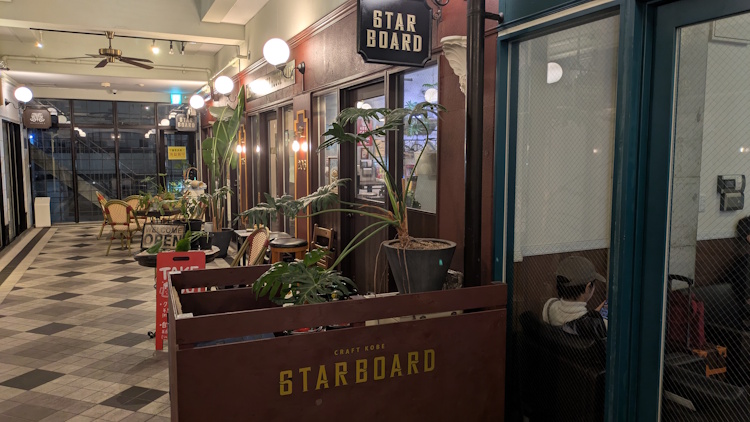
Kobe’s BrewPub Starboard is located in central Kobe City, at the western end of Hankyu Sannomiya Station, one street north of the tracks. The BrewPub Starboard bar is located on the 2nd floor of a nice, upscale building.
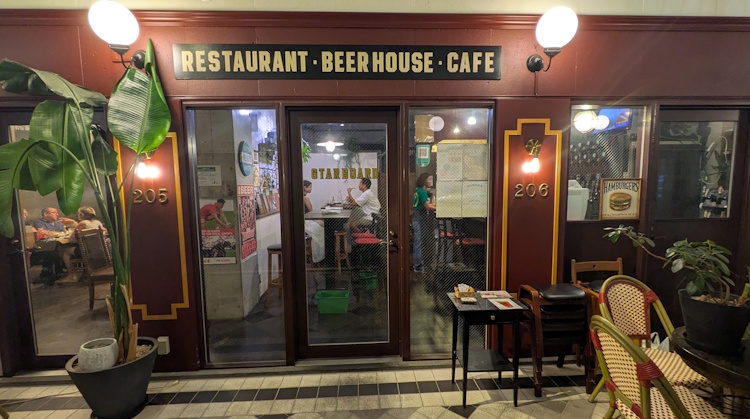
The restaurant is divided into two rooms; the taproom (which is where I wanted to be) also contains the kitchen (I could hear the sounds of grease popping in the deep frier); there is also a second room, a dinning area, around the corner.
Let’s give you a look at the pizza, then we’ll talk about the beer for a bit, and then come back to the pizza – which is really what makes Brewpub Starboard special.

How’s that look?  I’ll tell you how that looks; it looks fantastic. The cuts of bacon on that pizza are so big, it makes the pizza appear small. And even from these first pictures, you should be able to tell this is not a typical Chicago deep dish pizza.

That pizza is, however, one of the most beautiful deep dish pizzas in all of Japan, and it tastes even better than it looks.  We’ll go on and on about this pizza below, but for now, their beer selection is certainly worth a few words.
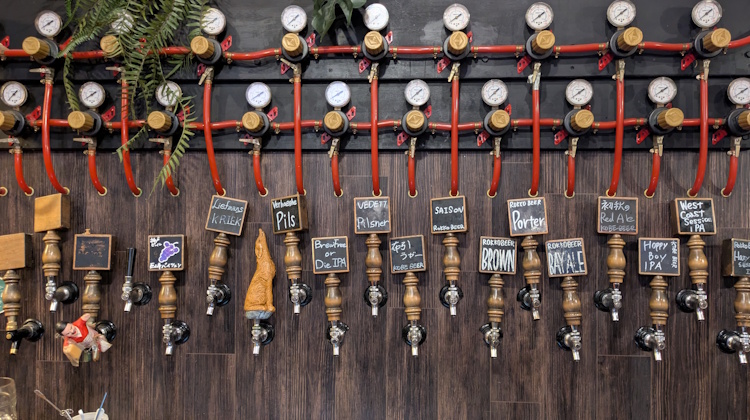
20 taps. I like that.

When I sat down, they handed me the “kiddie computer” tablet to order.  I personally never want a greasy tablet at my table, so I pushed it away.  I said I’d like to order “in person,” and that was accepted.

However, due to my stubborn resistance to the trend of pushing screens on customers at sit-down restaurants (I have walked out of places when then won’t let me order face to face), and because they don’t have a paper menu for the beer, that meant I could read the tap levers (some of them), but I had no clue about most of the beers.  A paper menu is not that hard, and it’s a better experience than forcing people to “scroll,” but…
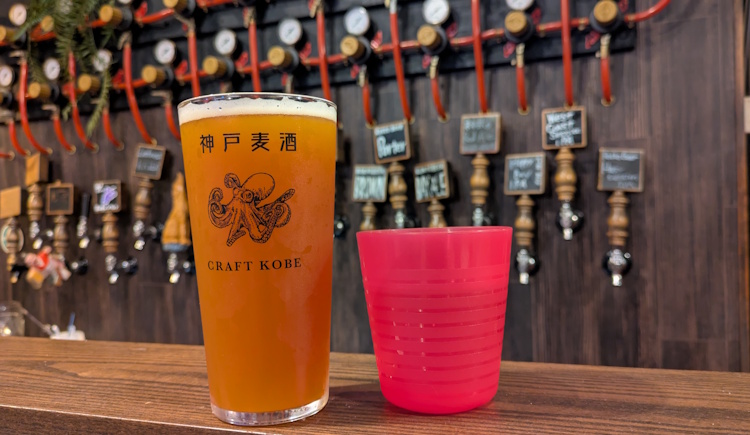
I managed to order the red ale. She asked me “what size,” and I said “large” and she showed me a tankard, and I downgraded to a modest 12-ounce pint glass. The red ale was thick, and murky, like apple juice. It was tasty, thou, and went down easy.
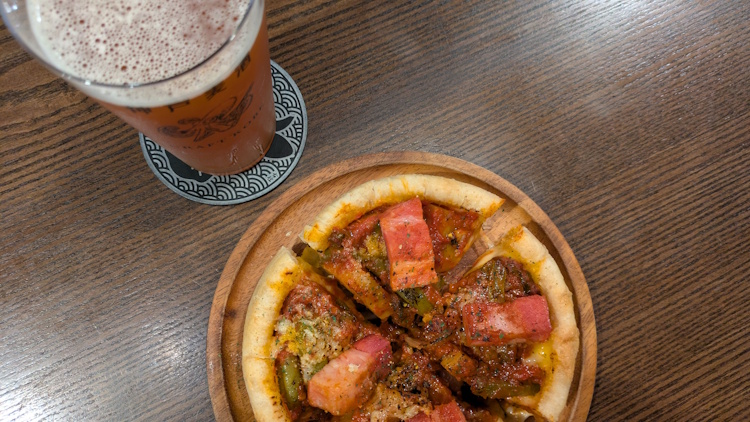
On their pizza menu, I found not one, but several deep dish Chicago pizzas. I ordered the Pepperoni Bacon Chicago pizza. I saw a pizza with some meat on it, I ordered it.  Done and done.

I did find the world’s most succinct description on their website:

Thick-sliced bacon and Ortolana pizza
— From the pizza menu at BrewPub Starboard

My server warned me that it would be “30 minutes” for the pizza, to which I was more than prepared. In fact, I’d planned for it.

If you’ve ever had a Chicago-style pizza, you’ll know they take a little while to bake.  As I have been working on a list of the best Chicago pizza’s in Japan, it has become a ritual to get one beer in my system while I wait for the pie (it would be easy to drink two, actually, as you have 20 to 30 minutes before it’s out of the oven).

That “slow food” combination of (at least) a couple of good craft beers, with a deep dish pizza arriving after the beer has had a chance to take effect, is a magic formula for a very good night.

As for the pizza:

When a bar claims to make a pizza, it is not always a good thing.  BrewPub Starboard is not even listed as a pizza restaurant in Kobe, and I didn’t expect the pizza to be particularly tasty.  However, when this pizza arrived on the counter in front of me, I was excited to see it.
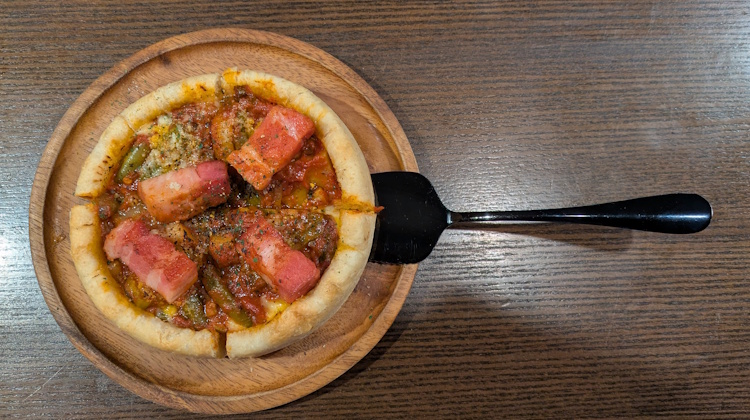
First impressions: It looked fantastic to me. Beautiful crust. And that is some seriously thick-cut bacon.

As I cut into it, I could not help but notice that the pizza had vegetables on it.  When I read “Ortolana” in the description, I confess I didn’t know what that meant. Something… “Italian,” maybe?  I would look into it later, but at that moment, what I saw as I cut into this suburb specimen of a pizza was specific: lotus root.  And, wait, wait, is that… there were green beans on this pizza.

Have you have heard of pizza sauce that included green beans?  Even now that sounds weird to me. What would that even taste like?

On my first bite, some flavor hit me that was not what I was expecting; it was good, but it was not a traditional pizza flavor at all.  I liked it, but I couldn’t exactly say what it reminded me of… something familiar, but hard to place. As I pulled a green bean out to give it a taste, it hit me:

“Vegetable soup pizza.” Not “soupy,” but that savory, rich veggie soup flavor.

That was it.  Even as I type this, I know that sounds weird.  It might even sound terrible, but that was what this “bacon” pizza was all about.  The flavor was original… and amazing.  Surprising; but I loved it.

Check this out:

Pasta all Ortolana is an Italian vegetarian pasta dish made with a seasonal summer vegetable sauce that combines garden vegetables, aromatic herbs and tomato sauce to create a comfort sauce packed with flavor.
— From LorianaSheaCooks.com

So instead of traditional red sauce, they use this Ortolana; Italian summer vegetable sauce. And it was without a doubt, one of the most special pizzas I’ve ever eaten, one of the most unusual and delicious pizzas in Japan.

Take another look at this pizza. She is a beauty.
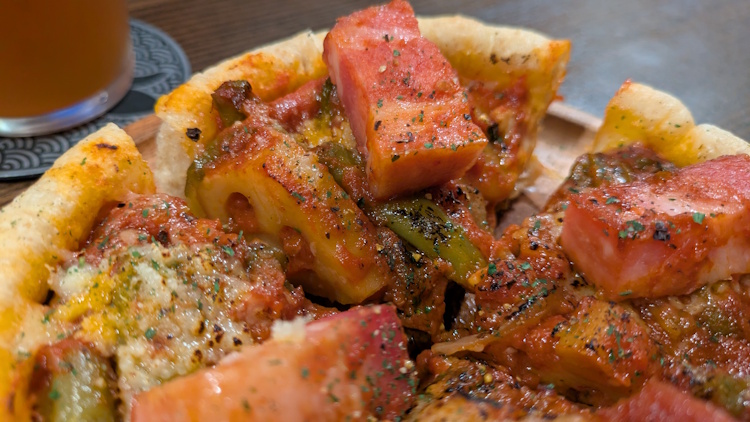
If you look at about “10:30” in the close-up picture of the pizza you might notice the lotus root; that “wagon wheel” looking oddity.  You can also see some evidence of the green beans as well.

(The green beans on this pizza were grilled. Maybe this could be categorized as a “grilled soup pizza?”)

While I can howl with pleasure after a good experience (read my review of Azzurri Pizza in Kobe, where I go way beyond “nice”), generally, I am not afraid to speak my mind when I’ve had a bad experience. I recently jumped up and walked out of Des Sante Pizza in Osaka (so much so, he was crystal clear I nonplused about something). In my review, I roasted Pizzeria Regalo (he deserves it, he may be even nastier than me). But when I call this vegetable soup pizza, I know it sounds like a dis… but it’s not a dis. Not at all.

This is kick ass vegetable soup pizza. The best veggie soup pizza ever (although… I am not sure anyone has tried this before). I mean it. This is an iconoclastic “Veggiee Ploos Ba-con” pizza (say that with a French accent).

Crust is great, too. Bready, just crispy enough, bakery-like. Nice.

When you think of Starboard, think of our Chicago-style deep dish pizza! We’ve upgraded our crust! It’s now an original dough made by Maison Murata.
— BrewPub Starboard

(Maison Murata is a local Kobe bakery, in Hyogo ward.)
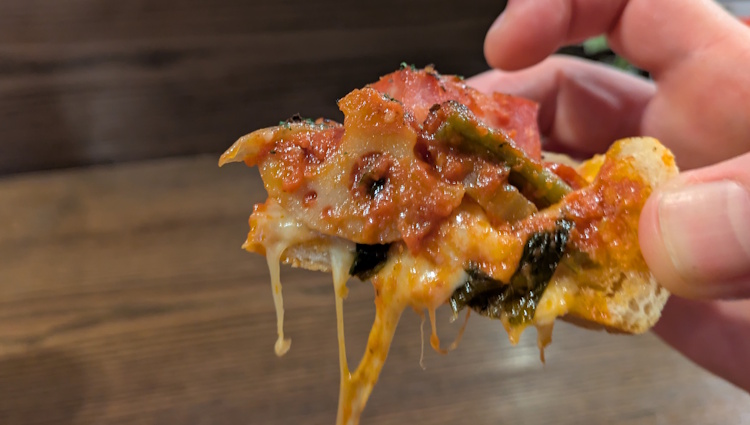
We can in fact pick up a slice, so it passes the Pizza Czar’s famous pizza test; very easy to pickup (presuming you’ve let it cool).

As the unofficial Official Pizza Czar of Japan, I have had the pleasure of sampling some of the best Chicago pizzas in Japan. From best to worst: Devil Craft Kanda in Tokyo makes a brilliant deep dish pizza (that Abe Froman is special). My second favorite is the Chicago pizza at Izakaya Ja Nai!!! in Okazaki (with the stark white crust and the sauce on top); unusual, and delicious. I hear Matt does Chicago pizza at Craft Beer and Pizza Imazato, Osaka, but I have only had his Detroit style pizza (which is epic, amazing pizza). Also in Osaka, Drunk Bears does a palatable deep dish pizza. For Chicago pizza in Sapporo, The Craft thinks they do that style, but it is a pretty miserable imitation. At the absolute bottom of the pile, worst deep dish in Japan, Butcher Republic in Ebisu does an embarrassing corporate parody of a Chicago pizza (I get mad even thinking of it).

Who else do you know that can rattle off a list of Japanese Chicago pizzas (across multiple cities) like that? Nobody. Fogettabahtit. Like I said…

Like my father before me (and his father, before him), I am the Pizza Czar of Japan. I have tried them all.

The pictures of the deep-dish pizza at Starboard in Kobe evoke such good memories, it takes real strength not to make plans to go, back, again, right, now.
I have eaten more pizza than you have. Oh, yes I have. And for me to have a “new” pizza experience is not easy to do. I felt like a school girl in Times Square; this pizza was shocking for me.

Kobe City has surprisingly good pizza.  I had a chance to try many of the best pizza restaurants in Kobe, and many were good experiences (all of them, actually).  But BrewPub Starboard, with it’s hard-to-find Chicago-style pizza, was one of my favorite pizza experiences in this country.

I liked this pizza so much, I was tempted to have a third red ale… but oh, no. No you don’t, you seductive siren of a veggie soup pizza.  I’ll have to save that beer, and my next Starboard pizza, for another time.

Get yourself down to BrewPub Starboard in Kobe.  Highly recommended.

Pizza Restaurants in Kobe

Trattoria Elefante Pizza in Chuo-ku, Kobe
— Get a New York-style slice at 2 Bro’s Pizza slices, in this same neighborhood
Neapolitan pizza at Pizzeria Azzurri in Chuo-ku, Kobe
Pizza slices at Jesus Pizza in Chuo-ku, Kobe
Kobe’s Allocco Pizza in Kunikadori in Chuo-ku, Kobe
Festivals in Kobe, Japan

As part of our list of resources for visitors to Kobe, here is a list of festivals in Kobe, Japan. Kobe has a wide variety of festivals that visitors can experience the changes of seasons throughout the year.

Lists Of Festivals In Kobe

The Lunar New Year festival at Kobe Chinatown (January)
BesNagata Shrine Traditional Tsuina Ceremony (February)
Oktoberfest at Kobe (April)
Danjiri Festival (May)
Kobe Festival and Parade (May)
Kobe Minato Festival (July)
Kobe Umino Bon Odori (August)
Summer Festival at Minatogawa Shrine (August)
Mid-Autumn Festival at Kobe Chinatown (September)
Mashup Festival Kobe (October)
India Mela (October)
Kobe Jazz Street (October)
Kobe Christmas Market (November – December)

Also see our guide to Kobe events for other types of events in Kobe City.
 

The Lunar New Year Festival at Kobe Chinatown

Date: (It depends on the lunar calendar)
Time: 10:00 17:00
Location: Nankin-machi, Kobe
Website: https://www.nankinmachi.or.jp/

The Lunar New Year, also called Chinese New Year in Kobe, is a huge celebration in many Asian countries. Kobe Chinatown celebrates the Lunar New Year with powerful lion dances and Chinese traditional performing arts.

Nagata Shrine Traditional Tsuina Ceremony

Date: 3rd of February
Time: 12:30 – 2:00
Location: 3-1-1 Nagatacho, Nagata-ku, Kobe-shi, Hyogo 653-0812
Website: https://nagatajinja.jp/gyouji/tsuinashiki.php

The Nagata Shrine Traditional Tsuina Ceremony is held at Nagata Shrine in Hyogo. This ritual serves the Oni (demon) as messengers of gods; their role is to purify all misfortunes on behalf of the gods; the shrine demons dance to pray for a fresh new year.

Oktoberfest at Kobe

Date: End of April to beginning of May
Time: 15:00 – 20:00
Location: Takahama Wharf Event Space
Website: https://okt-fest.com/

Oktoberfest is the world’s largest folk festival in Munich, Germany, celebrated with parades, dancing, orchestras, drinking, and games. Kobe is one of the places in Japan where Oktoberfest is celebrated; offering beer, food, and live music performances.

Danjiri Festival

Date: 3rd to 5th of May
Time: Depends on the area
Location: Higashinada Ward
Website: https://www.uhara-danjiri.jp/

The Danjiri Festival refers to a general term for festivals in which people pull dashi (festival floats) used in shrine ceremonies to pray for a good harvest of grains. Kobe has a unique Danjiri style as people dance on the top of the floats while putting on make-up.

Kobe Festival and Parade

Date: The third Saturday of May
Time: 11:00 – 17:00
Location: Sannomiya area
Website: https://kobe-matsuri.com/

The Kobe Festival takes place in the streets around Sannomiya Station. What is known today as the Kobe Festival was formed in 1971 by merging two previous events.

In 1933, the mayor of Kobe created the citizens’ festival, called Minatomatsuri (based in part on inspiration from a visit from Portland, OR officials). In the 1960s, Kobe had another event called Kobe Carnival; which included parades with singing, dancing, and costumes, mural paintings by artist groups, and a youth plaza for young people. These two events became the basis for the Kobe Festival.

Kobe Minato Festival

Date: July
Time: 10:00 – 19:30
Location: 2-2 Hatoba-cho, Chuo-ku, Kobe City, Hyogo 650-0042
Website: https://minatomatsuri.jp/about/

The Kobe Minato Festival is held to express appreciation for the port, and the sea that supports the city of Kobe. The festival features a variety of performances, such as dancing and singing, which people of all ages can enjoy together.

Kobe Umino Bon Odori

Date: August
Time: 18:00 – 20:30
Location: Meriken Park
Website: https://www.instagram.com/kobeumibon/?hl=ja

Kobe Umi no Bon Odori is an event where participants can dance to famous folk songs from around Japan (as well as folk songs connected to Kobe), accompanied by powerful live music and singing. The event is held at Meriken Park, and brings visitors of all ages and nationalities together in a circle to enjoy dancing as one.

Summer Festival at Minatogawa Shrine

Date: 22th to 26th August
Time: Depends on the day
Location: Minatogawa Shrine
Website: https://www.minatogawajinja.or.jp/natumaturi/

During the Summer Festival, the Minatogawa Shrine is decorated with many lanterns to honor and console the spirits. Visitors can enjoy various activities and foods, as there are spaces where everyone can dance together and many stalls are set up throughout the grounds.

Mid-Autumn Festival at Kobe Chinatown

Date: Follow the lunar calendar
Time: 10:00 17:00
Location: Nankin-machi, Kobe
Website: https://www.nankinmachi.or.jp/

Mid-Autumn Festival is a ceremony for the autumn harvest. Mid-Autumn Festival is the second largest festival at Kobe Chinatown.

MASHUP FESTIVAL Kobe

Date: October
Time: 10:00 – 19:00
Location: Bay area including Meriken Park
Website: https://mashup-fes.com/

Mashup Festival Kobe is the largest music event in Hyogo Prefecture. It brings together seven different music festivals and takes place over two days. The event features a lot of artists performing across various genres, along with many food stalls and vendor booths.

India Mela

Date: October
Time: 10:00 – 20:00
Location: Meriken Park
Website: https://india-mela.com/

India Mela is one of the largest Indian festivals in western Japan, where visitors can experience Indian culture, music, dance, and cuisine all in one place. It has been held in Kobe since 2010 under the theme of “introducing Indian culture to more people in Japan.” On the stage, a variety of performances are presented, including traditional Indian classical dance, Bollywood dance, live music performances, and yoga. There are also food stalls offering a wide range of Indian dishes and sweets as well as booths selling handicrafts and fashion items.

Kobe Jazz Street

Date: October
Time: 12:00 – 17:00
Location: Check the website
Website: https://www.kobejazzstreet.gr.jp/

Kobe Jazz Street began 38 years ago and continues to feature the same style of jazz that has been preserved in the city since the post–World War II period. Each year, jazz musicians from Japan and Europe collaborate (a popular aspect of the Kobe Jazz Street program). Both professional and amateur performers take part, and the event includes a variety of styles and performances by both small combos and big bands.

Kobe Christmas Market

Date: November to December
Time: 9:30~20:15
Location: Nunobiki Herb Gardens
Website: https://www.kobeherb.com/tips/kobechristmasmarket/index.html#guideMap

The Kobe Christmas Market is held at the Nunobiki Herb Gardens, a popular tourist spot in Kobe. Visitors can take the ropeway to enjoy the market. The gardens are decorated with Christmas lights, and there are several spots with beautiful night views. The market is located at the top of the herb gardens. In November, visitors can also enjoy the autumn scenery in the gardens.

See Also

Population of Kobe
Neighborhoods in Kobe, Japan
Shopping places in Kobe, Japan
Department stores in Kobe, Japan
Major train stations in Kobe, Japan
Kobe Airport in Kobe city, Japan
A boat service between Kobe and Osaka
Train Lines, Shinkansen and Subway in Kobe, Japan
Kobe foreign settlement
Temples and Shrines in Kobe, Japan
Events in Kobe, Japan
Hot springs and onsen in Kobe, Japan
Popular museums in Kobe, Japan
Parks and gardens in Kobe, Japan
Public swimming pools in Kobe
Japanese language schools in Kobe, Japan
Colleges and Universities in Kobe, Japan
International schools in Kobe
English speaking immigration lawyers in Kobe
Co-working spaces in Kobe
Tax specialists that speak English in Kobe

And Also:
Festivals in Osaka, Japan
Festivals in Nagoya, Japan (and the Ume no Hi Port Festival in Nagoya)
Festivals in Sapporo, the Sapporo Snow Festival, and the biggest events in Sapporo, Japan

Examples of Investment Property in Kobe City for Sale

To help investors that want to buy Kobe investment property, we have reviewed three income-generating rental properties that are for sale in Kobe now. Our intention is to show actual examples, so investors can learn more about the types of property available for investment in Kobe, as well as the cost and quality of some specific investments.

When you are ready for a local agent that can find high-yield rental properties for investment in Kobe, contact KobeAgents.com for more information.

Five Examples of Property for Investment in Kobe City

* Example #1: 1R Condominium Rental Property in Kaigandori, in Chuo-ku, Kobe
* Example #2: 1K Condominium Rental Property in Kusunokicho, in Chou-ku, Kobe
* Example #3: 6-Unit Apartment Rental Property for Sale in Kamisawa, Hyogo-ku, Kobe
* Example #4: 6-Unit Apartment Investment Property for Sale in Higashidemachi, Hyogo-ku, Kobe City
* Example #5: 2-Unit Mixed-use Commercial Residential Investment Property in Kamisawadori, in Hyogo-ku, Kobe
Why Focus on Specific Investment Properties in Kobe?
How We Chose the Kobe Real Estate for Investment in this Assessment
Online Listings for Investment Property in Kobe
The Best Real Estate Investments in Kobe Are Not Listed Online
Real Estate Brokers that Specialize in Investment Property in Kobe

There are much better investment properties available in Kobe. We can help you find them. For now, let’s get into some specific examples:
 

Example #1: 1R Condominium rental property in Kaigandori, in Chuo-ku, Kobe


— Investment Category: Single condominium unit as a rental property in Chuo-ku, Kobe
— Size: 24.6 m2
— Year Built: 2013
— Price: 16,300,000 JPY
— Annual Rental Income: 849,600 JPY
— Rental Yield: 5.21%
— Price per Square Meter: 662,332 JPY

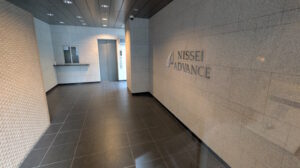
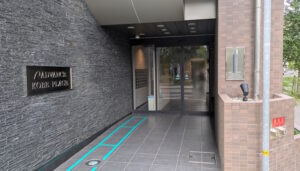
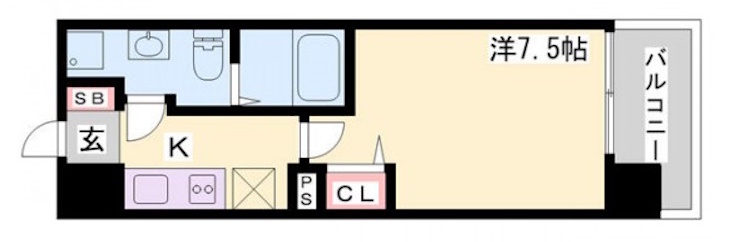
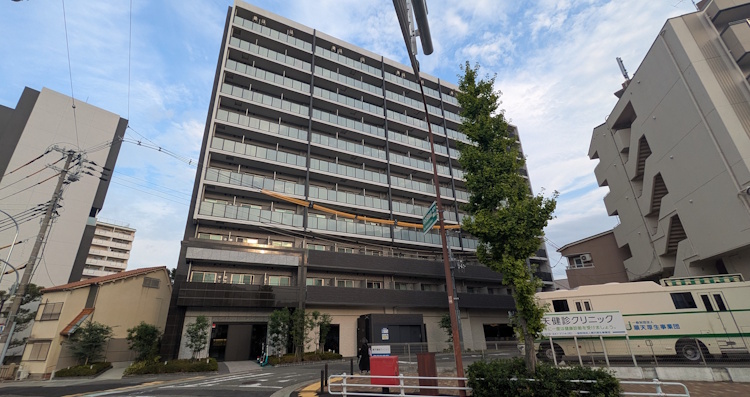
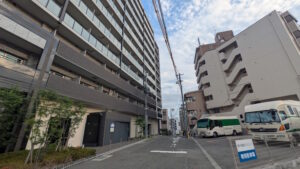
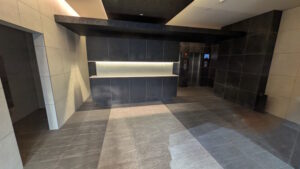
This Chou-ku condominium (what locals call a “mansion”) for sale is a good example of a single unit in a condominium building to use as a rental property. This particular unit is in a relatively new build (2013), in a good neighborhood a short walk from Harborland. The unit is small (1R), but based on the lobby and exterior of the building, likely modern, and in good condition. This is one of two condominium investment properties in this review; this one was slightly higher priced, has more floor space, and rents at a higher rate; the annual rental yield is 849,600 JPY, with a monthly rent of 70,800 JPY. The unit is small – about 25-30% smaller than similar condos for investment in Sapporo. The relatively high price for such a small unit is likely because of the excellent location and the unit presents as new. The rental yield of 5.21% is particularly strong.

Notes on the investment: The neighborhood for this rental condo in Kobe is nice. The block the building is located on is a mix of tall buildings and commercial structures, and the streets were relatively empty, but attractive. There is an elevated highway just across the street from this building, which may be what can be seen from south facing windows (not ideal). The rental yield of 5.21% is not particularly strong, and that is before maintenance fees and owner’s fees are paid. The building includes an elevator, which investors know increases annual maintenance costs. Given the fees, the actual yield is likely much lower.

This is a class “B” or “class “A” unit, in what is probably a class “A” neighborhood. It’s a new building, in a great part of Kobe; it is likely a safe investment, if not a particularly profitable one.


Example #2: 1K Condominium rental property in Kusunokicho, in Chou-ku, Kobe


— Investment Category: Single condominium unit as a rental property in Chuo-ku, Kobe
— Size: 21.3 m2
— Year Built: 2023
— Price: 16,200,000 JPY
— Annual Rental Income: 767,880 JPY
— Rental Yield: 4.74%
— Price per Square Meter: 758,072 JPY

This property is another 1K condominium in Kobe that generates rental income for a real estate investor. This unit is similar to the other condominium investment property we review above, however; it is newer, smaller, and was rented for a lower rate. This is is an investment condo in Chou-ku, Kobe, this unit is in Kusunokicho – close to, but not easily walkable to central Sannomiya-area Kobe. The unit is very new (2023), but generates less rental income than the previous unit; annual income from rent for this property is 767,880 JPY, and monthly rent 63,990 JPY. While this is the lowest cost of any property in we present here, the yield at 4.74% is the lowest of any of the properties included in this review.

Notes on the investment: This 1K Chou-ku Kobe investment condominium is a very nice, modern building, in an attractive neighborhood. The property is almost directly on top of the Okurayama Station on the Seishin-Yamate Line. At 21.3 m2, it is a very tiny living space (the smallest condominium we have evaluated in months). As the rental yield is 4.74%, and there would be monthly owner/maintenance fees, the return on investment for this property is likely too low to be attractive to many owners. It may be a suitable place to live, but not a good investment. However, before we could finish writing this review, the unit was off the market (it may have in fact sold, at or below asking).

This is a class “A” building in a class “B” or class “A” neighborhood in central Kobe. Not a good investment, but a great place to live.


Example #3: 6-Unit Apartment Rental Property for Sale in Kamisawa, Hyogo-ku, Kobe


— Investment Category: Apartment building rental property in Kobe
— Size: 165.8 m2
— Year Built: 2018
— Price: 72,800,000 JPY
— Annual Rental Income: 4,632,000 JPY
— Rental Yield: 6.36%
— Price per Square Meter: ¥439,083 JPY

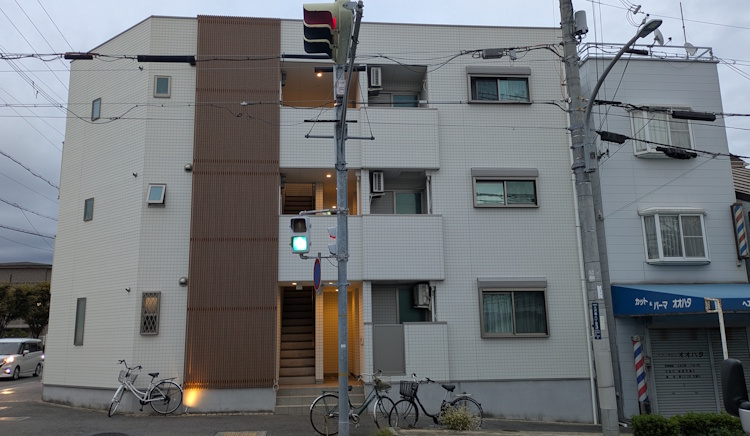
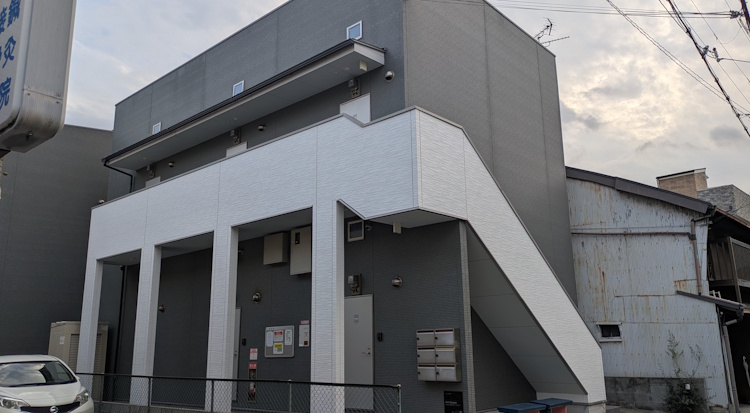
This property is a 6-unit apartment building for sale in Kobe, in the Kamisawa district of Hyogo-ku. This building was built in 2018, and has six 1K units that generate rent. This Hyogo investment property is located a short walk from Kamisawa. The six units generate 4,632,000 JPY in annual rent, or 386,000 per month. Dividing the total monthly income by six, it appears the units rent for close to 64,000 each. That seems like strong income for such small units, but they are relatively new, and the access to the subway is nearly ideal. The rental yield is 6.36%, which is highest yielding rental property in this review.

Notes on the investment: This looks like a relatively good investment. The neighborhood is quiet, pleasant, working class. The Kobe-Sannomiya Station is just 13 minutes away (including the walk to the station). The building is not particularly nice; and we were surprised it was built as recently as 2018 – it looks older. This type of unit is a classic investment for an investor with limited capital. Six units provides some diversity of income; if a unit is temporarily unoccupied, the remaining units can continue to generate cashflow. As this building only has three floors, there is no elevator, and maintenance cost is lower than the condominium investment properties we featured above.

This is a class “C” building in a class “B” or “C” neighborhood. Price may not be ideal, returns are not fantastic, but this is the best example in this review of available Kobe real estate investments.


Example #4: 6-Unit Apartment Investment Property for Sale in Higashidemachi, Hyogo-ku, Kobe City


— Investment Category: Multi-family building for rental income in Kobe
— Size: 134.8 m2
— Year Built: 2016
— Price: 75,000,000 JPY
— Annual Rental Income: 4,512,000 JPY
— Rental Yield: 6.02%
— Price per Square Meter: 556,215 JPY

This property is another interesting example of a multi-family apartment for sale in Kobe, that could serve an investor with a relatively small budget. This is a relatively new investment property in Higashidemachi in Hyogo-ku, in Kobe City. It has six rentable units; 1K units generating monthly rental income for a Kobe real estate investor. The annual income from rent is 4,512,000 JPY, or 376,000 per month. We don’t have a rent roll for this property, but dividing the monthly income by six suggests the units rent for 62,000 JPY per month (slightly lower rent, but similar to the 6-unit rental property we feature above). The location for this property is less central, and the neighborhood is less ideal, so the value to these renters may be harder to justify than some other properties in this review. The rental yield for this Hyogo-ku real estate investment is 6.02%; the second best yield in this review.

Notes on the investment: The location of this property is in a working class neighborhood, close to the bay, on the other side of Harborland from the city center. It is not a convenient or central location; Google Maps cites the nearest station as accessible via a 14 minute walk (Harborland Station) or a 16 min walk (Shinkaichi Station). The neighborhood was clean, but very humble. The structure itself is almost industrial looking; all concrete, no windows on the east side of the building at all, some small windows facing a wall on the west side. These unit may be comfortable on the inside, but are very unappealing on the outside. Other than the concrete structure, the property features a drab parking lot, with zero landscaping. If these units were difficult to rent, it would not be surprising.

This is a class “B” or “C” property in a class “C” (or “D”) neighborhood. This is Japan, so everything feels relatively clean and safe, but this was one of the most humble neighborhoods we have toured.

Example #5: 2-Unit Mixed-use Commercial Residential Investment Property in Kamisawadori, in Hyogo-ku, Kobe


— Investment Category: Mixed-use commercial/residential property for investment in Kobe
— Size: 237.9 m2
— Year Built: 2000
— Price: 80,000,000 JPY
— Annual Rental Income: unknown
— Rental Yield: unknown
— Price per Square Meter: unknown

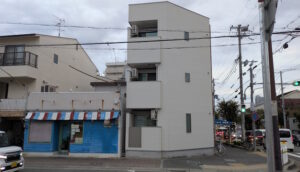
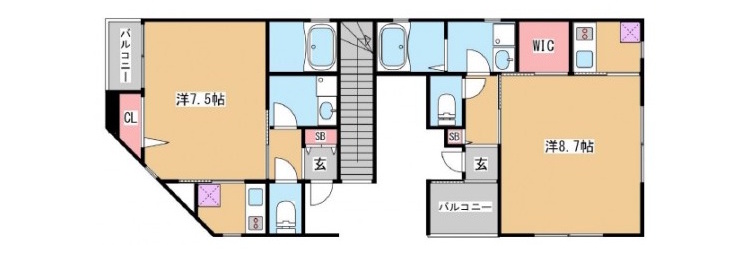
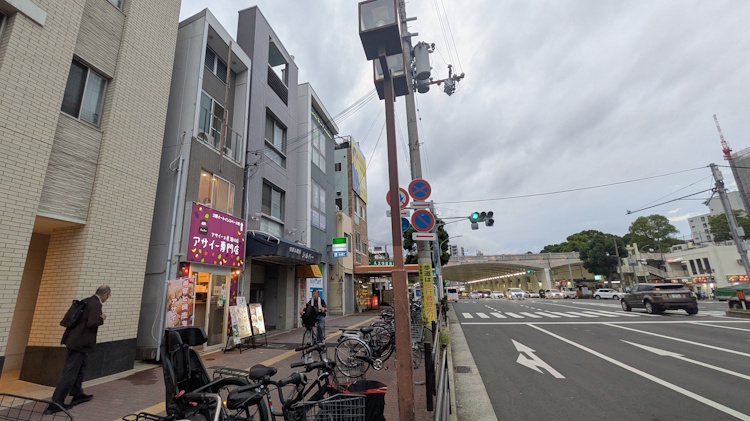
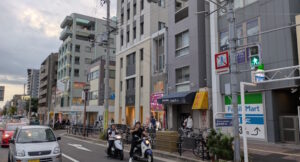
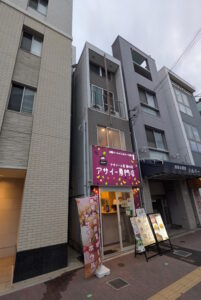
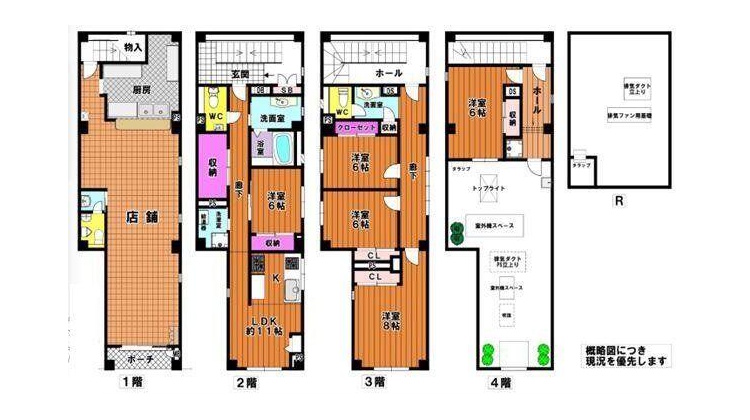
This is an interesting example of Kobe investment property for sale – it is a mixed-use, two unit property, with a retail shop on the 1F, and a relatively large 4LDKS residence on 2F – 4F. Looking at the floor plan, it’s not clear that there are two separate entrances; it may be that the entrance to the residence passes through the retail space (currently used as a shop that sells acai bowls). It could be ideal of a tenant that would like to run a retail/restaurant business, and live above the unit (perhaps with a family, even a large one). The location is excellent; 2 minutes from Minatogawa Koen and Minatogawa Koen Station. Rental income on the property is unknown (it could be the property was previously owner-occupied.

Notes on the investment: The unit appears to be a very narrow four-story building, but after looking at the floor plan, the building is larger in the rear of the property. It is an odd-sized, flag-shaped property, penned in by larger buildings. The windows that face the street (which face south) are likely the only windows (that don’t face walls). It’s not clear the building has egress, other than on 1F via the shop. The building was built in 2000, but feels old; it’s not a “nice property.” The location, however, is excellent. Almost on a corner, just moments from a station, near a large attractive park, it could a good location to both live and work. It could possibly rent for decent income, but find the right tenant could be difficult. For an owner-occupied business that benefits from walk-by foot traffic, it could be ideal.

This is a class “C” building in a call “B” neighborhood.


Why Focus on Specific Examples of Investment Real Estate

When investors consider buying real estate in Kobe for investment, they often begin with the same questions: What returns are available from Kobe real estate investment? What is the purchase price for investment property in Kobe? The answers to those questions always depend on the type of property (condominium rental unit, single family home rental property, multi-family investment property in Kobe, etc), the location of the property, the age of construction, the quality of construction, etc.

In this article we have reviewed five examples of income-generating properties in Kobe for investment. These examples provide some exact numbers for investors. From these examples, investors can begin to set some expectations about rental property in Kobe, and can prepare for what they might see when they work with a local Kobe real estate broker to purchase property for their own investments.

The examples presented here are just samples. Because of the nature of how investment property is bough and sold, there are better real estate properties available in Kobe. To see real estate investments with higher returns, talk to a local Kobe real estate broker.

How We Chose the Properties in This Assessment

To create a more interesting analysis for investment property in Kobe, we intentionally chose properties of a certain types, within similar price ranges. We intentionally only focused on available real estate investments in the central area of Kobe’s Chuo-ku and Hyogo-ku wards.

None of the properties we used for this review are particularly good investments. This report is, however, a good teaching tool to help investors to picture some specific examples of different types of Kobe property for investment. We intentionally focused on more affordable properties that may be within reach for investors; smaller, multi-unit properties in Kobe of six units or less. Larger, more traditional Kobe apartment buildings for sale exist, and may be better investments for investors that can fund those larger, more costly transactions.

By selecting similar properties, of similar age of the structure, similar real estate investment strategy, investors go beyond generalities and begin to see some practical examples of the real estate market in Kobe.

Websites that List Investment Property for Sale in Kobe

Several websites list real estate in Kobe for investment purposes. HokkaidoAgents.com publishes a list of several websites that show property for sale in Japan. It is also possible to visit local real estate companies in Kobe, that can provide examples of their own investment properties for sale, as well as other Kobe multi-family buildings for sale that are available locally. The property database REINS which is produced by the Japanese national government can also sometimes be a good resource for property for sale (REINS listings can only be accessed by licensed Kobe real estate agents).

There are also Japanese online listings websites that include rental properties in Kobe, that only show real estate for investment. Those websites are produced in Japanese, and the real estate companies that pay for those listings tend to do business with Japanese buyers, with contracts and negotiations in Japanese only.

For help finding suitable investment properties in Kobe, contact a local real estate agent in Kobe that speaks English.

The Best Real Estate Investments in Kobe Are Not Listed Online

Revenue-generating properties that are listed on public real estate websites in Kobe tend to have lower yield than properties that are never listed online.

Experienced real estate brokers will usually try to buy the best properties themselves. When they do not want a property, or when they don’t have the available funds to buy a property, they can make a good commission by selling the property to someone they know (sometimes another agent or broker, sometimes an investor). They can find a buyer from their network of local contacts. If a property is listed online, it has first been passed-over by all these local insiders.

For unlisted places and special deals, though, information tends to circulate locally and within a tight circle. Our industry is still very old fashioned.
— Toshihiko Yamamoto, from The Savvy Foreign Investor’s Guide to Japanese Properties

There are excellent investment properties with high returns in Kobe. Those properties are sold via the private relationships in the local community of brokers and Kobe investment property owners. Contact us a good local Kobe real estate advisor to find good investment properties in Kobe.

Real Estate Brokers that Specialize in Real Estate for Investment in Kobe

Every mature community in Japan has a few smart real estate brokers, owners, and investors. For visitors or foreigners buying real estate in Kobe, finding a good agent that speaks English is an important part of success. This is especially important for investment property in Kobe, as the best properties are not listed on public websites – you will need a local Kobe real estate company to provide access and introductions.

For More Information:

Examples of rental income properties in Osaka City
— See our guide to buying investment properties in Osaka
— We show several different types of real estate investment in Osaka
Off-market Properties in Osaka
— Examples of real estate investment properties for sale in Sapporo, Japan
— Different Real Estate Investment Opportunities in Sapporo
Examples of condominiums for sale in Sapporo, Japan
— A guide to the concept of Domestic Contacts in Japanese Real Estate
Services that Help Foreigners Buy International Real Estate
— See our piece about various Taxes in Japan
— Our detailed Guide to Paying Property Taxes in Japan

See Also:
Books about real estate in Japan
Books about investing in apartment building and multi-family property
— A review of The Complete Guide to Buying and Selling Apartment Buildings by Berges

“Bay Shuttle” High-Speed Ferry Service in Kobe, Japan

As a resource for visitors to Kobe City, this article provides details about the high-speed ferry service between Kobe and Osaka, Japan.

Kobe’s ferry service from Kobe Airport to Osaka Kansai Airport is called Bay Shuttle.

Kobe Airport Ferry Service

Ferry Service Between Kobe Airport and Osaka Kansai Airport
Fastest Way Between Kobe Airport to Osaka Kansai Airport
How to Buy a Ticket for the Bay Shuttle Ferry Service
How to Get to Kobe’s Ferry, Bay Shuttle
What is it like to Ride the Bay Shuttle Ferry in Kobe?
The Kobe-Kansai Bay Shuttle Ferry Service is Wheelchair Friendly
Why People Choose Bay Shuttle Ferry
How Much does the Bay Shuttle Ferry Service Cost?
Whether condition

Ferry Service Between Kobe Airport and Osaka Kansai Airport

Most people traveling between Kobe and Osaka take trains. However, you can travel by boat between Kobe and Osaka with the high-speed ferry service called Bay Shuttle. This boat service is a fast and interesting way to travel between the two airports. The high-speed boat runs both ways, to and from Kobe Airport and Osaka’s Kansai International Airport.

The Bay Shuttle takes around 30 minutes between airports, and the price starts from 1,880 JPY for adults.

Fastest Way Between Kobe Airport to Osaka Kansai Airport

The high-speed ferry is the fastest way to travel between the Kobe and Osaka airports.

From most parts of these cities taking the train is faster, but if you want to go to or from Osaka Kansai Airport (which is in the southern part of Osaka), taking the ferry directly to Kobe Airport is faster (and perhaps more fun) than taking the train.

From Kobe Airport to Osaka Airport by ferry takes about 30 minutes. If you are arriving or departing by plane from Osaka Kansai Airport, and travelling to Kobe, it can be faster and more convenient to take the ferry. If you try to take the train from Osaka Kansai Airport to Kobe’s Kobe-Sannomiya Station it takes an hour and half. If you’re going/coming directly to Kansai, the ferry is only 30 minutes from Kobe Airport (or 50 mins from Sannomiya station) and may be a good choice.

To get to or from Kobe from most locations in central Osaka (like Namba Station or Osaka Station), it is faster to take the one of Kobe train systems (like JR trains or trains on the Hanshin Line). But specifically from Osaka’s KIX airport, the Bay Shuttle is an ideal choice.

From Kobe Airport to downtown, it takes an addition 20 minutes on the Port Liner train line to reach central Kobe/Sannomiya.

How to Buy a Ticket for the Bay Shuttle Ferry Service

There are many ways to buy a ticket to ride the high-speed ferry between Kobe Airport and Osaka Kansai Airport. It is highly recommended to book your ticket for the Bay Shuttle in advance online.

You can make a reservation using your smartphone or laptop with a credit card. After booking, you will receive a QR code that serves as your ticket. If you register your face ID through your mobile device, you can easily check in for the Bay Shuttle without showing a ticket.

If you make a reservation by phone call, you can book from five to 90 days in advance. In this case, payment must be completed at a convenience store. You may also be able to register your face ID.

Of course, you can still purchase tickets on the day of travel at the ticket counter or from a ticket machine without booking in advance. At Kobe Airport, the ticket counter is located at the Bay Shuttle Terminal. At Osaka’s KIX Kansai Airport, there is a Bay Shuttle counter inside Terminal 1.

How to Get to Kobe’s Ferry, Bay Shuttle

The Bay Shuttle service for Kobe arrives and departs from the Bay Shuttle Terminal at Kobe Airport.

To use the boat service from Kobe Airport, you must first get to the airport. You can take the Port Liner train from central Kobe to Kobe Airport Station.

Once you arrive at Kobe Airport, you can take a free shuttle bus from either Terminal 1 or Terminal 2 to the Bay Shuttle Terminal. The free bus shuttle service does not run that often (sometimes only one time per hour). You can also walk from Terminal 1 through the parking lots to get to the Bay Shuttle Terminal in about 15 minutes (there are no signs, the path is not clear, the walk is possible, but a little awkward). If you want to use the free shuttle bus service, plan to allow extra time for the bus schedule.

What is it like to Ride the Bay Shuttle Ferry in Kobe?

There are two ships, called “Umi” and “Sora,” which operate a total of 32 times a day. Each boat has 110 seats (including six barrier-free seats). There are restrooms and vending machines on the ferry. There are some large televisions onboard, showing Japanese TV programming.

Riding the ferry is like riding a big, wide bus, with comfortable seats. All seats are located inside the ferry boat (there is no outside seating).

Some of the seats have window seats where you can look out across Osaka Bay as you travel. The windows are close to the water level, and some spray from the ocean hits the windows; the view is not ideal for pictures. The space between seats is wide, so guests don’t have to worry about feeling cramped.

The Kobe-Kansai Bay Shuttle Ferry Service is Wheelchair Friendly

The ferry features a barrier-free seating and is equipped with spaces where wheelchairs can be secured and restrooms accessible to wheelchair users. (However, passengers are not allowed to remain seated in their wheelchairs during the voyage.) There is Universal design at the ship and terminal building, with careful attention to details such as wide corridors and ramps.

Why People Choose Bay Shuttle Ferry

While from some locations between Kobe to Osaka the train is a better option, there are specific reasons why some passengers choose to take the Bay Shuttle Ferry service.

If you live on the east side of Kobe, Osaka is relatively close (and the train is usually faster). But for Japanese locals who live on the west side of Kobe, or nearby western cities, the Bay Shuttle Ferry can be faster than the train.

Also, for tourists who arrive at Osaka’s Kansai International Airport and want to go directly to Kobe, the ferry service is the fastest route (there are no flights between Kobe Airport and Kansai International Airport).

There are also passengers who use the ferry service for day trips to and from Kobe.

Passengers choose this service because it is fast (only takes 30 minutes) because seats can be reserved in advance, because the seats are wider and more comfortable than other transportation options.

How Much does the Bay Shuttle Ferry Service Cost?

A one-way ticket on the Bay Shuttle starts at 1,880 JPY for adults. If you purchase the correct ticket, that fee includes the train service on the Port Liner to/from Sannomiya station.

Round-trip: 3,060 JPY (Adults), 1,530 JPY (Children)
Round-trip (valid for one day): 2,510 JPY (Adults), 1,260 JPY (Children)
One-way: 1,880 JPY (Adults), 940 JPY (Children)
Disability discount: 950 JPY (Adults), 480 JPY (Children)
One way with a train ticket to Sannomiya Station: 1,880 JPY (Adults), 940 JPY (Children)

Weather Condition

If the Bay Shuttle is cancelled by the weather, there is an alternative bus. Passengers will be informed in advance when they cancel the ferry.

See Also

Population of Kobe
Neighborhoods in Kobe, Japan
Shopping places in Kobe, Japan
Department stores in Kobe, Japan
Major train stations in Kobe, Japan
Kobe Airport in Kobe city, Japan
Kobe Ferry to go Osaka
Train Lines, Shinkansen and Subway in Kobe, Japan
Kobe foreign settlement
Temples and Shrines in Kobe, Japan
Festivals to visit in Kobe, Japan
Events in Kobe, Japan
Hot springs and onsen in Kobe, Japan
Popular museums in Kobe, Japan
Parks and gardens in Kobe, Japan
Public swimming pools in Kobe
Japanese language schools in Kobe, Japan
Colleges and Universities in Kobe, Japan
International schools in Kobe
English speaking immigration lawyers in Kobe
Co-working spaces in Kobe
Tax specialists that speak English in Kobe

And Also:
OsakaCity.com‘s article about the Bay Shuttle High-Speed Ferry from Osaka Kansai International Airport

The Best Parks and Gardens in Kobe

As part of our list of resources for visitors to Kobe, here is a list of parks and gardens in Kobe, Japan.

Higashi Yuenchi

Higashi Yuenchi is a 2.7-hectare urban park located in the center of Kobe. Its history began in 1868 as Japan’s first Western-style park, which was used by foreigners living in the Kobe Foreign Settlement. Foreigners enjoyed various sports such as soccer, baseball, and rugby (it is currently not a park where sports are played), which made the park the starting point for introducing Western sports to Japan. After the Great Hanshin-Awaji Earthquake in 1995, it became the site for memorial events and is a part of citizens’ lifestyle.
Address: 6 Chome-4 Kanocho, Chuo Ward, Kobe, Hyogo 650-0001
Nearest station: Sannomiya Station
Website: https://eastpark.jp/

Hyogo Prefectural Maiko Park

Maiko Beach has long been featured in poetry and loved by travelers journeying by land and sea. The Meiji emperor also visited the area seven times. Maiko Park was opened in 1900 (Meiji 33) as the first Hyogo Prefectural Urban Park in this scenic location. With urban modernization, the area transformed into the gateway to the Akashi Kaikyo Bridge, one of the world’s largest suspension bridges.
Address: 2051 Higashimaikocho, Tarumi-ku, Kobe, Hyogo 655-0047, Japan
Nearest station: Maiko Station/ Maikokoen Station
Website: https://hyogo-maikopark.jp/

Kobe Nunobiki Herb Gardens & Ropeway

The Nunobiki Herb Gardens are a short walk from Shin-Kobe Station. There are 12 themed gardens featuring different flowers and plants that change with the seasons. If you don’t take the ropeway, you can see four waterfalls along the way to the Herb Gardens. To use the ropeway (which is like a gondola), you have to buy a ticket. On weekends and holidays, there can be long lines to board the ropeway.
Address: 1-chōme-4-3 Kitanochō, Chuo Ward, Kobe City, Hyogo 650-0002
Nearest station: Shin-Kobe Station
Website: https://www.kobeherb.com/

Kobe Sports Park

Kobe Sports Park is a comprehensive recreational facility that hosts a variety of professional and amateur competitions from both Japan and abroad.

The Kobe Sports Park is the home of the Kobe Sports Park Baseball Stadium, which is where the professional baseball team the Orix Buffaloes plays some of their home games (the remaining games are played at Kocera Dome in Osaka). For more information, see our guide to the Orix Buffaloes on OsakaCity.com.

The park is also famous for its flower spot, “Cosmos Hill,” where 50,000 rapeseed flowers bloom in spring and 100,000 cosmos flowers in autumn, allowing visitors to enjoy beautiful flowers throughout the year.
Address: Midoridai, Suma Ward, Kobe, Hyogo 654-0163
Nearest station: Sogoundo-Koen Station
Website: https://www.kobe-park.or.jp/sougou/

Meriken park

Meriken Park is the location of the famous “BE KOBE” monument. You can enjoy a beautiful view of the port at night.
Address: 2 Hatobacho, Chuo Ward, Kobe, Hyogo 650-0042
Nearest station: Minatomotomach Station

Sorakuen Garden

Sorakuen is the only Japanese traditional style garden among Kobe’s urban parks. The garden is on land, 20,000 square meters. Visitors can cross stone bridges while enjoying scenic features such as streams, waterfalls, and stone arrangements. The park also features a large camphor tree said to be about 500 years old, and azalea blossoms that bloom around late April.
Address: 5 Chome-3-1 Nakayamatedori, Chuo Ward, Kobe, Hyogo 650-0004
Nearest station: Kencho-Mae Station/ Motomachi Station/ Hanakuma Station
Website: https://sorakuen.com/

Sumaura Park

The location of Sumamura park is a scenic area consisting of two mountains. It is known as a famous Genpei battlefield (one of the biggest Japan historical wars) and is now famous as a popular cherry blossom viewing spot. Within the park, there are tourist attractions such as the Sumaura Sanjo Amusement Park. It is also part of the Rokko mountain traverse route and is frequently used as a hiking course.
Address: 4 Chome-4-3 Ichinotanicho, Suma Ward, Kobe, Hyogo 654-0076, Japan
Nearest station: Sumaurakoen Station
Website: https://www.kobe-park.or.jp/park/sumaura/

Suma Rikyu Park

Suma Rikyu Park was originally built in 1914 as “Muko Rikyu,” a villa for the Imperial family. It was mainly used as a place for the Emperor to stay when visiting the area. Today, the park is open to everyone, and visitors can enjoy different types of flowers in every season.
Address: 1-1 Higashisuma, Suma Ward, Kobe, Hyogo 654-0018
Nearest station: Tsukimiyama Station/ Sumadera Station / Higashi-Suma Station
Website: https://www.kobe-park.or.jp/rikyu/

Rokko Alpine Botanical Garden

Rokko Alpine botanical garden cultivates around 1,500 species of alpine and cold-climate plants in a natural setting. Visitors can enjoy seasonal highlights such as spring flowers, summer greenery, and brilliant autumn foliage, along with a plant-themed shop and a cozy café.
Address: 4512-150 Kitarokko, Rokkosancho, Nada Ward, Kobe City, Hyogo 657-0101
Nearest station: Take a bus from Rokko Sanjo Station
Website: https://www.rokkosan.com/hana/

Rokko Garden Terrace

Rokko Garden Terrace is one of Japan’s top scenic viewpoints, offering panoramic views from the Akashi Strait to Kansai International Airport. Within the terrace, several lookout spots provide different perspectives and atmospheres depending on the angle and time of day.
Address: 1877-9 Rokkosancho, Nada Ward, Kobe City, Hyogo 657-0101
Nearest station: Take a bus from Rokko Sanjo Station
Website: https://www.rokkosan.com/gt/

See Also

Population of Kobe
Neighborhoods in Kobe, Japan
Shopping places in Kobe, Japan
Department stores in Kobe, Japan
Major train stations in Kobe, Japan
Kobe Airport in Kobe city, Japan
Train Lines, Shinkansen and Subway in Kobe, Japan
Kobe foreign settlement
Temples and Shrines in Kobe, Japan
Festivals in Kobe
Events in Kobe, Japan
Onsen and hot springs in Kobe, Japan
Popular museums in Kobe, Japan
Public swimming pools in Kobe
Japanese language schools in Kobe, Japan
Colleges and Universities in Kobe, Japan
International schools in Kobe
English speaking immigration lawyers in Kobe
Co-working spaces in Kobe
Tax specialists that speak English in Kobe

See also:
— The best parks in Osaka City, Japan
— The best parks and gardens in Nagoya City, Japan
— The best parks in Sapporo City, Japan

The Best Hot Springs and Onsen in Kobe, Japan

As part of our resources for visitors to Kobe, here is the list of onsen in Kobe, Japan.

Below we’ll provide a list of onsen and super-sento in Kobe, including extra detail about onsen and hot springs in the Arima area of Kobe. We also provide a list of other onsen in Kobe, including a tattoo friendly onsen in Kobe. At the end of this article, we’ll provide notes and guidelines for using onsen in Kobe.

Kobe Onsen and Hot Springs

What is the difference between Onsen, Sento and Super-sento?
Hot Springs and Onsen in the Arima Area of Kobe City
How to Get to Arima Onsen (by bus)
Other Kobe Onsen, Sento, and Hot Springs
Tattoo-friendly Onsen in Kobe
Rules and Suggestions for Using Kobe Onsen

== What is the difference between Onsen, Sento and Super-sento?

An onsen is a hot spring in Japan, and there are two types. The first is a natural onsen (tennen onsen), which usually has a temperature of at least 25°C and contains nineteen mineral elements. The second is a man-made onsen (jinkō onsen), which is artificially created to meet the standards of a natural onsen. A sento, on the other hand, is a public bath that typically uses heated tap water instead of mineral water. Sento fees are regulated to make sure consistent pricing within each area, making them affordable and accessible for local residents.

In addition, there is another type of sento called “super sento.” Super sento are classified differently from sento because they usually offer additional services such as restaurants, beauty treatments, and gaming areas. For this reason, their admission fees are not regulated, and each facility sets its own prices. Some super sento even call themselves onsen, as they use hot spring water transported from actual onsen sources, containing the proper minerals and temperature to meet the standards of an onsen.

Kobe has many onsen/super sento facilities that we will provide the list in below.

== Hot Springs and Onsen in the Arima Area of Kobe City

Many visitors to Kobe want to try the famous hot-baths that are part of Japanese culture. Kobe is one of the most important destinations for hot springs and onsen in Japan. The area of Kobe that is famous for onsen is Arima.

Arima is about 30 minutes from Sannomiya Station by bus. We provide more details on how to get to Arima below.

What is the Arima Onsen Area of Kobe?

Arima is an area of Kobe, Japan, that is famous of onsen. The Arima area is one of Japan’s three oldest locations for hot springs, dating back to a time before humans had developed the technology to dig into the earth to find onsen. The Japanese call this area “Arima Onsen.” Within Arima Onsen are several different public hot springs, as well as some hotels that offer the onsen experience.

Visitors can enjoy two distinct types of baths: the brown-colored “Kinsen” (Gold Spring) water, and the clear, colorless “Ginsen” (Silver Spring) water. Kinsen is rich in iron that is said to be good for skin ailments and muscle pain, while “Ginsen” includes radium and carbonate and is known for various muscle and joint ailments.

Kinnoyu Onsen

Kinnoyu is a public onsen facility where you can enjoy Kinsen “gold” water. There is also a foot bath that can be used for free. Some locals visit daily, as it is said to be beneficial for leg and overall body health.
Type of Water: Sodium-chloride, strong saline, hyperthermic
Address: 833 Arimacho, Kita Ward, Kobe, Hyogo 651-1401
Admission Fee: 800 JPY (Adults), 350 JPY (Children)
Website: https://arimaspa-kingin.jp/kin-01.htm

Ginnoyu Onsen

Ginnoyu is a public onsen facility where you can enjoy Ginsen, the “clear” water. The facility also features a sauna, and visitors can try “Arima Soda,” a soda famouse in Arima.
Type of Water: Carbonated spring, radium spring
Address: 1039-1 Arimacho, Kita Ward, Kobe, Hyogo 651-1401
Admission Fee: 700 JPY (Adults), 300 JPY (Children)
Website: https://arimaspa-kingin.jp/gin-01.htm

Local Hotels in Arima with Onsen

In addition to day-use public onsen in Arima, there are also hotels where guest can stay, and use public or private onsen within the hotel itself.

Chorak Hotel

The hotel offers both Kinsen and Ginsen in its public baths, as well as private open-air baths exclusively for guests.
Address: 1654-1 Arimacho, Kita Ward, Kobe, Hyogo 651-1401
Website: https://choraku.com/spa/index.php

Hanano Hotel

While guests can enjoy views of Arima from the windows of the public baths, the indoor bath is filled with Kinsen. The open-air bath features the radon-rich Ginsen. Guests may also enjoy the hot springs of Hanano on a day-trip basis with reservations.
Address: 400-1 Arimacho, Kita Ward, Kobe, Hyogo 651-1401
Website: https://www.arima-hanano.com/

Nakanobo Zuien Hotel

There is a private room with an open-air bath featuring both Kinsen and Ginsen. In addition, guests staying at the hotel can enjoy private open-air Ginsen baths free of charge.
Address: 808 Arimacho, Kita Ward, Kobe, Hyogo 651-1401
Website: https://www.zuien.jp/

Taketoritei Maruyama Hotel

There are eight private onsens with Kinsen and Ginsen, available free of charge for hotel guests.
Address: 1364-1 Arimacho, Kita Ward, Kobe, Hyogo 651-1401
Website: https://www.taketoritei.com/

How to Get to Arima

While it is possible to take a train to Arima, the easiest way to get to the Kobe onsen at Arima from central Kobe is to take a Shinki Bus from the Sannomiya Bus Terminal at Sannomiya Station.

The Sannomiya Bus Terminal is located street level, on the southeast side of the station (under the tracks). While there are some local buses that park on the street, the Bus Terminal has a distinct entrance, and you can go inside to buy tickets and see the bus schedules. The bus for Arima departs from inside the terminal (running about once every 15 minutes).

== Other Kobe Onsen, Sento, and Hot Springs

There are other onsen and hot springs in Kobe that are located outside of the Arima area. Below are some other options for onsen and sento in Kobe.

Aguro-no-yu Onsen

Aguro-no-Yu Onsen offers 11 types of baths along with 2 types of saunas. At night, guests can relax while gazing at the starry sky.
Type of water: Natural and carbonated
Sauna Availability: Yes
Address: 1-6 Minami Komaemachi, Nagata Ward, Kobe, Hyogo 653-0044
Admission Fee: 1,000 JPY (Adults), 450 JPY(Children)
Website: https://aguro-no-yu.com/

Humor Resort Taisanji Nadeshiko-no-yu Hot Spring

This natural radium hot spring is said to be effective for relieving fatigue, neuralgia, and sensitivity to cold. Unlike ordinary hot springs, radium hot springs are classified as “gaseous” hot springs, distinguished by the proposed health benefits gained by inhaling their steam.
Type of water: Simple, weakly radioactive cold mineral spring
Sauna Availability: Yes
Address: 270-1 Maebiraki, Ikawadani-cho, Nishi Ward, Kobe, Hyogo 651-2108
Admission Fee: 850 JPY (Adults), 320 JPY (Children)
Website: https://www.nadeshikonoyu.com/

Kobe Harborland Onsen Manyo Club

In addition to the large public onsen, the facility offers a stone sauna, dining options, various wellness services, and even a rooftop footbath with scenic views, as well as a movie theater.
Type of water: Alkaline simple spring & carbonated spring
Sauna Availability: Yes
Address: Promena Kobe, 1-8-1 Higashikawasakicho, Chuo Ward, Kobe, Hyogo 650-0044
Admission Fee: Adults: 2,730 JPY, Children: 1,270 JPY, Infant: 990 JPY
Website: https://www.manyo.co.jp/kobe/

Kobe Minato Onsen Ren

“Kobe Minato Onsen” is rich in sodium bicarbonate (baking soda) and sodium chloride (salt), offering the combined benefits of both. The sodium bicarbonate hot spring is expected to have skin-beautifying effects by removing old keratin. Meanwhile, the sodium chloride hot spring helps the body stay warm longer after bathing.
Type of water: Sodium bicarbonate & chloride hot spring
Sauna Availability: Yes
Address: 1-1 Shinkocho, Chuo Ward, Kobe, Hyogo 650-0041
Admission Fee: 2,640 JPY (weekdays), 3,080 JPY (weekend)
Website: https://ren-onsen.jp/?utm_source=mybusiness

Minatoyama Hot Spring

It is said that Taira no Kiyomori (a famous Japanese samurai) once bathed here for therapeutic purposes. The slightly brown-colored water offers a refreshing feel on the skin. Guests can fully enjoy the hot springs in five different baths, each supplied with 100% free-flowing natural spring water. The hot spring has been continuously flowing for over 800 years.
Type of water: Carbon dioxide gas
Sauna Availability: No
Address: 26-1 Minatoyama-cho, Hyogo Ward, Kobe, Hyogo 652-0012
Admission Fee: 800 JPY (Adults), 230 JPY (Children)
Website: https://minatoyama-onsen.com/

Nada Onsen

Nada Onsen is a natural hot spring located in Nada Ward, Kobe City. The baths use natural spring water rich in carbon dioxide, allowing visitors to enjoy and relax.
Type of Water: Sodium – Chloride and Bicarbonate Hot Spring
Sauna Availability:
Address: 1-26 Suidosuji, Nada Ward, Kobe City, Hyogo 657-0831/ 3-4 Bingocho, Nada Ward, Kobe City, Hyogo 657-0037
Admission Fee: 490 JPY (Adults) 180 JPY (Children)
Website: https://www.nadaonsen.jp/rokko_index.html

Rokko Otomezuka Hot Spring

At Otomezuka Onsen, the natural spring flows abundantly at 480 liters per minute. The carbonated spring, known as a “beauty bath” with the same mineral composition as other famous hot springs, is said to promote smooth, radiant skin, improve circulation, and help relieve fatigue.
Type of Water: Bicarbonate spring
Sauna Availability: Yes
Address: 3-4-14 Tokui-cho, Nada Ward, Kobe, Hyogo 657-0033
Admission Fee: 470 JPY (Adults), 180 JPY (Children)
Website: https://otomeduka.com/

Suzuran-no-yu

Suzuran-no-yu is located between Arima and the center of Kobe. It features the largest open-air onsen in Kobe, where visitors can relax while enjoying the night sky and seasonal views surrounded by plants. There are a variety of facilities, including beauty salons, restaurants, dessert shops, and souvenir stores.
Type of Water: Weak alkaline simple hot spring
Sauna Availability: Yes
Address: 11-1 Myōga, Oaza Obu, Yamadacho, Kita Ward, Kobe, Hyogo 651-1101
Admission Fee: Adults: 1,000 JPY, Children: 600 JPY (weekday), Adults 1,200 JPY, Children: 800 JPY (weekend)
Website: https://suzurannoyu.jp/

Taihei-no-yu

SPA Sentaihei-no-Yu offers guests a view of the famous Akashi Kaikyō Bridge. At night, the bridge is beautifully illuminated against the starry sky. The facility provides not only hot springs, but also dining options and relaxation spaces.
Type of Water: High concentration artificial carbonic acid
Sauna Availability: No
Address: 2166-2 Kaigandori, Tarumi Ward, Kobe, Hyogo 655-0036
Admission Fee: Weekdays: 850 JPY (Adults), 250 JPY (Children) Weekends: 1,000 JPY (Adults)
Website: https://www.sentou.co.jp/

Tsuki-no-yufune

Tsuki-no-Yubune offers both natural hot springs and natural seawater hot springs, with the seawater drawn from the Setonaikai (Japan’s largest inland sea). The facility also features restaurants and a spa.
Type of Water: Sodium bicarbonate and chloride cold mineral spring
Sauna Availability: Yes
Address: 7-4-46 Aoyamadai, Tarumi Ward, Kobe, Hyogo 655-0873
Admission Fee: 1,000JPY (Adults), 450 JPY (Children)
Website: https://www.tsuki-no-yufune.com/

== Tattoo-friendly Onsen in Kobe

In almost all onsen in Kobe, tattoos are not allowed (you will not be allowed to use the onsen if you have any tattoos). However, visitors with tattoos may be allowed to use some onsen.

Nada Onsen

Nada Onsen is a natural hot spring located in Nada Ward, Kobe City. The baths use natural spring water rich in carbon dioxide, allowing visitors to enjoy and relax.
Type of Water: Sodium – Chloride and Bicarbonate Hot Spring
Sauna Availability:
Address: 1-26 Suidosuji, Nada Ward, Kobe City, Hyogo 657-0831/ 3-4 Bingocho, Nada Ward, Kobe City, Hyogo 657-0037
Admission Fee: 490 JPY (Adults) 180 JPY (Children)
Website: https://www.nadaonsen.jp/rokko_index.html

To be certain you can use the facility, please contact them directly to confirm.

== Rules for Onsen/Sento in Kobe, Japan

There are certain customs, expectations, and rules you should follow at Kobe onsen. At most onsen in Japan you should expect:
— Full nudity (you can’t wear any clothing in the water)
— No tattoos allowed
— Shower first before taking a bath
— Leave the towel off to the side of the bath (don’t bring your wash cloth into the water)


See Also

Population of Kobe, Japan
Neighborhoods in Kobe, Japan
Shopping places in Kobe, Japan
Department stores in Kobe, Japan
Major train stations in Kobe, Japan
Kobe Airport in Kobe City, Japan
A boat service between UKB and KIX
Trains, shinkansen, and subway in Kobe, Japan
Kobe foreign settlement
Temples and shrines in Kobe, Japan
Kobe festivals in Japan
Events in Kobe, Japan
Kobe hot springs and onsen
Popular museums in Kobe, Japan
Kobe gardens and parks in Kobe, Japan
Public swimming pools in Kobe
Japanese language schools in Kobe, Japan
Colleges and universities in Kobe, Japan
International schools in Kobe, Japan
English speaking immigration lawyers in Kobe
Co-working spaces in Kobe, Japan
Tax specialists that speak English in Kobe, Japan
Examples of rental properties for sale in Kobe, Japan

And Also:
— List of hot springs and onsen in Osaka, Japan
— List of hot springs and onsen in Nagoya, Japan
— List of hot springs and onsen in Sapporo City, Japan

Department Stores in Kobe, Japan

As a part of our focus on the best shopping in Kobe, we provide the list of Kobe department stores.

The department stores in Kobe City are commonly located near the Kobe-Sannomiya and Motomachi Station which are the main train stations in Kobe City (in Chuo ward).

Department Stores Near Sannomiya Station And Motomachi Station In Kobe

Daimaru Kobe

Daimaru was founded in 1717 as a small shop in Fushimi, Kyoto. In the latter half of 1960, it became Japan’s top-selling department store and, over the next eight years, earned a reputation as one of the nation’s top department stores. Today, Daimaru operates nine stores, along with four Matsuzakaya locations following their merger, continuing to offer customers quality products and exceptional service.
Neighborhood Profile: Chio-ku
Address: 40 Akashi-cho, Chuo-ku, Kobe 650-0037
Station: Motomachi Station
Website: https://www.daimaru.co.jp/kobe/

Kōbe Hankyū

Hankyu Department Store was the first in the world to open directly connected to a railway station. Today, it operates 12 stores, mainly in the Kansai region, with additional locations in the Kanto and Kyushu regions. For example, the Hankyu department store in Osaka is the most popular department store in that city.
Neighborhood Profile: Chuo-ku
Address: 8 Chome-1-8 Onoedori, Chuo-ku, Kobe, Hyogo 651-8511
Station: Kobe-Sannomiya Station
Website: https://global.hankyu-hanshin-dept.co.jp/store/kobe/

Kōbe MARUI

Marui opened its first store in Tokyo in 1931, before World War II. Although it temporarily closed during the war, it has since grown, and today Marui operates 27 stores. Kobe Marui is the first Marui store in the Kansai region.
Neighborhood Profile: Chuo-ku
Address: 1-7-2, Sannomiyacho, Chuo-ku, Kobe-shi, Japan
Station: Kobe-Sannomiya Station
Website: https://www.0101.co.jp/083/?from=01_pc_st083_info_gnav-top

Kobe BAL

Kobe BAL consists of its main building and ANNEX, designed together to evoke the atmosphere of a boutique hotel in a port town. Starting with MUJI, Kobe BAL features a wide range of stores, including beauty, fashion, and cafés.
Neighborhood Profile: Chuo-ku
Address: 6-1 Sannomiya-cho 3chome, Chuo-ku, Kobe-City, Japan
Station: Motomachi Station
Website: https://www.bal-bldg.com/kobe/

See Also

Population of Kobe
Neighborhoods in Kobe, Japan
Shopping places in Kobe, Japan
Major train stations in Kobe, Japan
Kobe Airport in Kobe city, Japan
Bay Shuttle Ferry between UBK and KIXTrain Lines, Shinkansen and Subway in Kobe, Japan
Kobe foreign settlement
Temples and Shrines in Kobe, Japan
Festivals in Kobe, Japan
Events in Kobe, Japan
Kobe onsen and hot springs
Popular museums in Kobe, Japan
Kobe gardens and parks
Public swimming pools in Kobe
Japanese language schools in Kobe, Japan
Colleges and Universities in Kobe, Japan
International schools in Kobe
English speaking immigration lawyers in Kobe
Co-working spaces in Kobe
Tax specialists that speak English in Kobe

See also:
— A guide to shopping in Osaka, Japan (list of department stores in Osaka)
— A guide to the best places for shopping in Nagoya, Japan (list of department stores in Nagoya)
— A guide to shopping in Sapporo, Japan (the best Sapporo department stores)

List of Kobe Museums

As part of our project to provide resources for visitors to Kobe, we created this list of museums in Kobe City, Japan.

Kobe Anpanman Children’s Museum & Mall

Kobe Anpanman Children’s Museum & Mall is popular with children and their parents, as it features both a play museum and a shopping mall. While children can enjoy the museum, adults can have fun at the mall, where they can grab some appetizers and shop for character-themed items for their kids.
Address: 1-6-2 Higashikawasakicho, Chuo Ward, Kobe City, Hyogo 650-0044
Admission Fee: 2,000 ~ 2,500 JPY
Website: https://www.kobe-anpanman.jp/

Hakutsuru Sake Brewery Museum

Hakutsuru Sake Brewery opened a sake brewing museum in a brewery building constructed in the early Taisho era. The museum displays traditional sake brewing processes and techniques through three-dimensional exhibits.
Address: 4 Chome-5-5 Sumiyoshi Minamimachi, Higashinada Ward, Kobe, Hyogo 658-0041,
Admission Fee: Free
Website: https://www.hakutsuru.co.jp/community/shiryo/

Hyogo Prefectural Museum of Art

The museum has collected around 13,000 works since its days as the former Museum of Modern Art.
Address: 1 Chome-1-1 Wakinohamakaigandori, Chuo Ward, Kobe, Hyogo 651-0073
Admission Fee: Adults: ¥550, University students: ¥400, High school students and younger: Free
Website: https://www.artm.pref.hyogo.jp/

Kobe City Museum

The Kobe City Museum, located along Kyomachi-suji, one of the most vibrant streets in Kobe, opened in the autumn of 1982. The surrounding area was once a foreign settlement and later became the heart of the port city of Kobe, which developed after the Meiji era.
Address: 24 Kyomachi, Chuo Ward, Kobe, Hyogo 650-0034,
Admission Fee: Adults: ¥300, University students: ¥150, High school students and younger: Free
Website: https://www.kobecitymuseum.jp/

Kobe Maritime Museum

The museum showcases the changing cityscape of Kobe over time, along with the history of its sea, ships, and port, through a combination of materials, models, videos, graphics, and interactive exhibits.
Address: 2-2 Hatobacho, Chuo Ward, Kobe, Hyogo, 650-0042
Admission Fee: Adults: ¥900, Children (elementary, junior high, and high school students):¥400
Website: https://kobe-maritime-museum.com/

Kobe Port Museum (KPM)

Kobe Port Museum is a multi-purpose cultural facility consisting of an aquarium, a food hall, and a bridal desk. The admission fee is for átoa; an aquarium that combines aquatic exhibits with art.
Address: 7-2 Shinkocho, Chuo Ward, Kobe, Hyogo 650-0041
Admission Fee: Adults (junior high school students and above): 2800, Children (elementary school students): 1600, Infant: Free
Website: https://kobe-port-museum.jp/

Kiku-Masamune Sake Brewery Museum

The museum displays the “Nada Sake Brewing Tools” and many other sake-making tools. It attracts about 50,000 visitors annually.
Address: 1-9-1 Uozaki-Nishimachi, Higashinada Ward, Kobe City 658-0026
Admission Fee: Free
Website: https://www.kikumasamune.co.jp/kinenkan/index.html

The Great Hanshin-Awaji Earthquake Memorial Disaster Reduction and Human Renovation Institution

This museum tells the story of the Great Hanshin-Awaji Earthquake through videos and dioramas, testimonies and photographs, and hands-on learning experiences about disaster prevention and mitigation.
Address: 1-5-2 Wakinohamakaigan-dori, Chuo Ward, Kobe, Hyogo 651-0073
Admission Fee: Adults: ¥650, University students: ¥450, High school students and younger: Free
Website: https://www.dri.ne.jp/

The Takenaka Carpentry Tools Museum

The Takenaka Carpentry Tools Museum is the only museum in Japan that aims to collect and preserve vanishing carpentry tools as part of the national heritage, and pass them on to future generations through research and exhibitions.
Address: 7-5-1, Kumochicho, Chuo Ward, Kobe, Hyogo, 651-0056
Admission Fee: Adults: ¥700, Seniors: ¥500, University and high school students: ¥500, Junior high school students and younger: Free
Website: https://en.dougukan.jp/

UCC Coffee Museum

The UCC Coffee Museum offers a factory tour, museum, and coffee academy. It has been temporarily closed since 2020 but is scheduled to reopen in the summer of 2026.
Address: 6 Chome-6-2 Minatojima Nakamachi, Chuo Ward, Kobe City, Hyogo 650-0046
Website: https://www.ucc.co.jp/museum/

See Also

Population of Kobe
Neighborhoods in Kobe, Japan
Shopping places in Kobe, Japan
Department stores in Kobe, Japan
Major train stations in Kobe, Japan
Kobe Airport in Kobe city, Japan
Kobe Bay Shuttle Ferry between Kobe Airport and Kansai International Airport
Train Lines, Shinkansen and Subway in Kobe, Japan
Kobe foreign settlement
Temples and Shrines in Kobe, Japan
Festivals in Kobe, Japan
Events in Kobe, Japan
Kobe onsen and hot springs in Japan
Kobe parks and gardens in Kobe, Japan
Public swimming pools in Kobe
Japanese language schools in Kobe, Japan
Colleges and Universities in Kobe, Japan
International schools in Kobe
English speaking immigration lawyers in Kobe
Co-working spaces in Kobe
Tax specialists that speak English in Kobe

See also:
List of museums in Osaka, Japan
List of museums in Nagoya, Japan

Kobe Airport in Kobe, Japan

As part of our guide for visitors to Kobe City, here is some information about the airport in Kobe, Japan.

Kobe Airport

Kobe Airport is an important airport in Hyogo prefecture and it is one of the airports in the Kansai region, followed by Kansai International Airport and Osaka Itami Airport.

The airport opened for domestic flights beginning in February, 2006. In April, 2025, a second terminal (Terminal 2) opened for international flights. The Kobe Bay Shuttle ferry service arrives and departs from Kobe Airport.

Where is the Airport in Kobe?

Kobe Airport is located about 9 km south of city of Kobe, on an artificial island called Kobe Airport Island. Visitors that want to get to Kobe City from the airport can take the Port Liner train to Sannomiya Station in Kobe City. The trip from the airport to the city takes about 18 minutes by train.

How to get to Kobe Airport?

Train, car, and bus are the available transportation options from Sannomiya Station or Shin-Kobe Station to Kobe Airport. The details are provided below.

By Train
It takes 18 minutes from Sannomiya Station to Kobe Airport by Port Liner, with a fare of 340 JPY. There is no direct train from Shin-Kobe Station to the airport, so passengers should take a 2-minute train ride from Shin-Kobe to Sannomiya for 210 JPY and then transfer to the Port Liner.

By Limousine Bus
Buses are operated by four companies: Shinki Bus, West Japan JR Bus, Honshi Kaikyo Bus, and JR Shikoku Bus. Shinki Bus stops at both Shin-Kobe and Sannomiya Stations, while West Japan JR Bus, Honshi Kaikyo Bus, and JR Shikoku Bus stop only at Shin-Kobe Station.

These services are designated as “Limousine” buses (as compared to regular city buses). These buses are designed for convenient and comfortable transportation for travelers with luggage, and often provide direct routes with minimal stops. Each bus ride takes approximately 35 minutes from Shin-Kobe Station and costs 340 JPY.

If you are coming from Shin-Kobe Station, taking the train is usually faster (~28 min), but you have to transfer at Sannomiya Station. Taking the the bus is slower (~28-35 min), but more cost-effective compared to the train. It may also be easier because there is no need to transfer (which may be easier if you have luggage).

By Car
It takes only 16 minutes from Sannomiya Station to Kobe Airport by car. Parking costs 150 JPY per hour, with the first 30 minutes free. For parking between 10 and 24 hours, the fee is 1,530 JPY. After 24 hours, the rate is 150 JPY per hour. Flight passengers receive a discount: parking is free for the first 24 hours, and after that, the rate is 150 JPY per hour.

By High-speed Ferry (from Osaka Kansai Airport)

There is high-speed ferry boat service to and from Osaka Kansai Airport on the Bay Shuttle ferry service. If you’re coming directly from Osaka Kansai Airport, the Bay Shuttle ferry is much faster than the train.

How do I get to Kobe City from Kobe Airport?

Kobe Airport is very close to the center of Kobe City. The trip from Kobe Airport to Sannomiya Station (the most central station in Kobe) takes only 18 minutes via Port Liner train.

Which Terminal at Kobe Airport is Used for Domestic Flights?

Domestic flights use Terminal 1 at Kobe Airport. The domestic flight slots have been expanded from 80 to 120 since April, 2025. The airlines operating domestic routes from Kobe Airport are All Nippon Airlines (ANA), Skymark Airlines (SKY), Solaseed Air (SNJ), Air Do (ADO), Fuji Dream Airlines (FDA), and Toki Air (TOK).

Which Terminal at Kobe Airport is Used for International Flights?

On April 18, 2025, Terminal 2 opened and is used for international flights. The international airlines operating from Kobe Airport include Korean Air, Juneyao Air, Starlux Airlines, and EVA Air.

How Many People Use Kobe Airport in a Year?

When the airport opened in 2006, it served 354,146 passengers with a boarding rate of 72.5%. Kobe Airport has significantly increased its passenger numbers over the years, reaching 3,545,886 passengers in 2024, with a boarding rate of 78.2%.

Highspeed Ferry Service from Kobe Airport to Kansai International Airport

There is a high-speed boat service available between Kobe Airport and Osaka’s Kansai International Airport. That service travels over Osaka Bay and takes only 30 minutes between Kobe Airport and Kansai Airport. The cost is 1880 JPY for a one-way ticket, and 3060 JPY for round trip. The ferry arrives and departs from the Bay Shuttle Terminal (located on the water, across the parking lot from Terminal 1).

See our article about the high-speed ferry service at Kobe Airport for more information.

What is the Most Common Way Visitors Travel to Kobe?

For visitors coming to Kobe City, there are a variety of transportation options including airplanes, local trains, shinkansen, and cars.

For people coming from areas that are close to Kobe – Kinki, Chugoku, Shikoku, and Chubu regions – local trains and cars are a common solution (source: FeelKOBE). For visitors from the Kanto region (including Tokyo) or the Kyushu region, these visitors typically use the shinkansen highspeed train service to Kobe. Airport passengers usually come from more distant areas, such as the Tohoku region and the southern part of the Kyushu region, or from international destinations.

Kobe Airport also serves as a gateway for Kobe residents traveling to other distant destinations. According to the City of Kobe, the top three destinations (for 2024) from Kobe Airport are: Haneda Airport (Tokyo), 1,104,287 passengers; Naha Airport (Okinawa), 913,983 passengers; and New Chitose (Hokkaido), 856,498 passengers.

Kobe Airport is Managed by the Kansai Airport Group

Kobe Airport is operated by a company called the Kansai Airport Group.

Kobe Airport was originally managed by the city of Kobe. In 2018, the Kansai Airport Group took over the operations of Kobe Airport. In addition to Kobe Airport (UKB), the Kansai Airport Group (which is a group of nine companies) also manages Osaka Itami Airport (ITM) and Kansai International Airport (KIX).

See Also

Population of Kobe
Neighborhoods in Kobe, Japan
Shopping places in Kobe, Japan
Department stores in Kobe, Japan
Bay Shuttle boat from Kobe to OsakaMajor train stations in Kobe, Japan
Train Lines, Shinkansen and Subway in Kobe, Japan
Kobe foreign settlement
Onsen and hot springs in Kobe, Japan
Temples and Shrines in Kobe, Japan
Festivals in Kobe, Japan
Events in Kobe, Japan
Gardens and parks in Kobe, Japan
Popular museums in Kobe, Japan
Public swimming pools in Kobe
Japanese language schools in Kobe, Japan
Colleges and Universities in Kobe, Japan
International schools in Kobe
English speaking immigration lawyers in Kobe
Co-working spaces in Kobe
Tax specialists that speak English in Kobe

And also:
Kansai International Airport in Osaka, Japan
Osaka Itami Airport in Osaka, Japan
Chubu Centrair International Airport in Nagoya, Japan
New Chitose International Airport near Sapporo, Japan
Okadama Regional Airport in Sapporo, Japan

Major Train Stations in Kobe, Japan

As part of our series of resources for visitors to Kobe, we provide details about train stations in Kobe, Japan.

The stations on this list are the most commonly used, especially by visitors from outside the city.

Sannomiya Station

Sannomiya Station is a major transportation hub in Kobe, serving several Kobe train lines. Although the area is commonly known as “Sannomiya,” the station name varies depending on the train line. For the JR Line, the station is written as “三ノ宮駅.” For the Hankyu and Hanshin Lines, it appears as “神戸三宮駅,” while other train lines use “三宮駅.” Despite these differences, the stations are interconnected, with their gates accessible through underground shopping arcades.
Neighborhood: Chuo-ku, Kobe
Schools: St. Michael’s International School, Star Brains International School
Shopping: Santica, Kobe Marui, Mint Kobe, Kobe-Hankyu
Consulates: Consulate-General of Panama, Consulate-General of the Republic of Korea
Popular Attractions: Ikuta shrine, China town

Bus Service from Sannomiya Station

In addition to trains, several buses provide service to and from Sannomiya Station.

Buses leave from just outside the station, as well as from the Shinki Bus Terminal. For visitors that want to visit the Arima onsen, you can take a Shinki Bus.

Motomachi Station

Motomachi Station is another station near Sannomiya Station, and connects Kobe to Osaka via the Hanshin Line.
Neighborhood: Chuo-ku, Kobe
Schools: St. Michael’s International School, Star Brains International School
Shopping: Santica, Kobe Marui, Mint Kobe, Kobe-Hankyu
Consulates: Consulate-General of Panama, Consulate-General of the Republic of Korea
Popular Attractions: Ikuta shrine, China town

Shin-Kobe Station

Shin-Kobe Station is the gateway to Kobe for the Shinkansen and also serves the city’s subway lines.
Neighborhood: Chuo-ku, Kobe
Popular Attractions: Kitano Ijinkan-Gai, Nunobiki Herb Gardens and Ropeway, Takenaka Carpentry Tools Museum

Kobe Station

Kobe Station is for JR lines, and commonly used by people visiting Kobe Harborland or shopping at the Umie mall.
Neighborhood: Chuo-ku, Kobe
Shopping: Kobe Harborland Umie
Popular Attractions: TIMES Meriken park, Kobe Harborland, BE KOBE, Kōbe Anpanman Children’s Museum & Mall

See Also

Population of Kobe
Neighborhoods in Kobe, Japan
Shopping places in Kobe, Japan
Department stores in Kobe, Japan
Kobe Airport in Kobe, Japan
Bay Shuttle Ferry in Kobe, Japan
Train Lines, Shinkansen and Subway in Kobe, Japan
Kobe foreign settlement
Kobe Onsen and Hot springs location
Temples and Shrines in Kobe, Japan
Festivals to go in Kobe, Japan
Events in Kobe, Japan
Kobe gardens and parks in Japan
Popular museums in Kobe, Japan
Public swimming pools in Kobe
Japanese language schools in Kobe, Japan
Colleges and Universities in Kobe, Japan
International schools in Kobe
English speaking immigration lawyers in Kobe
Co-working spaces in Kobe
Tax specialists that speak English in Kobe

And:
Train stations in Osaka City, Japan
Train stations in Nagoya City, Japan
Train stations in Sapporo City, Japan
Guide to one-day subway tickets in Japanese cities