Weather in Kobe City, Japan

As part of our series of resources for visitors to Kobe, we provide details about the weather in Kobe, Hyogo, Japan.

Profile on the Weather in Kobe, Japan

Summary of the Weather in Kobe, Hyogo
What is the Best Time to Visit Kobe, Hyogo?
What is the Hottest Month and Coldest Month in Kobe
— ADD SNOW
When Do the Cherry Blossoms Bloom in Kobe?

Summary of the Weather in Kobe, Hyogo

Here are some descriptions of the weather in Kobe by month:
January: Coldest month
High: 48°F (9°C) / Low: 37°F (3°C)
February: The another coldest month
High: 49°F (9°C) / Low: 37°F (3°C)
March: Early spring, temperatures gradually rise
High: 55°F (13°C) / Low: 43°F (6°C)
April: Mild, comfortable, increasing sunshine
High: 65°F (18°C) / Low: 51°F (11°C)
May: Mild, comfortable
High: 73°F (23°C) / Low: 60°F (16°C)
June: Warm and humid, rainy season begins
High: 79°F (26°C) / Low: 68°F (20°C)
July: Hot and humid, summer peak begins
High: 86°F (30°C) / Low: 75°F (24°C)
August: Hottest month, muggy, summer festivals season
High: 89°F (32°C) / Low: 77°F (25°C)
September: Hot with decreasing humidity, early autumn feel
High: 82°F (28°C) / Low: 70°F (21°C)
October: Mild and comfortable, autumn
High: 72°F (22°C) / Low: 60°F (16°C)
November: Cool and dry, getting into winter
High: 62°F (17°C) / Low: 50°F (10°C)
December: Cold, dry, winter begins, rare snowfall
High: 52°F (11°C) / Low: 41°F (5°C)

What is the Best Time to Visit Kobe, Hyogo?

The best time to visit Kobe would be either April, May, or October. Mild temperatures and the seasonal events like cherry blossoms and beautiful autumn leaves, create a better experience for visitors to Kobe.

You can also decide the time to visit by choosing festivals and events that you want to see. There is the Kobe Festival, which has street dancing and singing performances in May; the summer festival called Kobe Umino Bon Odori in August; Kobe Jazz Street in October; and the Kobe Marathon in November.

When it comes to seasons, you can see autumn leaves around Kobe City during the fall. The popular parks and gardens to see those autumn-colored leaves are Sorakuen Garden, Nunobiki Herb Garden, and Suma Rikyu Park.

What is the Hottest Month and Coldest Month in Kobe

The hottest months in Kobe are August and July (with July as a close second). September is also a hot month in Kobe, with October becoming a more comfortable temperature. Kobe is very close to Osaka, so the temperature and weather also would be about the same between these two cities. Although Kobe is not quite as hot as Osaka or Kyoto, please make sure to keep hydrated when you visit Kobe during summer because it is very hot and muggy.

The coldest months in Kobe are January and February.

Does it Snow in Kobe, Japan?

It rarely snows in Kobe, however, visitors can enjoy skiing on Mt. Rokko (ZZZZ) during winter.

It is also a great experience to go to an natural hot spring in Kobe in winter. These hot springs, or onsen, are very comfortable on cool winter days. Kobe has a famous onsen area called Arima Onsen.

When Do the Cherry Blossoms Bloom in Kobe?

Cherry blossoms in Kobe usually bloom from late March to early April. Cherry blossoms are seen at famous tourist places in Kobe such as Arima Onsen Town, Kitano Tenman Shrine, Meriken Park, and Ikutagawa Park.

In Japan, cherry blossoms (sakura) are a major cultural event in the spring season each year; friends and families go together to see cherry blossom (the Japanese call this experience “hanami) and enjoy the beautiful views. Some sakura places have stalls that sell food and drinks, and people enjoy gathering with their friends, family and colleagues.

See also

Kobe neighborhoods
Shopping in Kobe, Japan
Department stores in Kobe, Japan
Major train Stations in Kobe, Japan
Kobe Airport in Kobe, Japan
Bay Shuttle Ferry service between Kobe and Osaka
Train Lines, Shinkansen and Subway in Kobe, Japan
Kobe foreign settlement
Japanese Temples and Shrines to visit in Kobe, Japan
Kobe festivals to visit
Events in Kobe, Japan
Hot springs and Onsen in Kobe, Japan
Popular museums in Kobe, Japan
Parks and Gardens in Kobe, Japan
Swimming pools in Kobe
Leaning Japanese in Kobe, Japan
The best Universities and Colleges in Kobe and other cities in Hyogo prefecture
International Schools in Kobe, Japan
Co-working spaces in Kobe
Immigration lawyers in Kobe, Japan
Tax specialists that speak English in Kobe, Japan
Examples of investment property for sale in Kobe, Japan
Also

Weather in Sapporo, Hokkaido

Kitano-Ijinkan Foreign Settlement in Kobe, Japan

As part of our resources for visitors to Kobe, we present a brief history of Kitano-Ijinkan Town in Kobe, Japan, along with a list of the famous Kitano Ijinkan-Gai houses.

Kitano Ijinkan-Gai Neighborhood

What is Kobe’s Kitano Ijinkan?
History of Kitano-Ijinkan
List of Foreign Houses in Ijinkan Kobe
How to Get to Kitano Ijinkan Street
Shrines in Kitano-Ijinkan Town, Kobe
Starbucks in Kitano-Ijinkan Town
Co-working Space in Kitano-Ijinkan Town, Kobe
 

What is Kobe’s Kitano Ijinkan?

Kitano Ijinkan is a old neighborhood on the north side of Kobe City, that has become a popular tourist attraction. The Kitano Ijinkan-Gai features several former homes and buildings constructed in European-style architecture (Ijinkan means “foreigners building”). This neighborhood has become a popular place to explore, for sightseeing, to tour the old houses, and to enjoy beauitful views of Kobe.

History of Kitano-Ijinkan

Kobe has a long history of hosting foreign residents. As these foreigners came to the city of Kobe, in some cases they built homes in the style of their home countries. The Kitano-Ijinkan neighborhood has foreign-style homes dating back to the early 1900s.

Prior to 1968, the Kobe Port was not officially open to visits from foreign ships. Beginning in 1968, the port in Kobe began to allow foreign ships from countries including the US, the UK, France, Russia, and Netherlands. As Japan had treaties with those countries (such as the Treaty of Amity and Commerce), more and more foreigners became residents of Kobe, with many of them living in the special settlement areas (where both Japanese and foreigners are co-living).

At first, many foreigners lived close to the harbor, near Kobe City Hall. As the foreign population expanded, the Kobe government encouraged foreigners to live between the Ikutagawa River and Ujigawa River. A lot of foreigners preferred the area near the mountain (overlooking downtown Kobe), which is the current Kitano-Ijinkan location; the view of Kobe city from the Kitano area is very beautiful.

Many of the foreigners settled in a neighborhood in Kobe that came to be known as Kitano-Ijinkan foreign settlement (sometimes called the Ijinkan Gai, European settlement, or foreign concession). There were almost 200 foreign buildings in Kobe City. During this time, many foreign government officials established foreign consulates in this neighborhood.

The foreigners living in Kobe brought influences from their home countries, changing the local culture of parts of the city. The new international settlers to Kobe built some house and structures, often using European-style architecture. These houses are located throughout the neighborhood, with many located on the main Kitano Ijinkan street called Kitanodori (北野通り). After World War II, only the buildings in the Kitano area remained.

This history of international influence in Kobe is one reason why Kobe is home to restaurants representing more than 30 countries. The neighborhood of Ijinkan Town in particular offers many choices, including Chinese, French, Italian, Swiss, and Indian cuisine. Since the Kobe Port opened, foreign chefs who settled here have influenced food in Kobe, allowing visitors to enjoy authentic traditional cuisine from around the world.

In autumn, visitors can also enjoy listening to live jazz during the Kobe Jazz Street festival. Every October, jazz musicians from Japan and abroad gather, filling the streets with lively jazz sounds.

List of Ijinkan Houses in Kitano-Ijinkan Town

There are 16 Ijinkan (buildings) in Kitano-Ijinkan Town, each with a different style. Below we provide some details about the most important Kitano foreign houses in Kobe’s Ijinkan, including the addresses and the cost of tickets for Kitano Ijinkan houses.

Weathercock House
Moegi House
Rhine House
Italian Pavilion-Platon Decorative Arts Museum
Kobe Kitano Museum
Kobe Trick Art Museum
Yamate 8-Bankan
Yokan Nagaya (French House)
Kitano Foreigners Association
The English House
Uroko House and Uroko
Ben’s House
Hilltop House
Holland House
Wien Austrian House
Denmark House

Weathercock House

Price: Adults: 500 JPY, Children: Free
Website: https://kobe-kazamidori.com/
Address: 3 Chome-13-3 Kitanocho, Chuo Ward, Kobe, 650-0002
The Weathercock House (Former Thomas Residence) was built around 1909 as the private residence of Gottfried Thomas, a German trader. The building was designed by Georg de Lalande, a German architect. Its brick walls and the top of the building have been a symbol of Kitano Ijinkan, which is one of the Important Cultural Property of Japan.

Moegi House

Price: 400 JPY
Address: 3 Chome-10-11 Kitanocho, Chuo Ward, Kobe, 650-0002
Moegi House was built in 1903 as the residence of Hunter Sharp, the Consul-General of the United States. It was designated as an important cultural asset of the country in 1980. The building is a wooden two-story with light green exterior, featuring two different bay windows. The windows allow visitors to look at the wonderful view of Kobe City.

Rhaine House

Price: Free
Website:https://kobe-kazamidori.com/rhine/
Address:2 Chome-10-24 Kitanocho, Chuo Ward, Kobe, 650-0002
Rhine House, the two-story wooden building, was built in 1915 by J.R. Drewell. The design is the classic architectural style of Western residences from the Meiji era in Japan. While the second floor exhibits the history of Rhine House and other Kobe ijinkan buildings including the time of Kobe earthquake, the first floor has a souvenir shop and some furniture exhibitions.

Italian Pavilion-Platon Decorative Arts Museum

Price:800 JPY
Address:1 Chome-6-15 Kitanocho, Chuo Ward, Kobe, 650-0002
Italian Pavilion-Platon Decorative Arts Museum (Italian House) exhibits European furniture, paintings, and sculptures from the 18th and 19th century (with primarily Italian art by Corot and Millet). In addition, the Western-style garden on the south side of the house features a swimming pool, and visitors can enjoy having a lunch by the poolside.

Kobe Kitano Museum

Price:500 JPY
Website:https://www.kitano-museum.com/
Address:2 Chome-9-6 Kitanocho, Chuo Ward, Kobe, 650-0002
Kobe Kitano Museum has a history as the residence of the American Consulate. Kobe Kitano Museum was modernized and reopened one year after the Great Hanshin-Awaji Earthquake in 1995, with new the earthquake-resistant construction. Today the museum plays a role for international artistic collaboration such as Kobe Kitano–Yamamoto District × Paris Montmartre. Currently, the site hosts an art gallery, and offers photo sessions for weddings.

Kobe Trick Art Museum

Price:880 JPY
Website:https://kobe-ijinkan.net/md/trick/
Address:2 Chome-10-7 Kitanocho, Chuo Ward, Kobe, 650-0002
The building used to be used as the Panamanian Consulate after World War II. Currently, the building offers what is called “trick arts” – where visitors can pose for photos in combination with background scenes.

Yamate 8-Bankan

Price:550 JPY
Website:https://kobe-ijinkan.net/md/yamate/
Address:2 Chome-20-7 Kitanocho, Chuo Ward, Kobe, 650-0002
Yamate 8-Bankan exhibits western and eastern sculpture, including masterpieces by the three great sculptors Rodin, Bourdelle, and Bernard. “Chair of Saturn” (said to grant wishes to those who sit in it) is one of the famous works hosted Yamate 8-Bankan.

Yokan Nagaya (French House)

Price:550 JPY
Website:https://kobe-ijinkan.net/md/france/
Address: 2 Chome-3-18 Kitanocho, Chuo Ward, Kobe, 650-0002
The French House used to be an apartment of foreign residents. The house features French interior design, with glass art and furniture exhibits, including an early Louis Vuitton trunk and other works that travelled to Japan from distant countries.

Kitano Foreigners Association

Price:550 JPY
Website:https://kobe-ijinkan.net/md/club/
Address:2 Chome-18-2 Kitanocho, Chuo Ward, Kobe, 650-0002
Kitano Foreigners Association is a two-story wooden house, featuring a half-timbered style on the second floor. The grand dining room showcases elegant furnishings along with a wooden fireplace originally from a 17th-century French noble residence. On the second floor, the antique organ room displays a manuscript of Gregorian chant, compiled for church use in the 6th century.

The English House

Price:880 JPY
Website:https://kobe-ijinkan.net/md/england/
Address: 2 Chome-3-16 Kitanocho, Chuo Ward, Kobe, 650-0002
This Colonial-style Western residence was designed by a British architect. The father of modern design, William Morris, decorated the room with fabrics. A theme of the second floor is Sherlock Holmes and visitors can tour the house wearing Holmes’s outfits, allowing them to take memorable photos.

Uroko House and Uroko Museum

Price:1,100 JPY
Website:https://kobe-ijinkan.net/md/uroko/
Address: 2 Chome-20-4 Kitanocho, Chuo Ward, Kobe, 650-0002
The Uroko House was the first Ijinkan in Kobe to be opened to the public. The name came uroko means “fish scale” in Japanese; the design of the exterior walls resembles fish scales. The Uroko museum exhibits a collection of European modern and contemporary paintings.

Ben’s House

Price:550 JPY
Website:https://kobe-ijinkan.net/md/ben/
Address: 2 Chome-3-21 Kitanocho, Chuo Ward, Kobe, 650-0002
The Ben’s House is made with red bricks imported from Germany. The house is a unique museum where visitors can enjoy rarely seen animal taxidermy, butterfly specimens collected from around the world, and wonderful artworks on the walls. Ben’s House in Kitano Ijinkan is recognized as a Cultural Property by Kobe City.

Hilltop House

Price:550 JPY
Website:https://kobe-ijinkan.net/md/sakanoue/
Address: 2 Chome-18-2 Kitanocho, Chuo Ward, Kobe, 650-0002
The Hilltop House is the only Ijinkan that features East Asian culture. The furniture and artworks are from China, dating from the 14th to the 20th century. In the courtyard, a pair of guardian lion statues stand with both mouths open in the “A” shape. It is said that walking between them brings good fortune in love and affection.

Holland House

Price:700 JPY
Website:http://www.orandakan.shop-site.jp/index.html
Address: 2 Chome-15-10 Kitanocho, Chuo Ward, Kobe, 650-0002
The Holland House is the former home of the Dutch Consulate, beloved for its nostalgic atmosphere. In 1987, the house reopened as the “House of Fragrance, Dutch Pavilion.” Visitors can make their own original perfume that is inspired by the Netherlands (known as the land of flowers).

Wien Austrian House

Price:500 JPY
Website:http://www.orandakan.shop-site.jp/austrianhouse.html
Address: 2-15-18 Kitanocho, Chuo Ward, Kobe, 650-0002
Wien Austrian House is a museum themed around the composer Wolfgang Amadeus Mozart and introduces Austrian culture through exhibits related to his life and works. The interior shows the atmosphere of an 18th to 19th century aristocratic residence. On display are replicas of instruments Mozart used for composing, including a piano. Visitors can also enjoy and purchase Viennese chocolate cake and other treats shipped directly from Vienna, Austria.

Denmark House

Price:500 JPY
Website:http://www.orandakan.shop-site.jp/denmarkhouse.html
Address: 2-15-12 Kitanocho, Chuo Ward, Kobe, 650-0002
Denmark House is a museum that showcases the history and culture of Denmark and Scandinavia, in cooperation with Denmark’s Viking Museum and Andersen Museum. It has a half-scale replica of a Viking ship, as well as a recreated study of the fairy-tale writer Hans Christian Andersen, displaying his personal belongings and favorite items.

How to Get to Kitano Ijinkan Street

There are mainly two ways to go to Kitano-Ijinkan town area: One way is to come from Nunobiki Garden & Ropeway/Shin-Kobe Station; and the other one is from Sannomiya Station.

From Nunobiki Garden & Ropeway/Shin-Kobe Station to kitano-Ijinkan Town

The Shin-Kobe Station is located nearby, and provides convenient public transportation to this part of Kobe. The Nunobiki Herb Gardens and Ropeway are located next to Shin-Kobe station. Visitors to these attractions can access Kitano-Ijinkan on foot.

From Shin-Kobe, visitors can walk along the “Kitano Yuhodo” path (past the Nunobiki Herb Gardens and Ropeway) to Kitano-Ijinkan. The Kitano Yuhodo path is moderately difficult, and takes 15 minutes to arrive at the Kitano-jinkan area (with a great view along that path). For an easier, faster route, visitors can walk via Kitano Street (it will only take 10 minutes).

From Sannomiya Station to Kitano-Ijinkan Town

Another popular route to Kitano-Ijinkan town is from Sannomiya Station. Visitors can take the “city loop bus” from Sannomiya station to the Kitano-Ijinkan bus stop (260 JPY and 15 minutes). You can, of course, also walk to the town area from the station, which will take approximately 15 minutes (entirely uphill).

Shrines in Kitano-Ijinkan Town, Kobe

You can find a famous shrine in the Kitano Ijinkan area called Kitano Tenman Shrine. It is located next to the Weathercock House, up a steep concrete staircase, to the top of the hill.

In 1180, when the capital of Japan was moved from Kyoto to Kobe temporarily, Taira no Kiyomori, a Japanese Shogun invited the deity from Kitano Tenmangū Shrine in Kyoto to Kitano Tenman Shrine in Kobe, praying for the protection of the new capital. Today, the shrine is known for bringing blessings of academic success and good fortune in love.

There is also a small shrine called Sambommatsu Fudōin, located along Kitanodori Street. The name Sambommatsu comes from the Japanese words san (three) and matsu (pine tree), meaning “three pine trees.” According to local tradition, three pine trees once stood here and served as a resting place and landmark for travellers passing through the area.

Starbucks in Kitano-Ijinkan Town

Website:https://store.starbucks.co.jp/detail-940/
Address: 2 Chome-9-19 Yamamotodori, Chuo Ward, Kobe, 650-0003

There is a Starbucks coffee shop in Kitano-Ijinkan Town that has a different atmosphere from other Starbucks in Japan. The Kitano Injinkan Starbucks was originally built in 1907 as the residence of J. Shea’s. The building is a two-story wooden structure and has been designated as a registered Tangible Cultural Property of Japan. Visitors can enjoy the western-style architecture’s Starbucks on Kitanozawa street in the Ijinkan area.

Co-working Space in Kitano-Ijinkan Town, Kobe

Address:2 Chome-9-19 Yamamotodori, Chuo Ward, Kobe, 650-0003
Website:https://mediumtei.com/
There is a co-working space in the Kitano Ijinkan area called Kitano Medium (北野メディウム邸 コワーキングスペース2F). This two-story building is believed to have been built in the 1880s for Russian merchants, and is one of the oldest buildings in Kitano Ijinkan Town.

Today, the building has been known for a multi-purpose space that includes a café and bar, a rental studio, and a co-working area. The café and bar are located on the first floor, where visitors can also enjoy afternoon tea. The building itself can be rented for purposes such as a location for movies, photo shoots, or music events.

The second floor is also used as a co-working space, available for 2,200 JPY (which includes unlimited tea refills). Membership options are available for those who wish to use the space more frequently, but non-members are also welcome to use the co-working facilities.

See Also

Population of Kobe
Neighborhoods in Kobe, Japan
Shopping places in Kobe, Japan
Department stores in Kobe, Japan
Major train stations in Kobe, Japan
Kobe Airport in Kobe city, Japan
Bay Shuttle Ferry service in Kobe, Japan
Train Lines, Shinkansen and Subway in Kobe, Japan
Temples and Shrines in Kobe, Japan
Festivals in Kobe, Japan
— Events in Kobe, Japan
Hot springs and onsen in Kobe, Japan
Popular museums in Kobe, Japan
Parks and gardens in Kobe, Japan
Public swimming pools in Kobe
Japanese language schools in Kobe, Japan
Colleges and Universities in Kobe, Japan
International schools in Kobe
English speaking immigration lawyers in Kobe
Co-working spaces in Kobe
Tax specialists that speak English in Kobe

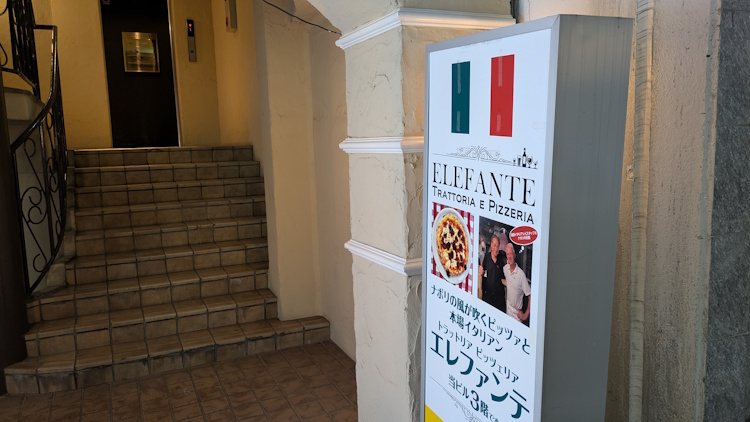
Trattoria & Pizzeria Elefante in Chuo-ku, Kobe

As part of our reporting on pizza in Kobe, we present this review of Trattoria E Pizzeria Elefante – serving Neapolitan-style pizza in Kobe at an excellent, “family style,” Italian restaurant.  Nice place, great pizza.

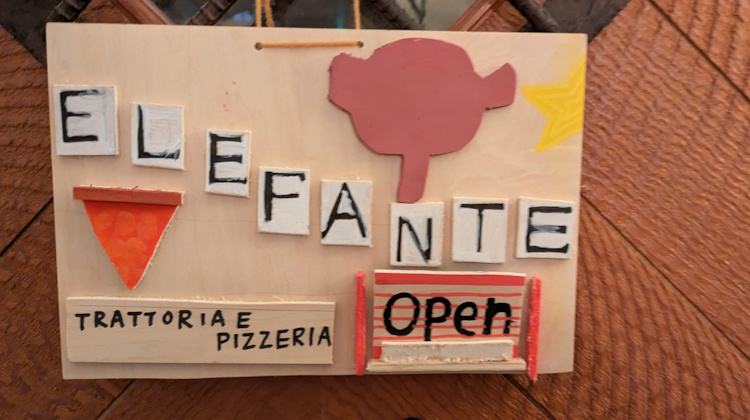
We know the exact name of this spot is Trattoria E Pizzeria Elefante – with an “E” (meaning “and”) and the more-Italian “F” instead of “PH” in “Elefante.”  But because we are describing an Italian business, in Japan, and often using English to do it, we get a mix of names.  On Google you’ll find this business listed as Trattoria & Pizzeria ‘Elephant.’ We know it is also likely called Elefante Pizza.  By any name, the taste is just what you what it to be; very good pizza in the Italian tradition.

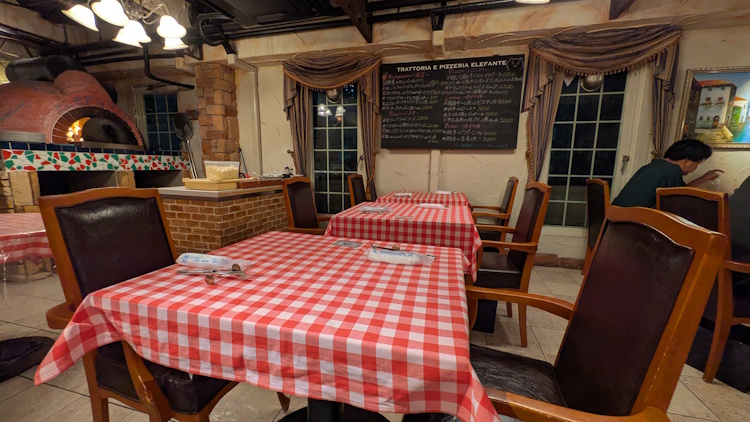
Kobe’s Elefante Pizzeria is located a very short walk from Sannomiya Station, on a quiet street, in architecture that (like a lot of Kobe) barely feels like you’re in Japan. “Where am I, again?”  The Elefante restaurant is distinctly European, and even the building has Western qualities to it that are almost disorienting.  Everything about Elefante feels more “solid,” more “built to last” (better materials), with a less temporary feel than the way most of Japan is constructed.
(There is a heavy influence of international culture in Kobe, including a section of town called Kobe Kitano Ijinkan-Gai – a once “foreign settlement,” that has many examples of expressly European buildings.)

“Yeah, yeah, sure, whatever; show me then pizza.”  Okay, fair enough; here you go:

How’s that look?  Pretty amazing, huh?  It was fantastic.

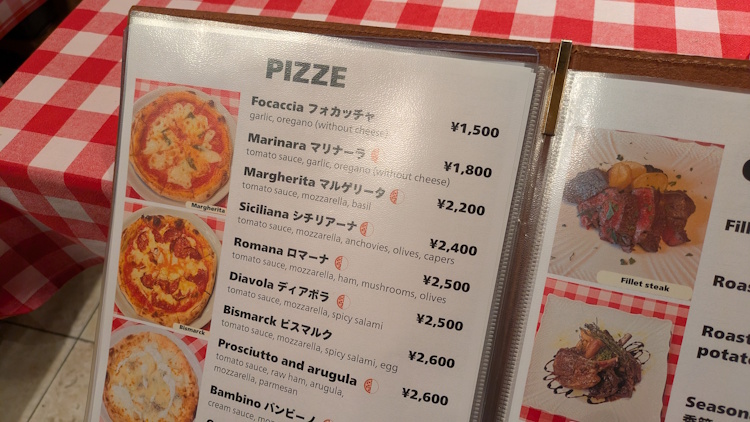
Elephante Pizza in Kobe has an extensive pizza menu.  Maybe twenty choices, covering the classic Naples-inspired range of pizza from the stripped-down Marinara to the spicy Diavola – and everything in between.

This is not strictly a “pizza joint,” it’s a “trattoria” – which is an Italian word (based on a French word) which loosely translates to “restaurant serving local, regional food.”  The menu includes much more than pizza, and the interior feels like the kind of place you might come for pasta as much as a pie.

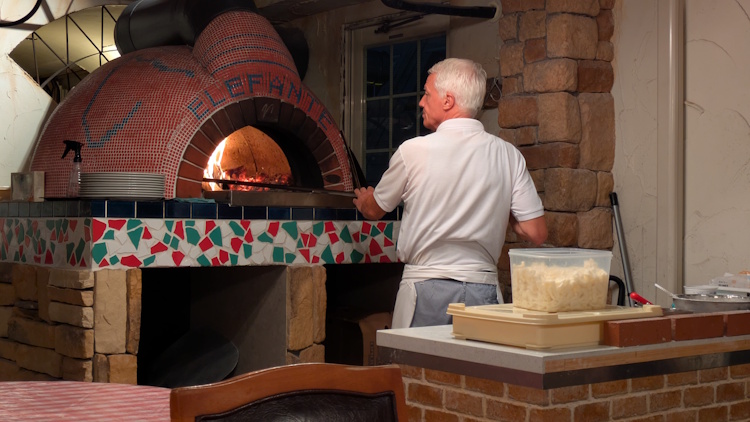
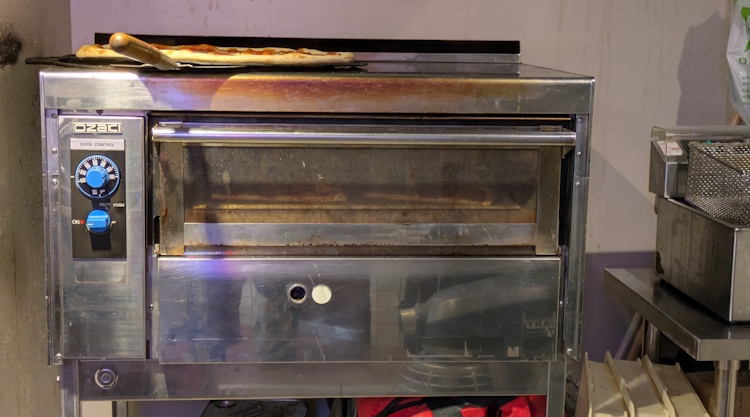
The interior is spacious, and comfortable. And there is that beautiful, domed oven. Wood-fired, yes.

As I enjoyed my meal, I noticed the pizzas were allowed to bake for well over a minute, beyond two minutes, and more.  I have written about the pizza at Savoy in Asabujuban, Tokyo, and Di Massimo in Sapporo; at each of which they cook a pizza in as little as 50 seconds.  Compared to most Napoletana pizza in Japan, the cook time is much longer at Elefante (although the product comes out equally wonderful).  Hmmmm.  I am always interested to learn about pizza, and there was something unusual about the time in oven at this spot (more on that below).

The pizza master is a white guy. Maybe 60 years old (?), white hair, good looking.  His blue eyes reminded me of my grandfather (who was, as you know, also a Pizza Czar, like his father before him).  Other than at pubs and bars, I don’t think I have ever been so aware of someone non-Japanese preparing my meal in Japan. Combined with the cuisine and the design of the room, it was part of the transported quality of my night at this spot.

While the traditional offerings on the pizza menu at Elefante were worthy of consideration (the opportunity to have a Siciliana, with olives and capers, is always a temptation that is difficult to resist), I was interested in their seasonal specials. Along with a special “Truffle Cream Bismarck Pizza,” there was another special that caught my eye:

Elefante Pizza was offering a pizza topped with fish.  Growing up in America, (other than anchovies) we don’t see much “fish” pizza.  It is my official opinion as Pizza Czar of Japan, that it is the “island” culture of Japan that so often pairs fish with pizza.  I’m interested in “seafood pizzas” in Japan, and have been going out of my way to try them.
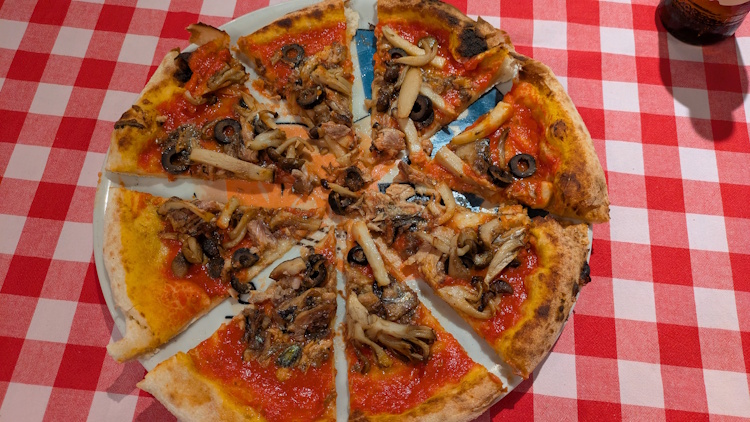
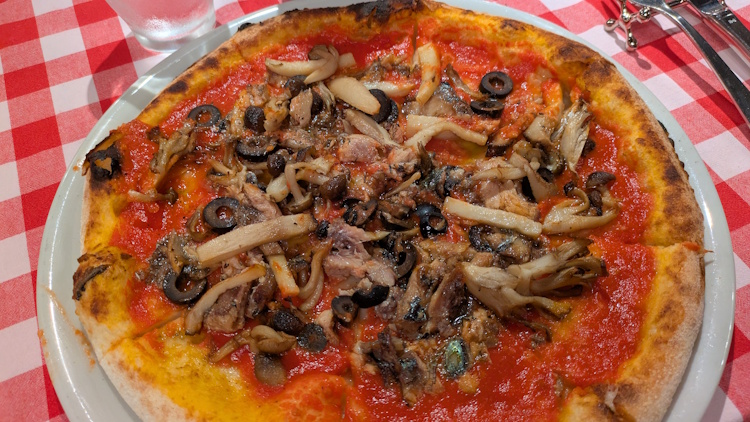
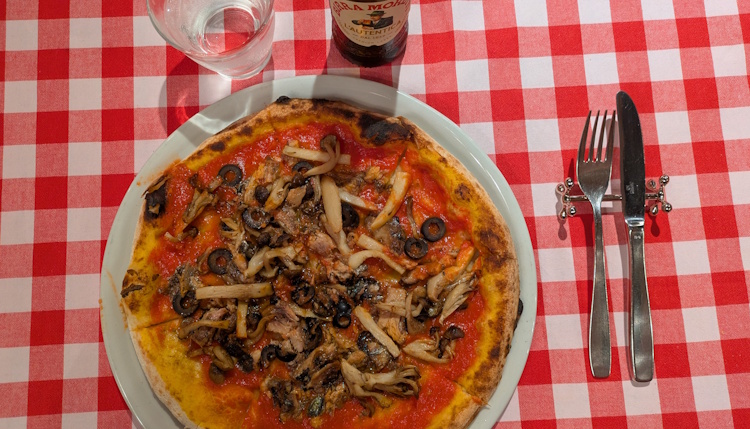
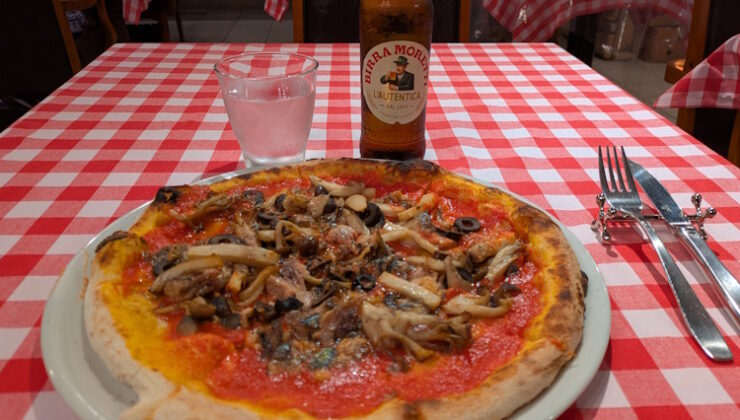
Elefante’s special fish pizza was made with Pacific Saury (a kind of mackerel) and mushrooms.

“Pacific Saury Mushroom Marinara Pizza: Tomato Sauce, Pacific Saury, Mushrooms, Olives, Anchovies, Oregano”
— From the “specials” on the Elefante Pizza menu

Hey, look at that.  Beautiful.

“Also known as the Mackerel Pike, Pacific Saury is a staple in many cultures as both food and bait. Pacific Saury are a long, small-mouthed, silver-scaled fish that populate the Pacific Ocean.”
— A description of Pacific Saury from North Atlantic Pacific Seafood

Pacific Saury (cololabis saira) are called Sanma (秋刀魚) in Japan. This is a popular fish used in Japanese cooking, and is commonly served in the Fall (these pictures are from Fall 2025). The Saury was on the menu as it was part of the local fresh catch.

As I was saying, I have had a lot of seafood pizzas recently.  Just on this trip to Kobe, I had the seafood pizza at Pizza Allocco, and then the “tako” (meaning “octopus”), spicy Normanna Pizza at Azzurri Pizzeria (which was fantastic, by the way).

In Hokkaido, I recently had the “Cod Confit” Pizza at Savoy Ezo in Sapporo; while that pizza was very good, the flavor of the fish was subtle.  The Pacific Saury on this pizza at Elefante had a more insistent, powerful flavor (like sardines).  There were also at least two kinds of mushrooms (bunashimeji and maitake, maybe eringi as well), and the fish-flavor fought through the earthy, woodiness of the ‘shrooms.

Garlicky; the mushrooms, spongy; salty fish; that burnt crust flavor.  Wow. Interesting, special pizza.  Heavily laden with toppings, very satisfying.  Good stuff.

The crust was relatively minimally, playing a modest role at the margins. Most of its contribution coming from the charred bubbles.

Tasty pizza.

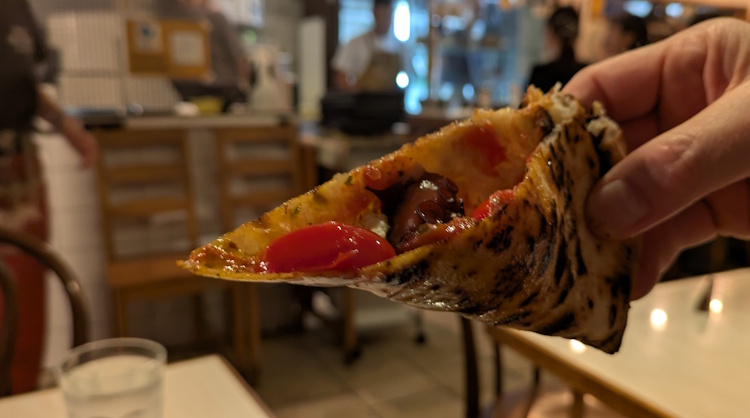
Did it pass the “pizza test?”  Well, barely.  The pictures here show it’s thin-crust pizza, but not infinitely thin.  With the weight of all the toppings – you can see everything sliding off of the slice as you try to pick it up.  If you wanted to try to tackle this one with knife and fork, no one could blame you.

I want to say more about how long the pizzas at Elefante in Kobe are baked:

At the risk of revealing my (pretty obvious) “pizza nerd” affinities I will confess; I am very interested in how pizza is made.  And, I have been known to time the process.  I mentioned earlier that many pizza ovens can cook a Naples-style pizza in under one minute (I still find that a remarkable fact), often about 50 seconds.

(This “50 seconds” cook time is specifically for Napoletana style pizza.  For comparison, I was at The Pizza in Hiroo, Tokyo, recently, and for a typical “New York” Style pizza, they might bake in the oven for eight minutes or more. Chicago pizza can take 20 minutes. The cooking time depends on the style.)

As I watched the pizza master cook, I was expecting a one-minute process, and I couldn’t tell what he was cooking, because it was taking so long.  For educational purposes (and my own maniacal curiosity), I set the timer on my phone…

From start (raw dough) to finished pizza, here is the process at Elefante:

0:00 dough hits the counter, and is stretched, toppings added
1:24 in the oven
2:20 threw some cardboard in to create flames/smoke
3:16 lifted, turned
4:20 he lifted it again, held it close to the roof of the oven
4:37 done

If I subtract the pre-oven prep time, that means that pizza was in the over for about three minutes, which is about 3X the cooking time of most of the pizza restaurants where I’ve watched (and timed) the process.

I had a chance to ask the pizza master, and he said, “It really depends on the oven.”  That makes sense, of course it does.  The time in the oven matters, but more importantly, it’s the condition of the pizza – when it’s ready, it’s ready.

That particular lesson was served from the pizza master, with a thick Italian accent. Grazie. I’m always eager to learn. And I *do* learn, every time I lean in and pay attention.

Nice place.

As I mentioned earlier, Elefante Trattoria in Kobe is not just a pizzeria; there is a full menu, including pasta and more. The table next to me got a seafood dish of fish and shells – I absolutely want that next time.  I had a busy itinerary on this trip, or I would have gone back just to try that seafood dish.  Everything was “high end,” but not overly expensive.

Elefante is doing the most common type of pizza in Japan – Neapolitan pizza – but they are doing it in such a natural, organic way.  I supposed actually being Italian might in fact help to create a different vibe.
Excellent pizza.  Wonderful atmosphere. I want to go back.

Highly recommended.

Pizza Restaurants in Kobe

Azzurri Pizzeria in Chuo-ku, Kobe
Jesus Pizza NYC-style slices in Chuo-ku, Kobe
Chicago pizza at BrewPub Starboard Pizza in Chuo-ku, Kobe
Pizza slices at Kobe’s 2 Bro’s Pizza in Chuo-ku, Kobe
— Simple, neighborhood pizza at Pizzeria Allocco in Chuo-ku, Kobe

2 Bro’s Pizza Slice, Chuo-ku

As part of our series on the best pizza in Kobe, we present this very favorable review of 2 Bro’s Pizza, in Chuo-ku, Kobe, near Hanshin Kobe-Sannomiya Station. The Brothers make an excellent New York-style slice.

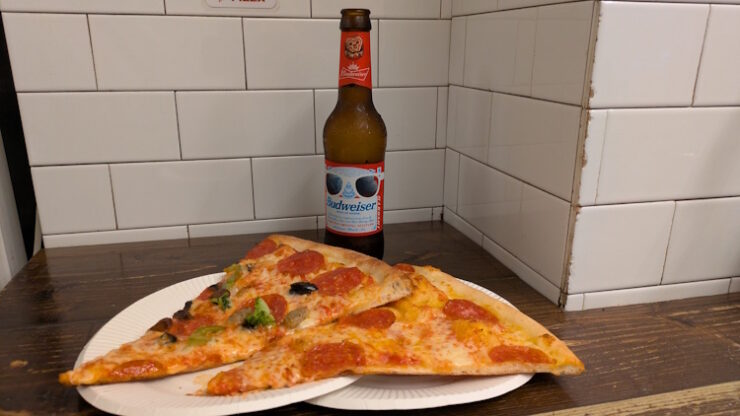
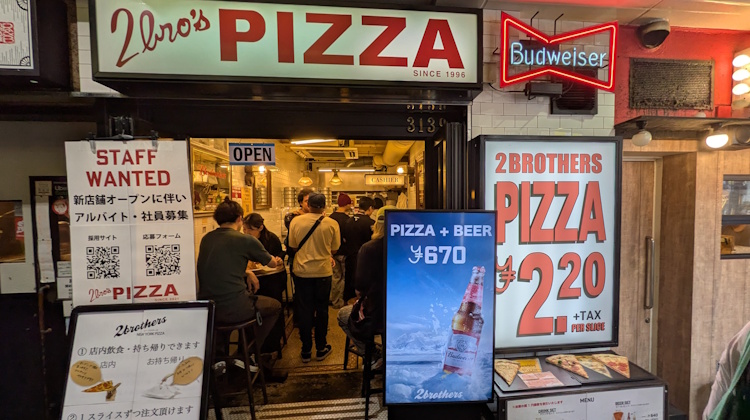
Pizza and beer for 670 JPY sounds like a pretty good deal?  That is because it is a good deal.  Low prices can be a good thing, but more than that, this is delicious New York-style pizza.

Let’s take a look at what we’re talking about:

The 2 Brother’s Pizza slice spot in Sannomiya is classic NYC-style pizza in Kobe.  If you’re kicking around online, you might find a listing for 99 Pizza in Kobe – this is the same place.  (My guess is they want more than one listing for delivery apps, 99 Pizza is probably a “ghost kitchen.” Kinda shady behavior, actually.)

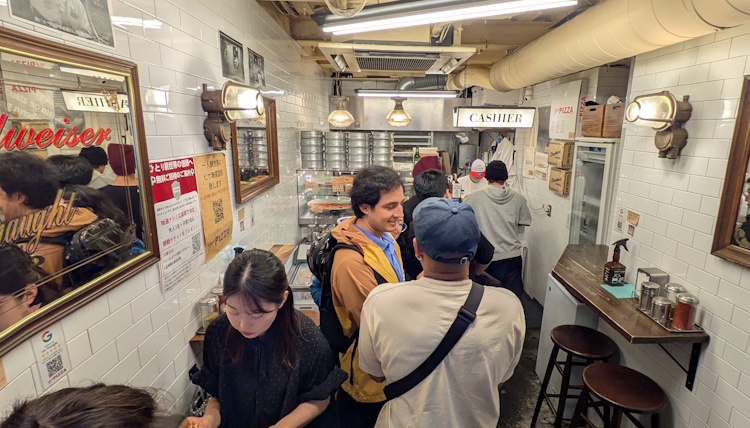
By whatever name you want to call it, Kobe’s 2 Bro’s pizza is located almost directly under the Hanshin and JR lines, just to the east (slightly downhill) of those two stations.  It is a very small shop, in a busy walkway, not a particularly relaxing place to sit; but they offer really excellent slices, and are absolutely convenient if not perfectly comfortable.

Of all of the pizza slice restaurants in Japan that I have been to (and as the Official Pizza Czar of Japan, I have been to almost all of them – I’ll say more below), this shop is the most like an actual NYC shop.  It has that “right on the street” feel, which is how they do it at American pizza slice shops.
For my first visit, I had just arrived in Kobe Airport by boat (I took the Bay Shuttle Ferry from Osaka’s Kansai Airport). From the airport, I took the Portliner train from the Bay Shuttle terminal to Sannomiya Station. As I arrived I was hungry, and my first stop in town was the 2 Brother’s shop.

2 Bro’s Pizza Shop is popular, and the shop was crowded as I arrived.  The few small tables were full, and there was a a line.

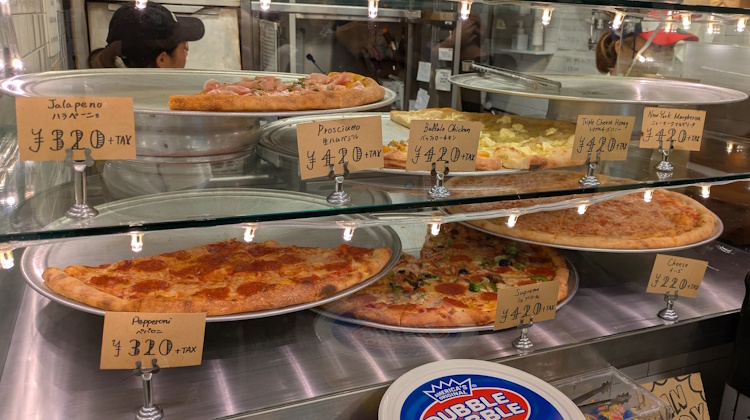
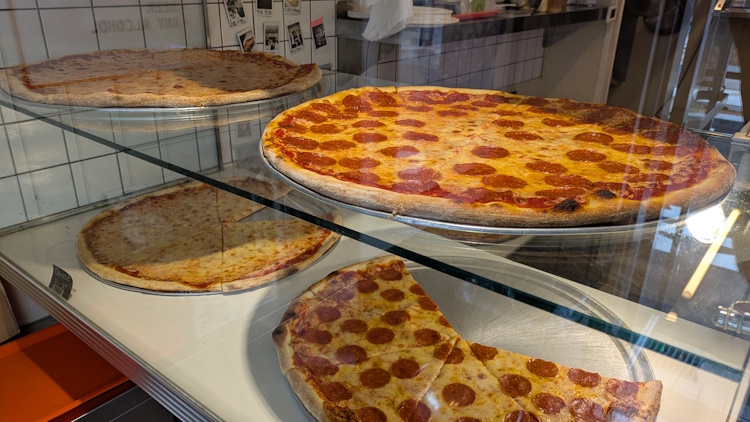
Looking past the crowd as I waited, I could see some pizza; in the New York traditional way, Two Brothers keeps all the pizzas on display in a glass case.

The day I arrived, that 2 Brother’s Pizza case was fully stocked with several kinds of slices. Everything looked fantastic.

It is a great part of the New York pizza tradition that you can see what you’re getting before you order.  You can’t always tell what the pizza will taste like (many pizzas look good, but aren’t that tasty – Nim’s Pizza in Tokyo has a case full of good-looking pizza, but their pizza is mostly pretty average).  Generally speaking though, a good looking case is a fun part of the pizza slice experience, and your first clue you’re about to have a good time.

While the pizza in the case is the best indication of what is available, there is also a menu.

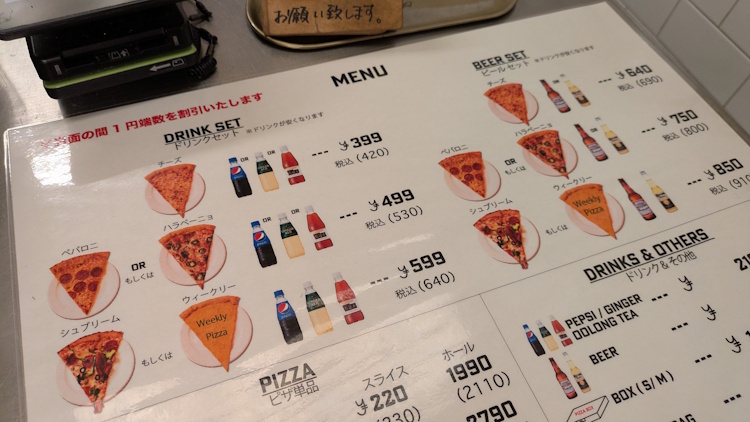
On the printed menu, you’ll see: the Cheese Pizza, Pepperoni Pizza, Jalapeno Pizza, their Supreme Pizza, and a “weekly pizza” (which is like a special).  There are also several attractively-priced “beer sets;” pizza combined with beer (choices of Corona or Budweiser).

The reality was that there were several special pizza slices in the case that weren’t on the menu, including: the Prosciutto Pizza, the Buffalo Chicken Pizza, and a “Triple Cheese” (which you might see as a causal version compared to the classic Quatro Fromage four-cheese pizza, like a budget version of the seven-cheese pizza you’ll find at Tokyo’s Pizza Bar on 38th).

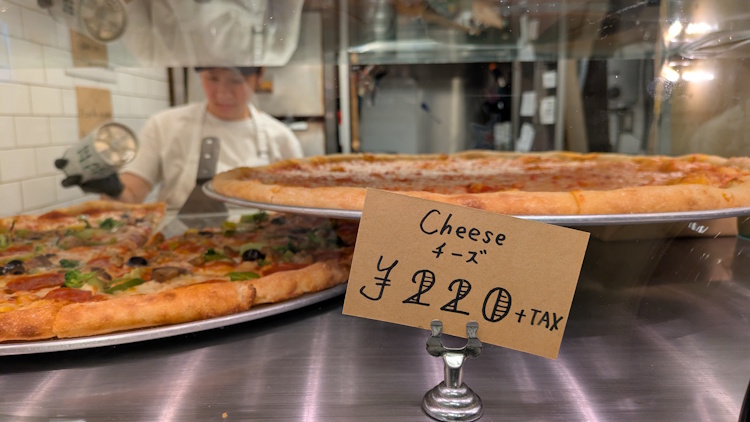
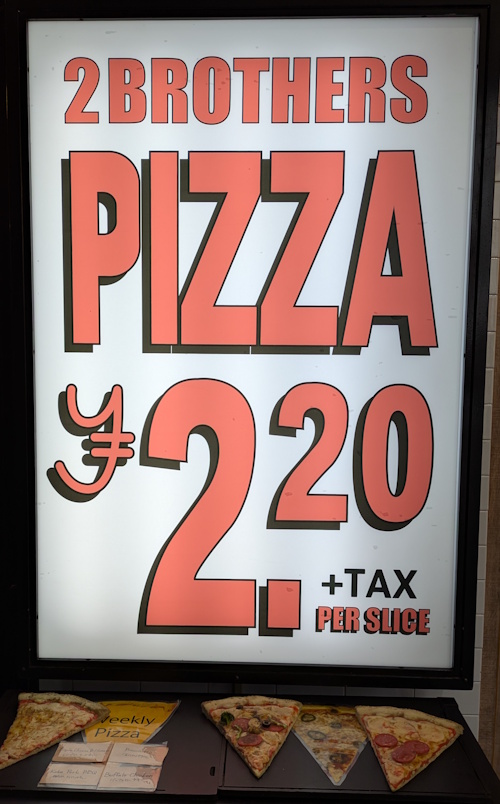
The cheese pizza at 2 Bro’s in Kobe may not be particularly gourmet, but it has a nice price at 220 JPY.  That is a screaming deal. For a slice of cheese pizza and a Bud, 640 JPY.  Best prices in Japan, not doubt.

To be honest with you, I love the friendly prices at 2 Bro’s pizza.  But if the pizza wasn’t good, I’d say so (and I wouldn’t care that it was cheap).  In this case, the pizza was excellent, so in the end we have something to be excited about.

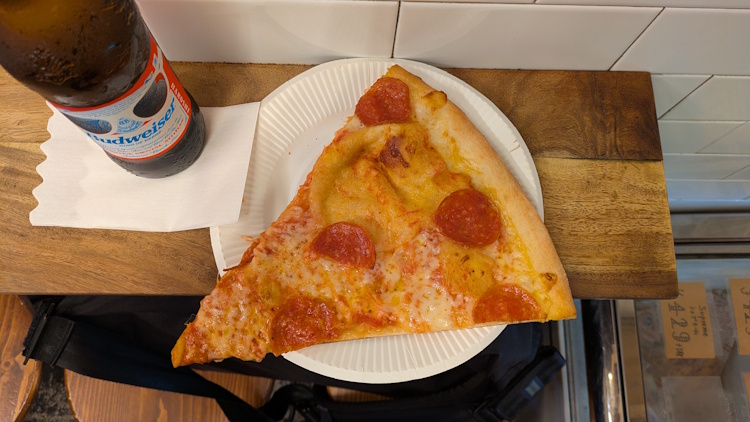
When it was my turn to order, I could choose from nine different types of pizza slices.  They had just run out of Pepperoni Pizza while I was waiting in line, but… they had a fresh baked Pepperoni Pizza waiting by the time I got to the register. For me, it was to be a Pepperoni slice, and I wanted to try that Supreme Pizza (both are classic America NYC slice choices).

Along with my two slices, I ordered a cold Bud as part of one of their pizza + beer combo sets. This all set me up for an excellent lunch, and a warm welcome to Kobe.

That Supreme Slice comes loaded with toppings. It is 399 JPY, which is almost twice the price of a slice of cheese, but still much less expensive than an equivalent slice at any other good pizza slice shop in Japan. Deals here, on all their pizza.

“Supreme Pizza: Cheese, Pepperoni, Sausage, Olives, Jalapeno, Mushrooms, and Broccoli”
— From the pizza menu at 2 Brother’s Pizza in Kobe

My first bite; CRUNCH. That is a beautiful crispy crust. That Supreme slice had that sausage flavor coming through. Fantastic. You know I put some red chili flakes on that, as soon as I could.

I had just arrived in Kobe, and I was already having a good time.  This was my first taste of pizza on this trip, but all of the pizza in Kobe turned out to be very good. Kobe is a real pizza town, every place I went was a winner. See our list of pizza in Kobe for all my reviews.

Because this shop is located right under the tracks, I could hear the trains rumbling overhead. But that wasn’t all I could hear.

Sticking with the New York influence, 2 Bro’s Pizza was playing some very good hip hop in the shop. What kind of hip hop? East Coast, yo – of course. Some Gang Star (“Step in the Arena”). Show and AG (“Next Level”). (Is that Q-Tip?)  Some Tribe Called Quest (Yep, that’s Tip… “Find a Way”). And then a little “Left Coast” Warren G (“It’s ’94, That’s How We Doin’ It”) thrown in to bring the fam together.

Pizza and hip hop are a good combination.

I often talk about how NYC pizza shops in Japan love the pizza slice/hip hop/skateboarding combination. It’s true; it’s very common to find that combination in Japan (check out Roccos NYC Pizza slices in Tokyo for a good example) – but no skateboard references at 2 Bros (so I guess there is some room for improvement).

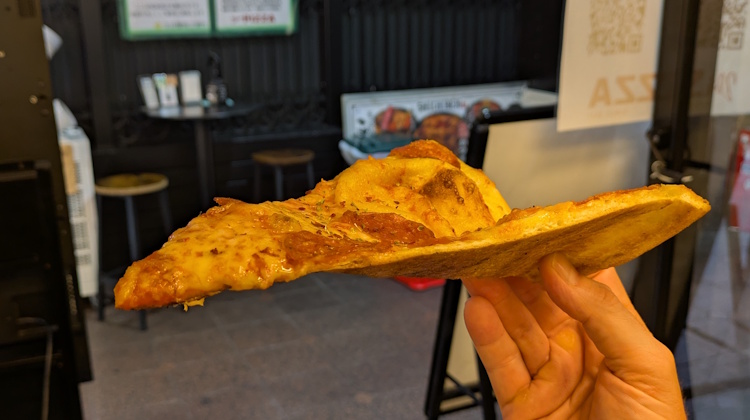
As part of my duty as the Pizza Czar, I ran my classic “pizza test.”  Can you pick up a slice?  At Kobe’s 2 Brothers, you most certainly can.  That crunchy crust not only tastes good, but (with a little fold) it holds up well.

Someday soon I’ll write about an article about the best pizza slices in Japan, and 2 Brother’s Pizza will be on that list.  To be fair, Kobe’s Jesus Pizza (just a few blocks away) will also be on the list of the best NYC slices in Japan; both of Kobe’s slice shops are excellent, and stand up against other top-quality pizza slice shops like Henry’s Pizza in Osaka, Dookie’s Pizza in Nagoya (their “Combo” is better than 2 Bro’s, actually, much better, that is a slice on anther level), or The Pizza in Tokyo’s Hiroo neighborhood (they make a very good slice).

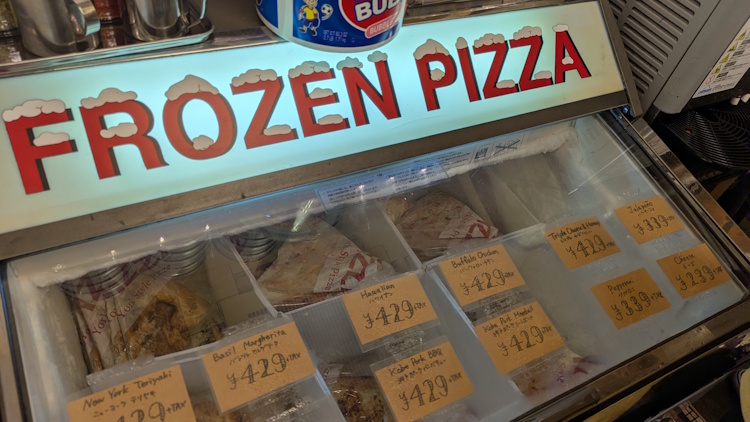
If you like what you see at Two Bro’s pizza in Kobe, apparently you can take some frozen slices home with you.

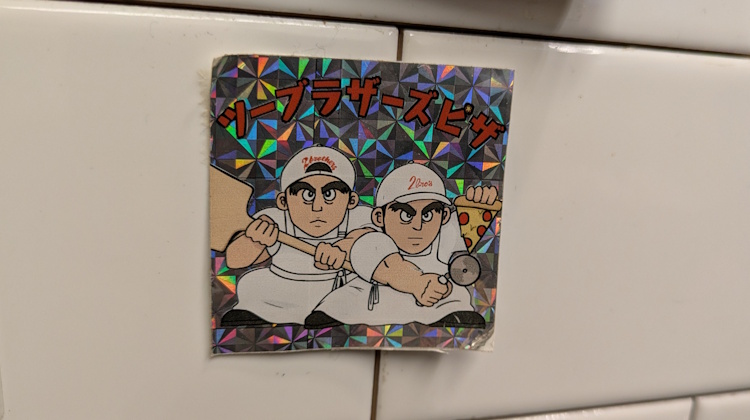
Earlier in the review, I mentioned that 2 Brother’s Pizza is using a second name (“99 Pizza”), probably to get an extra listing on delivery apps. That’s kind of dodgy behavior. They are also bribing customers to write reviews by offering to give you a free sticker for a review. That means you can’t trust the Google reviews (but if you know Google Maps, you already know that). The sticker thing is more evidence of aggressive marketing behavior from the Brothers. Generally, that would make me distrust the product (and not like the shop).

*sparkle sparkle*

While I do like stickers, I don’t like the spammy marketing methods. However, the quality of the pizza stands tall. I have personally eaten Two Bro’s Pizza myself, and I can say from experience – absolutely fantastic pizza.

I am not the only one that likes what they are serving up. When I walked into the shop that day, it was packed, shoulder to shoulder. I had a really good pizza experience (at a great price).

The shop emptied out while I ate, and in the end, it was just me, an empty plate, and some bumpin’ hip hop overhead.

Fun place. Really excellent pizza.

Pizza Restaurants in Kobe

— World-class Neapolitan pizza at Azzurri Pizzeria in Chuo-ku, Kobe
Elefante Pizzeria in Chuo-ku, Kobe
— Get NY-style pizza slices at Jesus Pizza in Chuo-ku, Kobe
Chicago pizza at BrewPub Starboard Pizza in Chuo-ku, Kobe
— Simple, neighborhood Napoletana pizza at Pizzeria Allocco in Kunikadori in Chuo-ku, Kobe

Public Swimming Pools in Kobe

As part of our list of resources for visitors to Kobe, here is a list of public swimming pools in Kobe, Japan.

Kobe City Municipal Kita-Suma Cultural Center

This heated swimming pool in Kobe City Municipal Kita-Suma Cultural Center is warm, so the visitors can enjoy it year round in all seasons. The pool size is 25 m × 6 lanes (depth: 1.2 m).
Address: 3 Chome-1-2 Nakaochiai, Suma Ward, Kobe, Hyogo 654-0154
Closed: Mondays (1st, 3rd, and 5th Mondays of the month)
Opening hours: 10:00–20:00
Fees: Adults 600 JPY, Children 300 JPY
Website: https://www.kobe-bunka.jp/facilities/kitasuma/kitasuma-detail/#18

Kobe City Welfare Sports Center

The swimming pool at Kobe City Welfare Sports Center measures 25 m × 6 lanes, with a depth of 1.2–1.3 m. It is located on the 10th floor, and visitors can enjoy swimming under the open sky when the roof windows are open.
Address: 3 Chome-1-32 Isogamidori, Chuo Ward, Kobe, Hyogo 651-0086
Closed: Thursday
Opening hours: 9:00–21:00, 9:00–17:00 (Sunday)
Fees: Adults 600 JPY, Children 300 JPY
Website: https://www.cospa-wellness.co.jp/corp/kobefukushi-sc/

Kobe Tokiwa Arena

Kobe Tokiwa Arena has a 25 m × 7-lane swimming pool with a depth of 1.2–1.3 m. There is also a small swimming pool for children.
Address: 1-1 Hasuikecho, Nagata Ward, Kobe, Hyogo 653-0837
Closed: The first Monday of the month
Opening hours: 9:00–22:00 (Sundays: until 21:00)
Fees: Adults 550 JPY, Children 250 JPY
Website: https://www.hyogobuntai.jp/

Port Island Sports Center

Port Island Sports Center features both a 50 m × 8-lane pool (depth: 2.0 m) and a 25 m × 5-lane pool (depth: 1.1 m). The 50 m pool is usually used for competitive swimming such as water polo and other aquatic sports. It is open to the public when no events are being held. The 50 m pool operates only during the summer season; in winter, the space is used as an ice-skating rink.
Address: 6 Chome-12-1 Minatojima Nakamachi, Chuo Ward, Kobe, Hyogo 650-0046
Closed: Wednesday
Opening hours: Please check the calendar on the website
Fees: Adults 650 JPY, Children 300 JPY
Website: https://www.kobe-spokyo.jp/psc/

Shiawasenomura Pool

Shiawasenomura offers a heated swimming pool measuring 25 m × 6 lanes, with a depth ranging from 1.1-1.3 m.
Address: 1-2 Onsen Kenko Center, Shiawasenomura, Kita Ward, Kobe, Hyogo 651-1106
Closed: The third Tuesday of the month
Opening hours: 9:00–21:00, 9:00–13:00 (Tuesday)
Fees: Winter – Adults 500 JPY, Children 250 JPY; Summer – Adults ¥400, Children ¥200
Website: https://shiawasenomura.org/sports/pool/

See Also

Population of Kobe
Neighborhoods in Kobe, Japan
Shopping places in Kobe, Japan
Department stores in Kobe, Japan
Major train stations in Kobe, Japan
Kobe Airport in Kobe city, Japan
Bay Shuttle Ferry service in Kobe, Japan
Train Lines, Shinkansen and Subway in Kobe, Japan
Kobe foreign settlement
Temples and Shrines in Kobe, Japan
Festivals in Kobe, Japan
— Events in Kobe, Japan
Hot springs and onsen in Kobe, Japan
Popular museums in Kobe, Japan
Parks and gardens in Kobe, Japan
Japanese language schools in Kobe, Japan
Colleges and Universities in Kobe, Japan
International schools in Kobe
English speaking immigration lawyers in Kobe
Co-working spaces in Kobe
Tax specialists that speak English in Kobe

And:
Swimming pools in Nagoya, Japan

Jesus Pizza in Chuo-ku, Kobe

As part of our growing list of reviews of Kobe pizza restaurants, we present these enthusiastic comments about a NYC-style pizza slice place in Kobe; Jesus Pizza.  Great spot.

On a quiet street in a nice neighborhood (not far from Kobe’s famous Kitano Ijinkan Gai), you will find Jesus Pizza; one of two very good pizza slice places in Kobe (the other one being, 2 Brothers Pizza near Sannomiya Station).  Of the two, Jesus Pizza is less central, but a much larger, more comfortable shop.

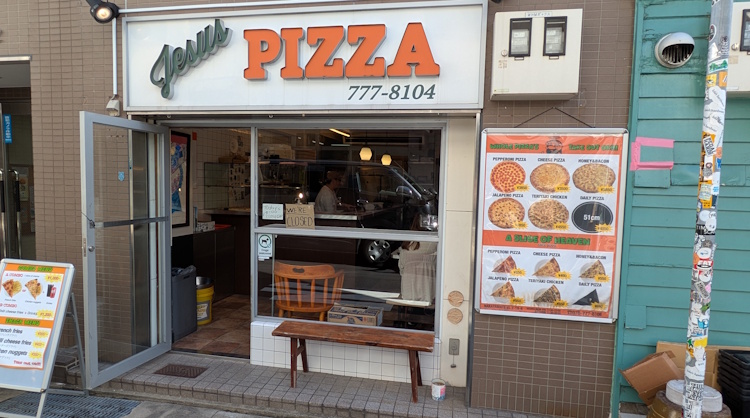
The sign is old, the colors faded, and has a simple, seven-digit phone number. While much of Japan has a 11-digit format (three digits, then four, then four again), when I was a kid in America, we would format our local phone numbers just like on the sign at Jesus. When I looked at it, I assumed the sign was purchased from an old shop in the US.

So why is this place called Jesus Pizza, anyway?  What’s the deal with that?

Well, I asked: The pizza master on duty that day said it is simply because the owner is into Jesus.  “Ohjisan wa, Christian desu.”  Okay.  I’m guessing there is more to the story than that, but that’ll do for now.

Let’s get into the pizza.

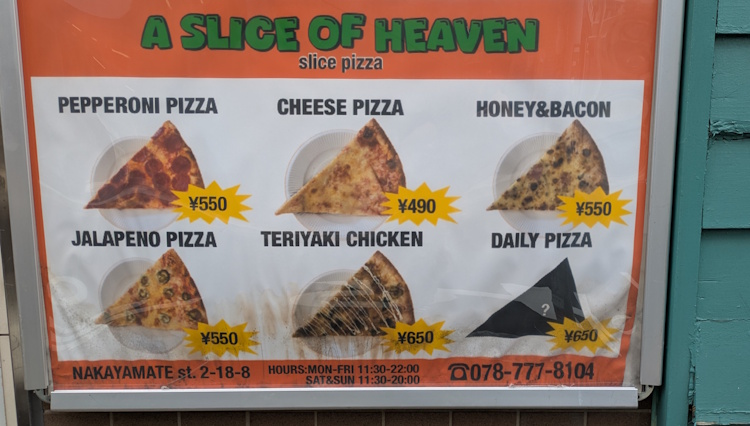
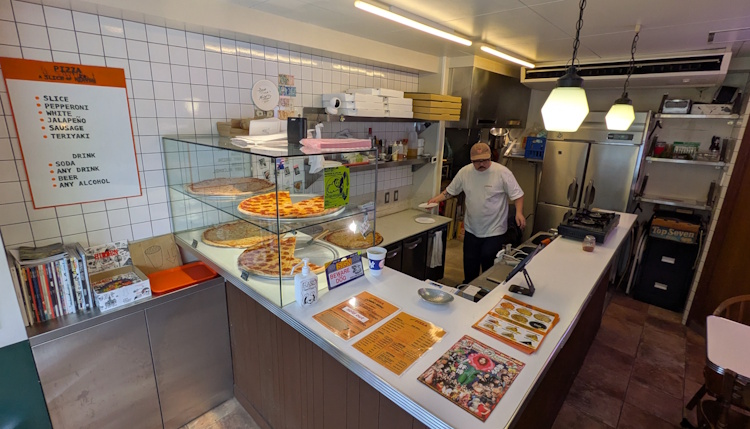
While there is a pizza menu on the wall outside (and another inside), the best way to know what kind of pizza slices are available is to check out what’s on display in the case. The NYC-style pizza slice experience at Kobe’s Jesus Pizza includes the New York tradition of putting the pizzas behind glass, showcased in a box on the counter.

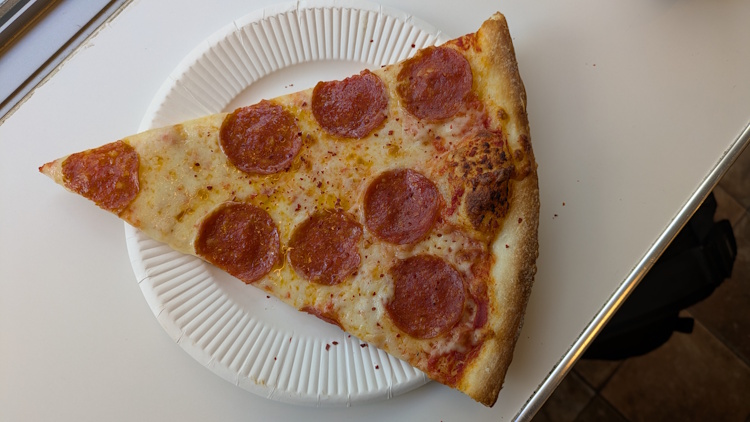
Kobe’s Jesus pizza slices usually does several flavors (five types of pizza, plus maybe some “specials?”). When I came by, they were doing an event that day, and they were to close at 2 PM, so; pepperoni and cheese slices only.  That was fine by me, I was very ready to sample one of the best pepperoni pizza slices in Kobe.

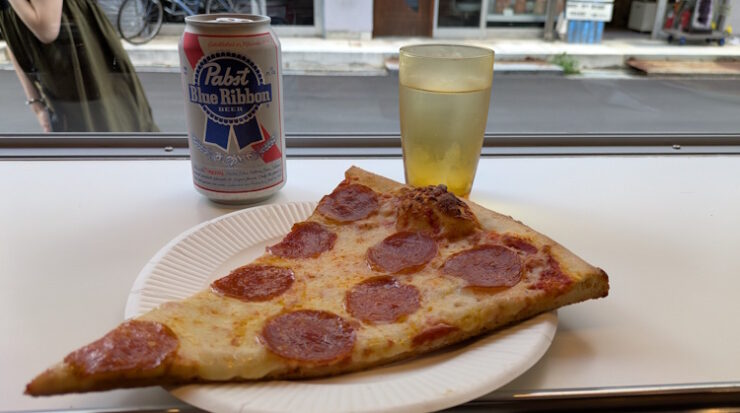
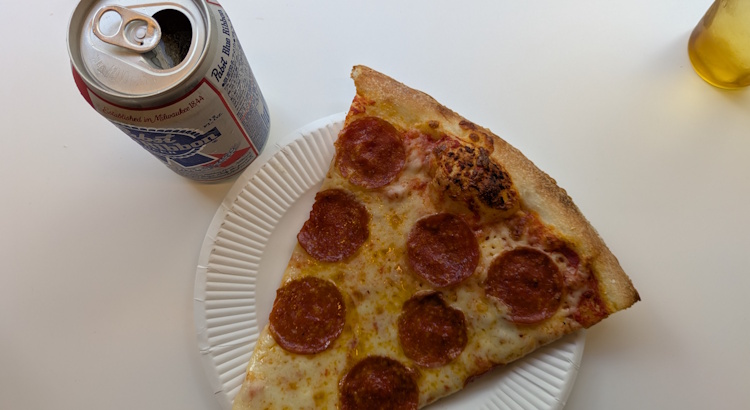
I ordered two slices, and to drink, a cold PBR (Pabst Blue Ribbon, an American “blue collar” beer).

As the pizza arrived, I was excited to be there.  Kobe is a great city, and pizza is one of God’s finest creations. A beautiful combination. The mood in the shop was just right, for me, celebratory; it was pizza time.

Jesus Pizza in Kobe makes a perfect, NYC slice.  There are a lot of experiences were the Japanese do what feels like a “copy” of an international classic, but this pepperoni pizza slice was the real thing. Not copied, but co-created in the New York City tradition, yet half a world away.

And there was that watery, thin, slightly sour PBR to wash it all down.  I can’t say that I think Pabst is a particularly good beer (I think most of the standard Japanese beers you can buy at the supermarket are better).  Pabst is a very similar, but slightly more “edgy” alternative to Budweiser (which might be among the worst beers in America, IMAO).  On this day, that PBR was just right, and a tasty compliment to the slices.

It helped that I got the timing right; I arrived in time for a fresh slice, just out of the oven. Great pizza experience.

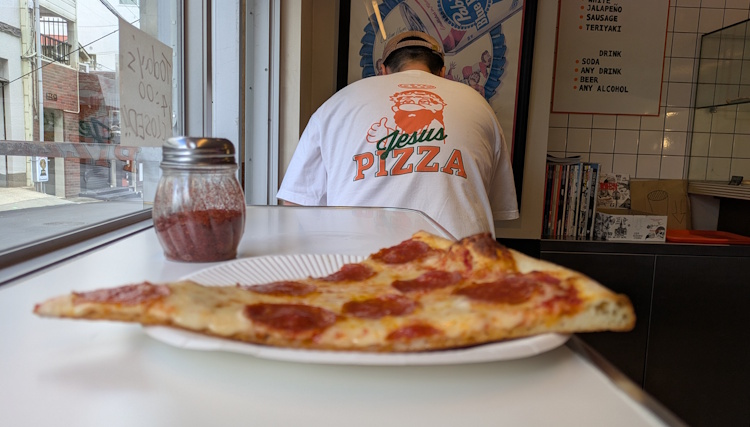
Inside, Kobe’s Jesus Pizza is a comfortable, roomy shop.  To sit, you can choose between counter seating facing the street or a few sit-down tables.

Like many pizza slice places in Japan, the vibe of the shop is set up to include a kind of “checklist” of New York City references; it’s the fat, crispy slices of pizza, but there are often two other features you can count on in a NYC pizza shop in Japan; hip hop playing overhead, and some reference or another to skateboarding.

Slices, hop-hop, and skateboards. You’ll see this same trifecta at shop after shop in Japan.  For example: You can see a shot I took of a well-worn board under the table at Henry’s Pizza slices in Osaka.  You’ll see it again at the NY-Italian neighborhood inspired shop Rocco’s Pizza slices in Tokyo.  You’ll see at least the hip-hop part at Dookie’s pizza slices in Nagoya.  (Those are all great pizza slice shops, by the way, some of the best in Japan).  As the Pizza Czar of Japan, I have eaten at New York-style pizza shops in Tokyo, Osaka, Nagoya, Sapporo, Kobe, and more, and the NY-influenced formula is very consistent, and often makes for a great vibe.

Why that combination, again and again?  While the hip hop and pizza are very NYC specific, the skateboarding addition is more curious. I think it probably begins with a certain kind of young Japanese guy in Japan; probably a skater, not particularly studious or traditional, maybe he likes to party.  Maybe that guy has a few tattoos.  He is looking for a business idea to fits his lifestyle; low cost to create, low cost for customers, fun for him (and for his friends).  Maybe he learned about pizza while living in NYC for a summer. Or maybe he is copying the NY vibe from another pizza shop in another Japanese city (and the reference becomes a part of the Japanese skateboard culture itself). The NYC pizza shop fits that kind of “formula” – and is often a wonderful template for a tasty, affordable, slightly “punk” experience.

I could feel that formula coming as I stepped into the shop, in part because the music at Jesus Pizza was so good. 

The music was awesome: There was an excellent down-tempo mix streaming off a cell phone to a tiny Bose speaker above the pizza case. Soul, R & B tracks, and with some more current, aggressive samples dropped in (“Cash rules everything around me”), all expertly blended into one another.  In my notes, I wrote; “A lot of original sources from samples that would be easy to recognize for a hip hop head (‘Killin’ me softly.’ ‘Mary Jane.’ ‘We spend most our time, living a gangsters paradise.’).”

Here is a tangent for you: That last track “Gangster’s Paradise” is a 1995 track by Coolio. That may sound like it is an “old” song, but that is the new part.  The original is “Pastime Paradise” by Steve Wonder, from 1976.  Both the beat and many of the words from the hook in Coolio’s song are sampled from the Stevie Wonder hit. In the mix, the two songs were being blended back and forth together. I asked about the mix that was playing and the pizza master was good enough to share that the arrangement was done by a DJ named J.Period.  If you’re a real hip-hop head, you may be sort of laughing at this point, because my “notes” are an accidental near-perfect description of what J.Period is famous for: taking well-known, somewhat current hip-hop tracks, and spinning them back together with the original songs they sample from.  I have enough music knowledge to hear what was going on, but it was that day at Jesus Pizza that introduced me to J.Period. Thank you, very much.

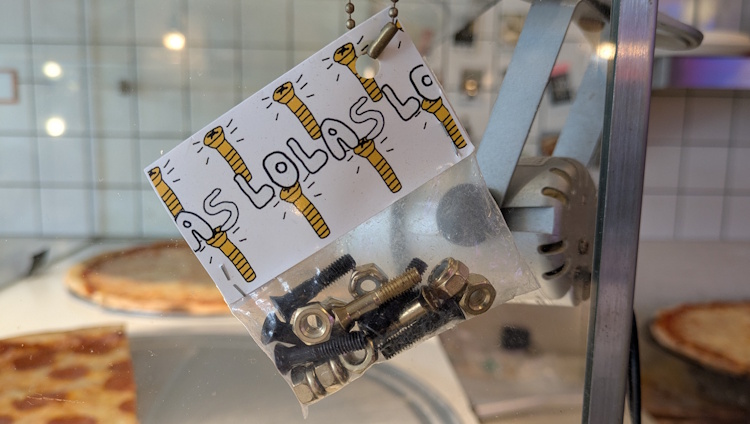
Hip hop.  Pizza.  Good stuff.  What about the skateboards?  I had to look around for a second, but yeah, as expected:

Lolas is a “hardware” company, affiliated with one of the shop workers.  In the picture in this review, you can see some Lolas truck bolts hanging off the pizza case.  Classic.  Jesus Pizza has sub-culture stacked within sub-culture.

You don’t have to know anything about music or “wooden toys” to be into Jesus Pizza – the pizza alone will carry the day.

As pizza slices go, these pizza slices are fantastic.

I am always trying to learn a little bit more about pizza.  When I had dinner at Azzurri Pizza, I learned something about ricotta cheese (and how it might work in combination with the spicy flavor of Italian red chill flake-infused oil). Here at Jesus, as I watched him preparing a slice for someone else, I learned something new as well:

In the NYC pizza slice tradition, the pizzas are made in advance, and put in the case.  If you’re there at the perfect time (like I was on my visit), or in a busy time (where they are selling-out quickly), you may get a fresh slice, right out of the oven.  If it’s been a few minutes since the pizza was finished, they’ll take your slice(s), and throw them back in the oven to re-heat them.

That is often a great experience, but the re-heating process is commonly “less than perfect,” as cooking the pizza twice can dry it out.  It’s not ununcommon to have an over-cooked, dried-out slice (this was true for me with my Detroit-style slice at NIM’s Pizza in Tokyo. Probably true at Pizza Joint Pike’s in Sapporo).

At Jesus Pizza on this particular day, I watched the pizza master use a spray bottle to spray down the slices before he reheated them. Ah-ha; that was a good lesson for me.  A couple blasts of misty water can help hydrate the slice a little and keep it from drying out. For an observant Pizza Czar like me, that was all very interesting.

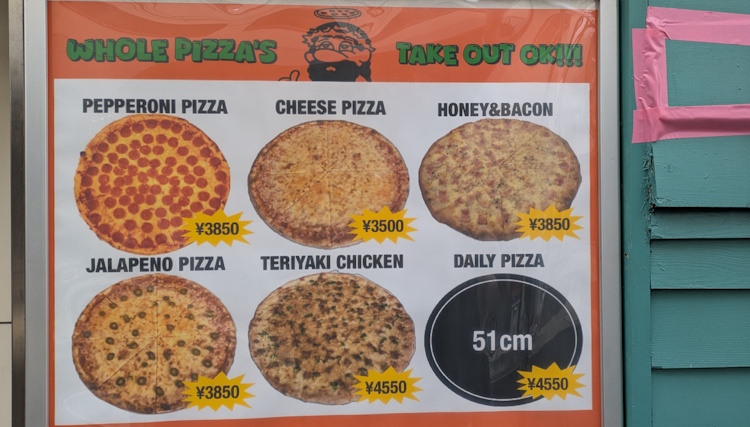
In addition to slices, Jesus does full pies.  You can eat them in-house, or get them to-go.

(And I would assume some app-driven service will deliver them as well.)

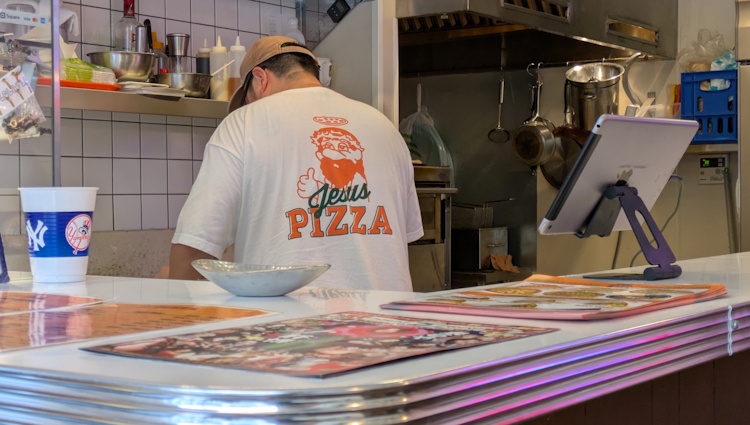
In addition to the music and pizza, there are many more cultural references to American ethnography. The pizza, of course.  The NY Yankees cup on the counter.  The choice of pictures on the wall.

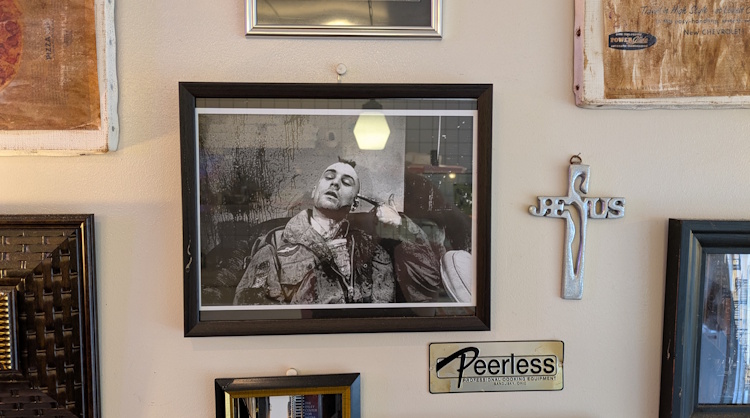
There is even a dystopian shot from the classic American movie (set in New York City), Taxi Driver.

That is a young, very dodgy looking Robert Dinero posted up next to the cross.

At Jesus Pizza in Kobe, the atmosphere is created as layer after layer of references and “ingredients” are curated and assembled.  It takes a while to create a vibe like this.  It’s all clean, comfortable, intentional, and very well done.

(This has been a fun review to write.)

As a closing note; this same street also hosts Kobe’s Beyond Coffee – which is both a roastery and a “craft coffee” shop (very craft, full hipster – Gavin McInnes would be proud, maybe.).  I had the chance to get a very special cup of Beyond Coffee coffee after lunch that day; also a great experience.

Okay, Jesus Pizza.  I think that is enough for this piece.  Great shop, delicious pizza.  I’m a fan.

Pizza Restaurants in Kobe

Azzirri Pizzeria in Chuo-ku, Kobe
Trattoria E Pizzeria Elefante in Chuo-ku, Kobe
Chicago pizza at BrewPub Starboard Pizza in Chuo-ku, Kobe
— Local, neighborhood Neapolitan pizza at Pizzeria Allocco in Chuo-ku, Kobe
Kobe’s 2 Brother’s Pizza in Sannomiya in Kobe, Japan

Pizzeria Allocco in Chuo-ku, Kobe

As part of our list of the best pizza in Kobe, we offer this review of Pizzeria Allocco, in Kunikadori in Chuo Ward, Kobe; a neighborhood pizza spot with tasty Neapolitan-style pizza (and local honey).

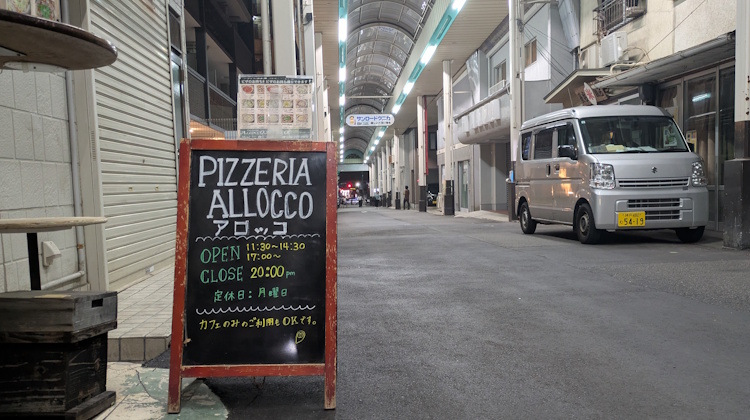
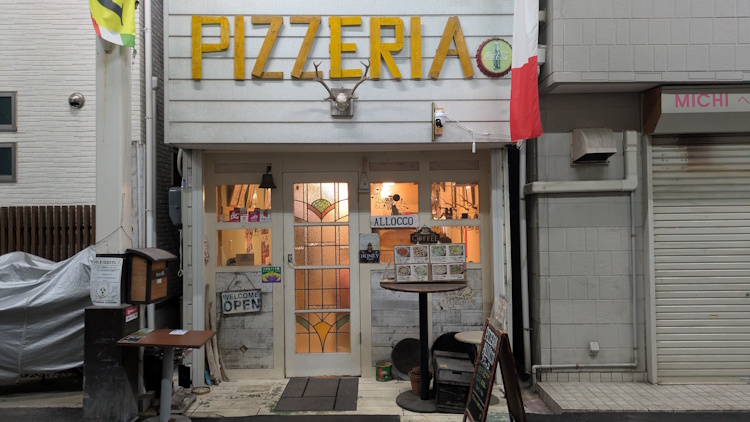
Pizzeria Allocco in Kobe also goes by it’s Japanese name, ピッツェリア アロッコ. This pizza shop is located in Sunroad Kunika, which they call a “business park,” but is what I would call a quiet shotengai (Japanese “shopping street” ). The Allocco pizza shop is about a five minute walk from Kasuganomichi Station.

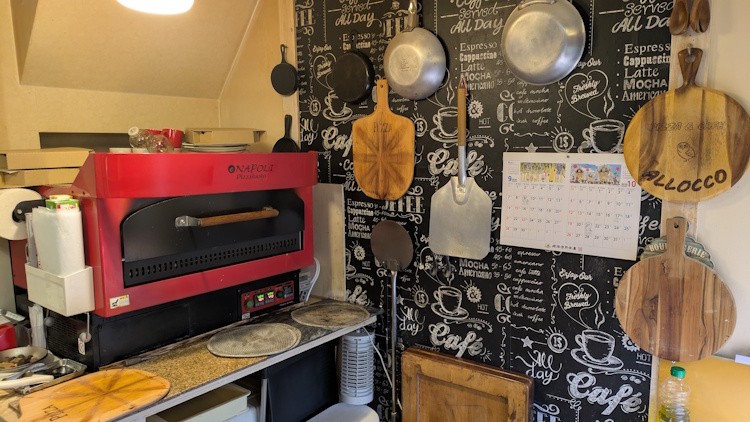
Allocco Pizza, is causal; almost feels like someone’s home. A comfortable spot. Moderately-priced. The shop could seat maybe 12 people (tops), if everyone was crammed together. You could bring a family, or someone special for a casual date.

Let’s look at the pizza:

Allocco Pizzeria does several different varieties of Neapolitan-style pizza. Some are classic traditional pizzas, and some allow for the originality of the pizza master to shine through.

For example:

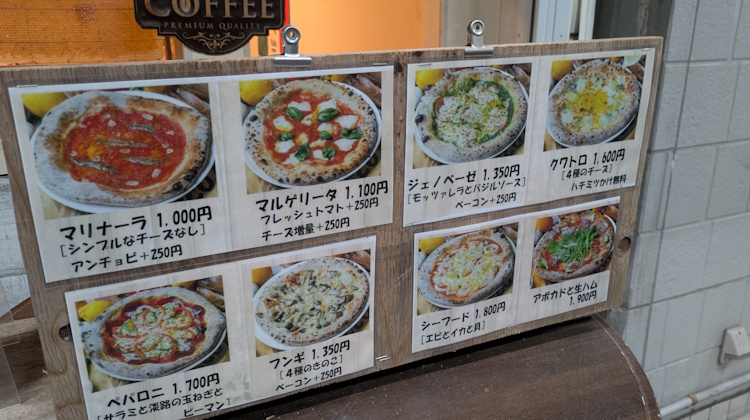
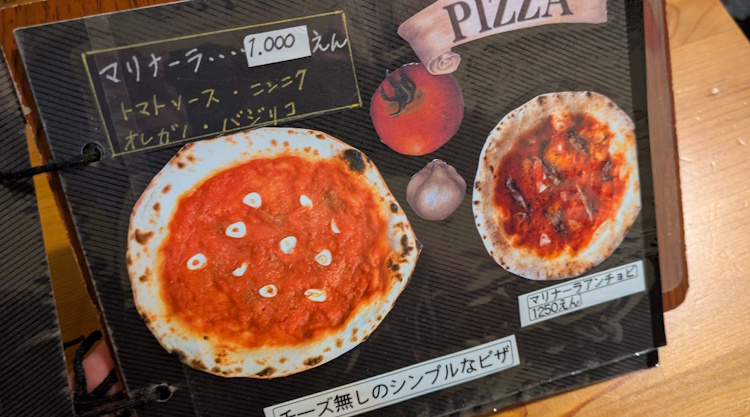
The Marinara pizza at Allocco is the most bare bones I’ve ever seen. Very stripped down. For an extra 250 JPY (per the pictures on the menu), you can add a full compliment of anchovies.

The menu also features a Prosciutto Avocado Pizza; which is definitely not traditional, but sounds good. I was tempted to try it.

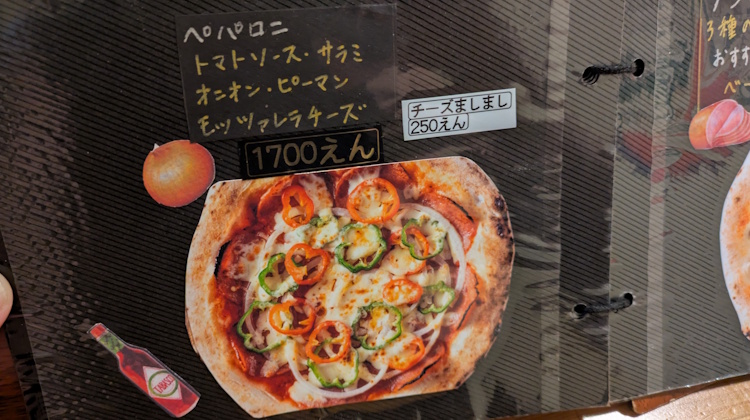
And Allocco does a Pepperoni Pizza, but it’s not typical pep and cheese. (For the classic versions, check out Jesus Pizza and 2 Bros Pizza for low-cost pizza slices in Kobe).

The Pepperoni Pizza at Allocco has onions and peppers; is almost like an American “Combination” Pizza.

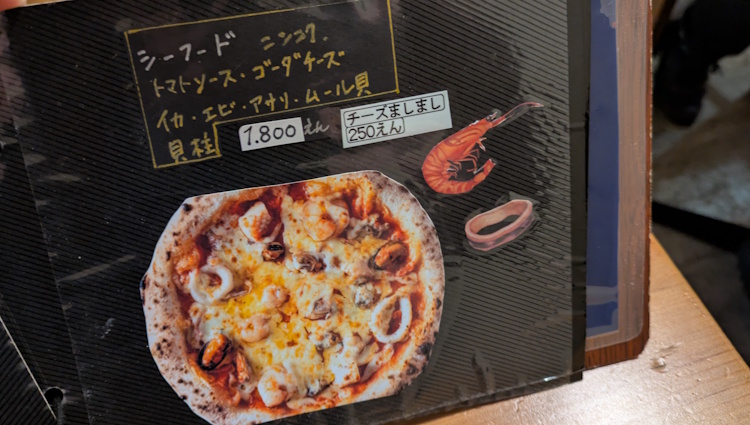
(As you can see in the pictures in this review, he has a hand-made menu, that is artsy in an unpretentious way. Very cool, very personal, very local.)

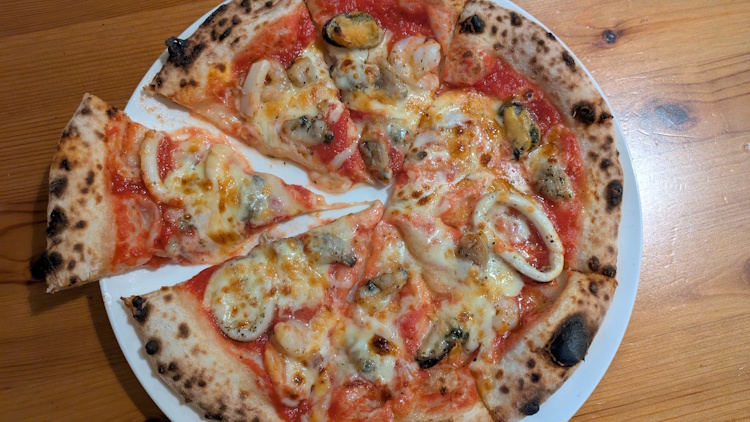
His Pepperoni was very tempting (sounded great), but I had my eye on the Seafood Garlic Pizza:

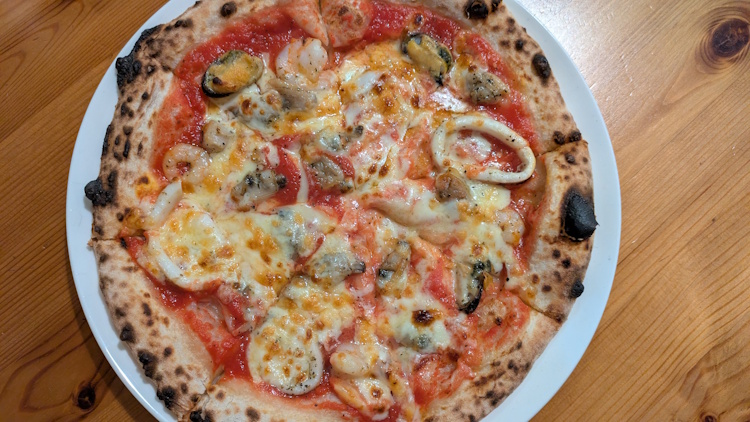
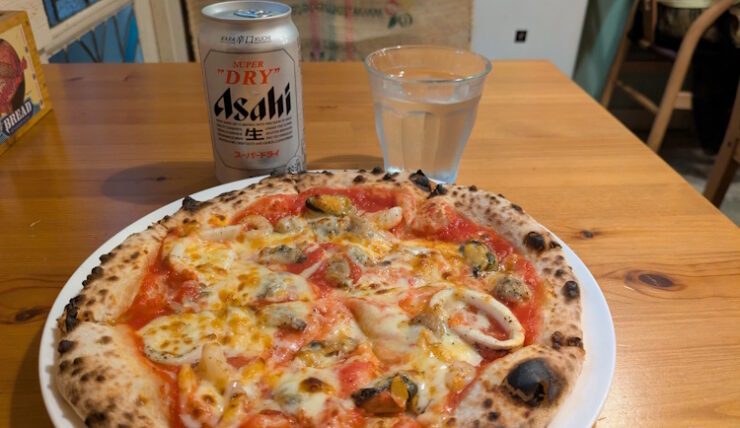
“Seafood Garlic Pizza: Tomato sauce and gouda cheese, squid, shrimp, anari, muscles, scallops”
— From the pizza menu at Pizzeria Allocco

It is part of my personal history that even as I am the Pizza Czar of Japan (like my father before me), I spent much of the first part of life in the US of A. And while Americans love their pizza (I’ve eaten hundreds of pizzas), I don’t think I’d ever had a proper seafood pizza in the US (with the exception of the occasional option of a slice of clam and garlic).

Japan, however, commonly does seafood pizzas. I’m thinking of Seared Tuna pizza at Savoy in Azabujuban, Tokyo. Here in Kobe, there is a Octopus pizza Normanna at Azzirri Pizza. There is a classic Cicinielli pizza at Critters Pizza in Osaka (Cicinielli is a small whitebait fish, what the Japanese call shirasu). Similar to Allocco, the Nishi-ku location of That’s Pizza in Osaka also does a mixed-seafood pizza.

I wanted to give this one a try. I am working up to writing an article about “fishy” pizzas in Japan, and the Seafood Pizza at Allocco will go on that list.

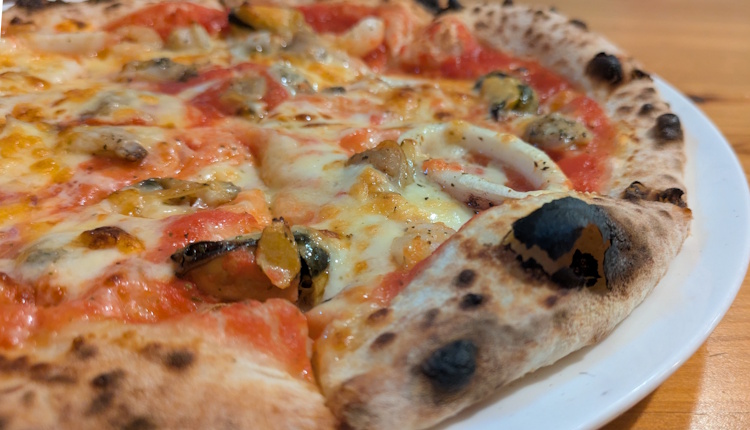
As it arrived, it was simple, but tasty. Sweet sauce. Lots of cheese. Loaded with seafood, but maybe a little dominated by the Gouda.

To add a little heat to your pizza, Allocco offers Marie Sharps Jalapeno Sauce and Tabasco. If he wanted to step it up a little, he could bring us some proper red pepper flakes.

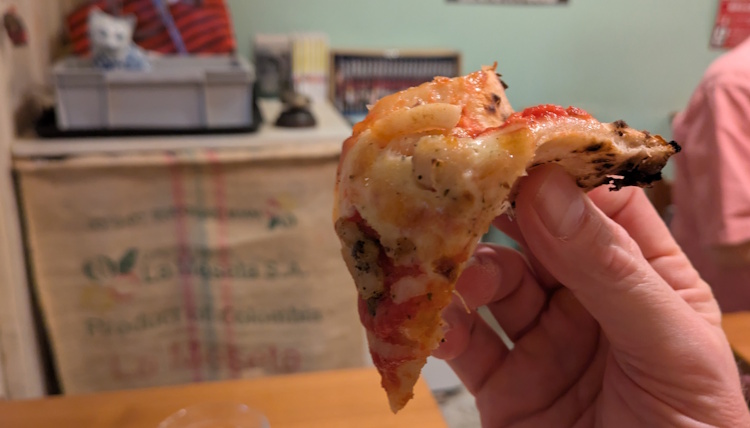
Does it pass the official Pizza Czar slice test? Can you pick it up? Give or take… yeah, maybe. Sort of.

You’ll notice that one of the ways in which he departs from “official Naples style” is in his more generous use of toppings. With more meat, (vegetables,) and cheese, a slice can be heavy. With that traditional thin crust, it’s not easy to support that extra weight.

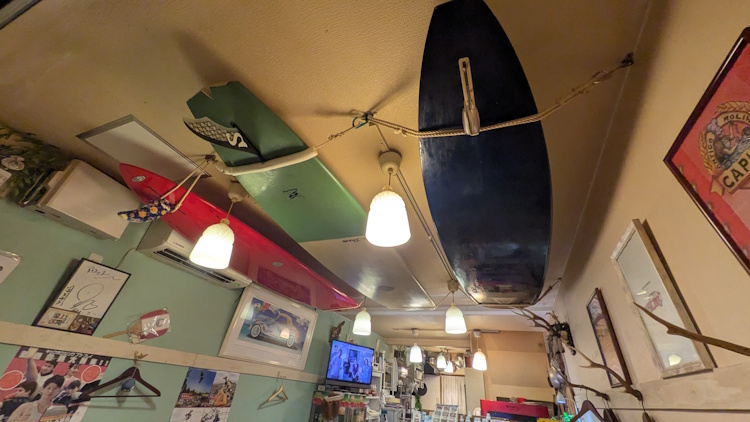
As I arrived inside Pizza Allocco that night, it was impossible not to notice the three big, gorgeous longboards hanging overhead. A killer split-tail Dick Brewer, a Harbour (that might be close to 10′), and a big, red, Surftech epoxy monster. All lined up, like a squadron of bombers, pointed back into the kitchen. The shop is just wide enough to hold them all, side by side, lashed to the ceiling.

While surf towns often have a good pizza spot or two, it is not obvious to connect surfboards with pizza.

As it happens, I had had pizza for lunch as well, at a pizza shop in Kobe called Track Pizza. At Track Pizza, the pizza master had a wide, floaty, fish surfboard up on his wall. Two pizza shops, both with surfboards, in the same day. Was it a coincidence? Yeah, I guess it was. I did ask the pizza master at Allocco if he knew the guy at Track, and yes – they are friends. Of course. That makes sense (somehow).

It is also true that Kobe’s Pizzeria Allocco does a classic Quatro Fromage Pizza; four kinds of cheese, with some honey to offset the salty, savory dairy flavor. And this sets us up to mention:

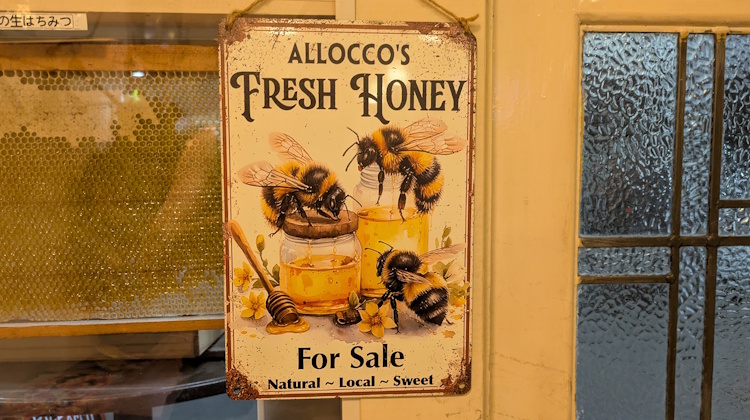
Allocco Pizza sells local Kobe honey in the store, as well.

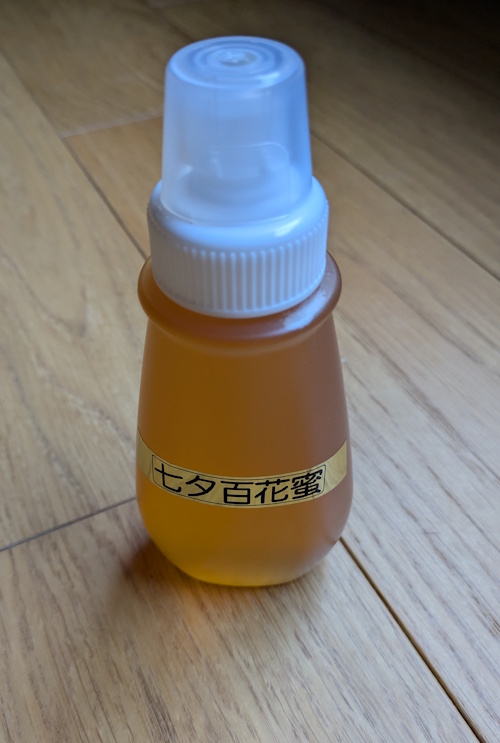
I was curious about the honey, and it seems like it could be a good souvenir to bring back from this trip to Kobe. The owner showed me three varieties, drawn from the activities of the bees from different times in the year in Kobe.

I choose the “Tanabata Flower Honey,” from the spring of 2025. Sweet, but a special, “floral” honey. It’s in my kitchen now. Good stuff.

I like this place. Simple, comfortable. Of course I like the surfboards too (pray for surf).

Pizza Restaurants in Kobe

Azzurri Pizzeria in Chuo-ku, Kobe
Neapolitan-style pizza at Elefante Trattoria and Pizzeria in Chuo-ku, Kobe
Jesus Pizza NYC-style slices in Chuo-ku, Kobe
Chicago pizza at BrewPub Starboard Pizza in Chuo-ku, Kobe
220 JPY cheese pizza slice at 2 Bro’s Pizza in Chuo-ku, Kobe

Events in Kobe, Japan

As part of our list of resources for visitors to Kobe, here is a list of events in Kobe, Japan.

Lists of Events in Kobe

Kobe Beer Jamboree (February)
Oktoberfest (April)
Infiorata Kobe Kitanozawa (May)
Kobe Rokko Meets Art (August)
India Mela (October)
Minato HANABI (October)
Kobe Jazz Street (October)
Kobe Marathon (November)

Also see our guide to Kobe festivals for traditional Japanese festivals in Kobe and more.
 

Kobe Beer Jamboree

Date: End of February
Time: 11:00 20:00
Location: Kobe Sambo Hall
Website: https://www.instagram.com/kobe_beer_jamboree/

Kobe Beer Jamboree is a beer festival held at Kobe International Exhibition Hall. The event aims to promote the development of the craft beer industry and beer culture. Beer bars and bottle shops from Kobe, as well as stores from across Japan, participate in the event.

Oktoberfest

Date: End of April to beginning of May
Time: 15:00 – 20:00
Location: Takahama Wharf Event Space
Website: https://okt-fest.com/

Oktoberfest is the world’s largest folk festival in Munich, Germany, celebrated with parades, dancing, orchestras, drinking, and games. Kobe is one of the places in Japan where Oktoberfest is celebrated, offering beer, food, and live music performances. While Oktoberfest is celebrated in October in Germany, the local Kobe event is in April/May.

Infiorata Kobe Kitanozawa

Date: Early May
Time: 14:00 – 17:00
Location: 2 Chome-14-29 Yamamotodori, Chuo Ward, Kobe, Hyogo 650-0003
Website: https://infiorata-kobe.net/

Infiorata is an event that originated in Italy, where artworks are created on streets and squares using flowers. The Kobe Infiorata was first held in 1997 in the Sannomiya Higashi area, inspired by the Infiorata in Genzano, Italy. Today, it is established as an annual spring event. The Infiorata is an event where local residents, people who work in the area, and visitors cooperate to create flower artworks.

Kobe Rokko Meets Art

Date: August – November
Time: 10:00 – 17:00
Location: Rooko town
Website: https://rokkomeetsart.jp/

Kobe Rokko Meets Art is a contemporary art festival, held every year on Mt. Rokko in Kobe. Since 2010, more than 580 groups of artists have participated in the event. Visitors can spend a fulfilling and enriching time while enjoying both the nature of Mount Rokko, which is one of Kobe’s iconic mountains, and the art on display.

India Mela

Date: October
Time: 10: – 20:00
Location: Meriken Park
Website: https://india-mela.com/

India Mela is one of the largest Indian festivals in western Japan, where visitors can experience Indian culture, music, dance, and cuisine all in one place. It has been held in Kobe since 2010 under the theme of “introducing Indian culture to more people in Japan.” On the stage, a variety of performances are presented, including traditional Indian classical dance, Bollywood dance, live music performances, and yoga. There are also food stalls offering a wide range of Indian dishes and sweets, including curry, as well as booths selling handicrafts and fashion items.

Minato HANABI

Date: October
Time: 18:30 – 18: 45
Location: Meriken Park
Website: https://minatohanabi.jp/

Minato Hanabi is a five-day fireworks event held at Meriken Park. Beautiful fireworks are launched and synchronized with music, and everyone can enjoy the show free of charge.

Kobe Jazz Street

Date: October
Time: 12:00 – 17:00
Location: Check the website
Website: https://www.kobejazzstreet.gr.jp/

Kobe Jazz Street began 38 years ago and continues to feature the same style of jazz that has been preserved in the city since the post–World War II period. Each year, jazz musicians from Japan and Europe collaborate. Both professional and amateur performers take part, and the event includes a variety of styles and performances by both small combos and big bands.

Kobe Marathon

Date: November
Time: 10:00-19:00
Location: Kobe International Exhibition Hall
Website: https://kobe-marathon.net/2025/

Kobe is the place where the first marathon in Japan was held in 1909. Today, the Kobe Marathon is held every year, and food stalls and markets are set up at the Kobe International Exhibition Hall.

See Also

Population of Kobe
Neighborhoods in Kobe, Japan
Shopping places in Kobe, Japan
Department stores in Kobe, Japan
Major train stations in Kobe, Japan
Kobe Airport in Kobe city, Japan
Bay Shuttle Ferry service in Kobe, Japan
Train Lines, Shinkansen and Subway in Kobe, Japan
Kobe foreign settlement
Temples and Shrines in Kobe, Japan
Festivals in Kobe, Japan
Hot springs and onsen in Kobe, Japan
Popular museums in Kobe, Japan
Parks and gardens in Kobe, Japan
Public swimming pools in Kobe
Japanese language schools in Kobe, Japan
Colleges and Universities in Kobe, Japan
International schools in Kobe
English speaking immigration lawyers in Kobe
Co-working spaces in Kobe
Tax specialists that speak English in Kobe

And Also:
Festivals in Osaka, Japan
— A guide to the biggest annual events in Osaka City
— A list of marathons in Osaka City, Japan
Festivals in Nagoya, Japan, including the Nagoya Port Festival
Festivals in Sapporo, Japan, including the Snow Festival in Sapporo
List of big events in Sapporo City, Japan

Pizzeria Azzurri in Chuo-ku, Kobe

As a part of our guide to the best pizza in Kobe City, we are excited to bring you this review of Pizzeria Azzurri in Chuo-ku, Kobe. The short answer is: fantastic pizza, surely one of the best Napoletana pizzas in Japan.

We first heard of Azzurri Pizza in Kobe, from the pizza master at Pizzeria Quarantuno 41 (in Nagoya). He had a book of great pizza restaurants in Japan (maybe a directory?), and he looked up Kobe’s Azzurri to show it to me.

Azzurri Pizza is located in Chuo-ku, Kobe, not far from Sannomiya Station, in between Yamate Kansen and the mountains (to the north). I was there on a Saturday at dinner time, without a reservation. It was crowded. A serious guy that seemed to be running the show told the server to have me wait outside.

I was just one for dinner, but inside was packed and the wait was about 20 minutes. They brought me a menu. I was glad to just sit; it had been a long day, crawling across Kobe. I had a chance to relax and look around.

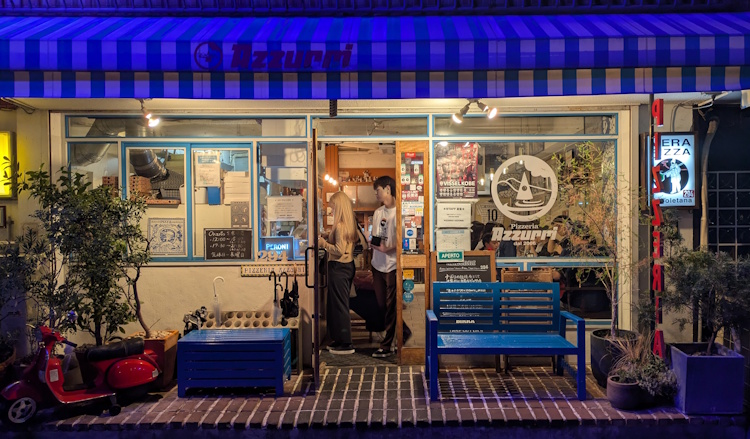
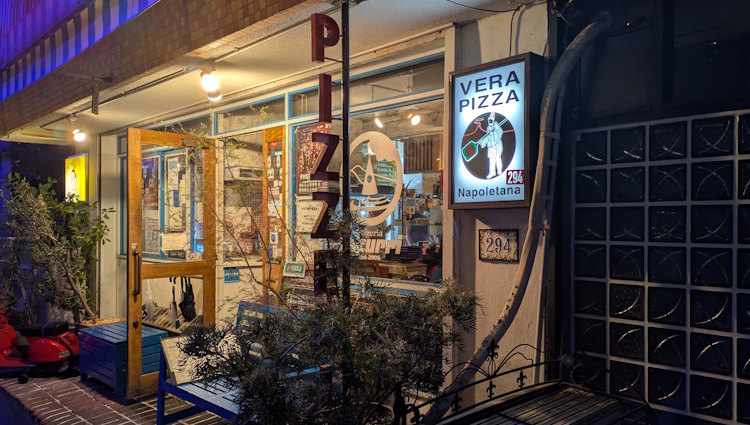
Outside of Azzurri; you step off the pavers onto old dark bricks, their edges at the entrance rounded from so much use. Bright blue benches. A piece of wood wedged under the wood-frame door, holding it open.

I know we’re all here for the pizza, so let’s get to it.

This place makes a fantastic pizza; a pizza that photographs well, and tastes even better.

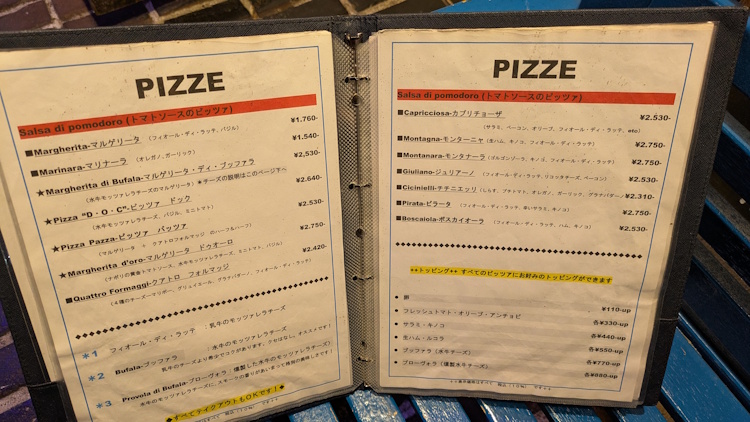
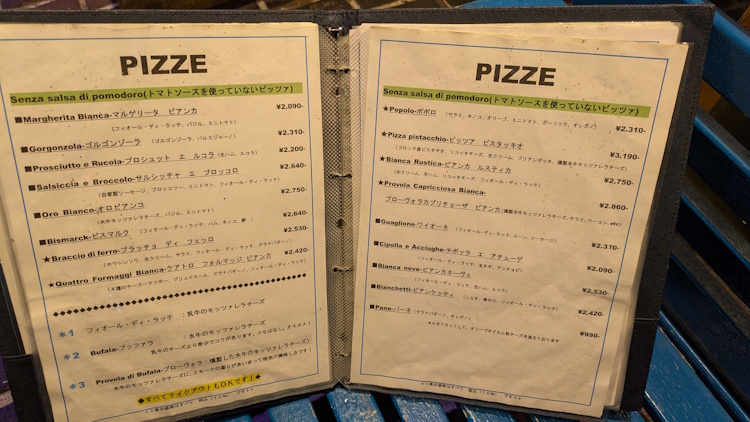
It all begins with Azzurri’s extensive pizza menu; several pages of options, as well as a list of special and seasonal pizzas.

The menu also lists three kinds of cheese: mozzarella, a buffalo mozzarella, and a smoked buffalo mozzarella. One of the first times I thought much about buffalo mozzarella was at Sabasu Pizza in Akasaka, Tokyo (if you know it, it makes for a suitable comparison to Azzurri).

For my part, I wanted to try something they call the Pizza Normanna, from the the “Specialita” menu:

Pizza Normanna: Octopus, pepperoncini macinati, homemade ricotta cheese, basil, garlic, oregano, tomato sauce
— From the Pizzeria Azzurri pizza specialty menu

Every part of that sounded good to me. I have been working on a list of seafood pizzas from Japan, and the opportunity to eat an Octopus pizza was irresistible.

After a while I was seated, at a quiet table, next to the door (from which I could look into the kitchen). The smells in the room were garlic and sauce. A family of four next to me ate a meaty Bolognese sauce on pasta that was so tempting it almost made me rethink my order. They also ate a jet black pasta (presumably made from octopus ink?). Everything was comfortable, but high-end and special.

Pricing fits the experience: For a single pizza you’ll pay 2100 JPY, nudging up into 3200 JPY (depending on what you order).

When my server came to my table, I ordered that Pizza Normanna and a beer.

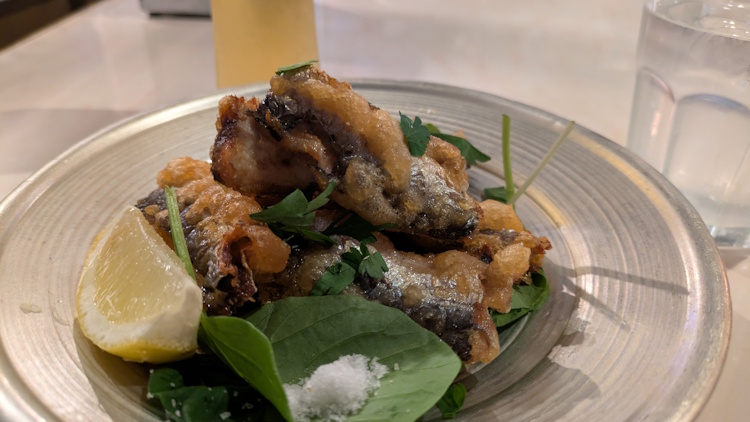
I wanted to try something else off the menu besides pizza, so I also ordered the Fritto di Mare del Giorno. I know “fritto di mare” means “fruit of the sea,” but (because my Japanese is admittedly terrible) exactly what would be served was to be a mystery until it arrived.

I asked some questions, but my understanding was limited. To the best of my knowledge: the “fruit of the sea” at Azzurri varies by day, and what is in season. On my visit my appetizer arrived in an aluminum dish; small fish, battered and fried, with a slice of lemon, and a pile of salt set on a leaf of basil.

It was basically like a Japanese “fish and chips,” minus the potatoes. More fine than that. Very tasty. I was glad to have something to get started, and to give you all another view of the food; which was beautiful, like everything else at Azzurri.

And then, of course: it was show time.

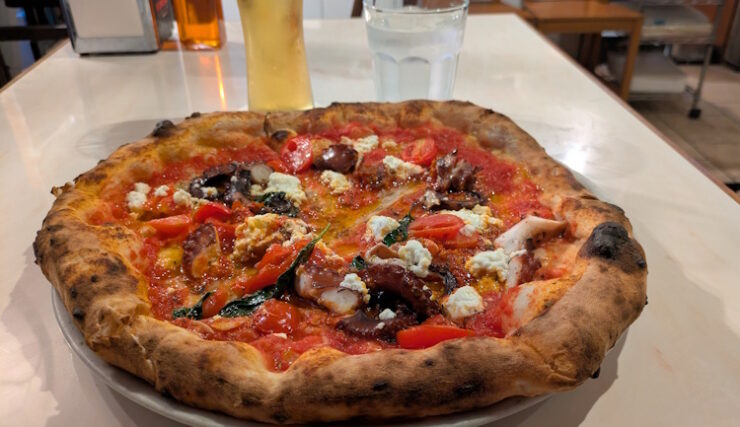
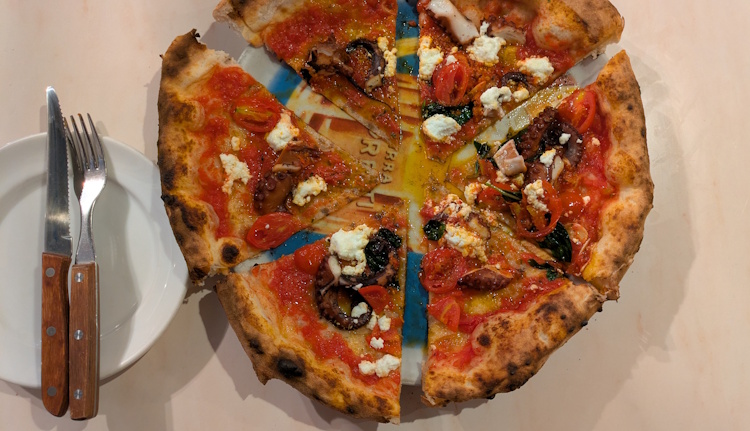
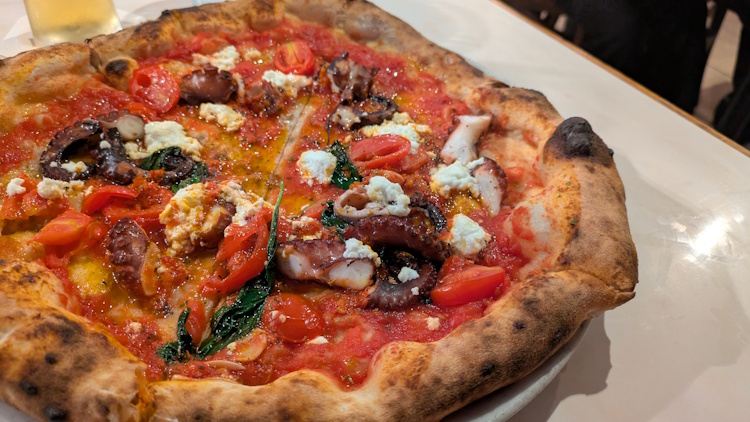
Behold: the Pizza Normanna at Azzurri Pizza in Kobe.

Once I had the pizza in front of me I went back to look at the ingredients; I had some more questions and curiosity to be satisfied.

For example: I looked up “peperoncini macinati.” In America, a pepperoncini is a mild green pepper in vinegar (a classic deli pepper, goes well with a roast beef sandwich). In this case, the “from Italy” use of that term is a chopped red pepper, often in olive oil, with a decidedly hot flavor (like the red chili flakes you’d find at a pizza slice place). In this, case it means the pizza was to be a little spicy.

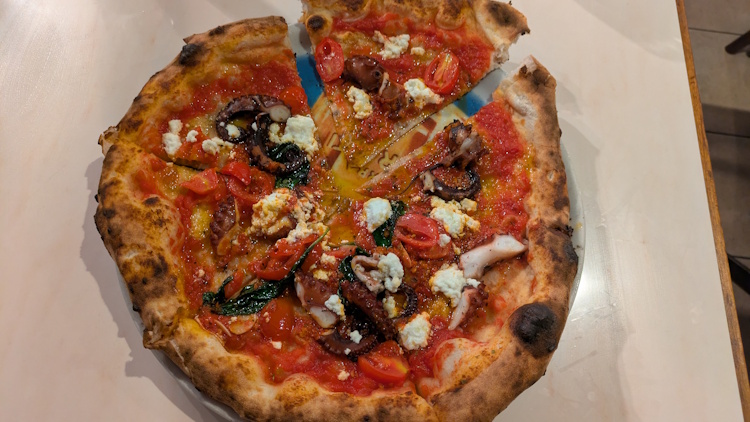
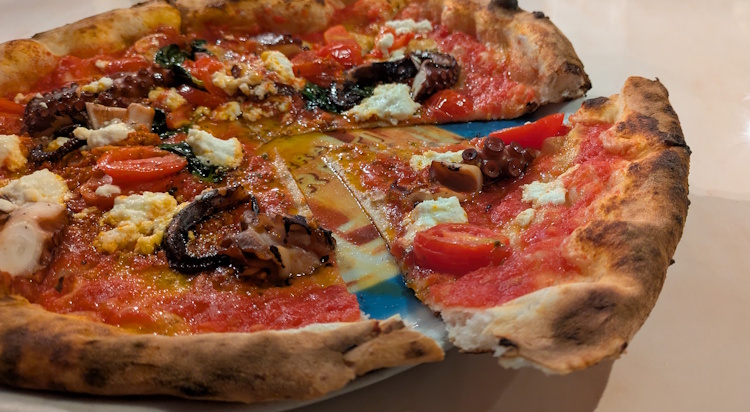
It certainly was spicy; this pizza was a fireball. The crust, was paper thin; both as it was stretched across the plate, and in the big, broken-black bubble of the crust. Amidst all that firepower, the ricotta cheese comes through like a blanket of creme to cleanse your palette, and put the fire out.

(In my research for this review, I came across another Pizza Normanna that had a creamy cheese as well – in that case the pizzeria was in Slovakia, and the cheese happened to be from Hokkaido, Japan. That pizza had some baked Italian ham, but doesn’t look to have been spicy. It may be that the cheese is the defining element of a Normanna Napoletana pizza.)

The tomatoes on the Normanna pizza at Azzurri were bright, heavy, juicy. There was an occasional burst of basil. With all of this going on, the octopus becomes a source of protein, both otherwise plays only a supporting role to flames, tomatoes, and soft, soothing cheese.

(In my final bites I took a bite of octopus, and one of the tomatoes on a fork – the two alone, together. A fantastic duet. I did it again. The octopus was tender, and needs a less-crowded stage to be noticed.)

This pizza became a fantastic lesson in ricotta cheese. Ricotta – can be overwhelming. But paired with acidy tomatoes, and in this case with all that spice, it was wonderful.

I found one slice that was cut a little wide. When I folded it over, even loaded w/ toppings I could pick it up. With regard to the classic Pizza Czar Pizza Test: Azzurri in Kobe offers very thin-crust pizza, most definitely “knife and fork pizza” (even I used a fork to get started, I never do that). But, with the right slice, part of this pizza could be picked up.

Look at that slice. For their typical slice, there is no way you’re going be able to pick them up.

The shop feels masculine. From the moment the big guy (with the grey beard) in the kitchen kind of barked for me to seat down and wait my turn (outside), I could tell this place has some testosterone. Good deal. I like it.

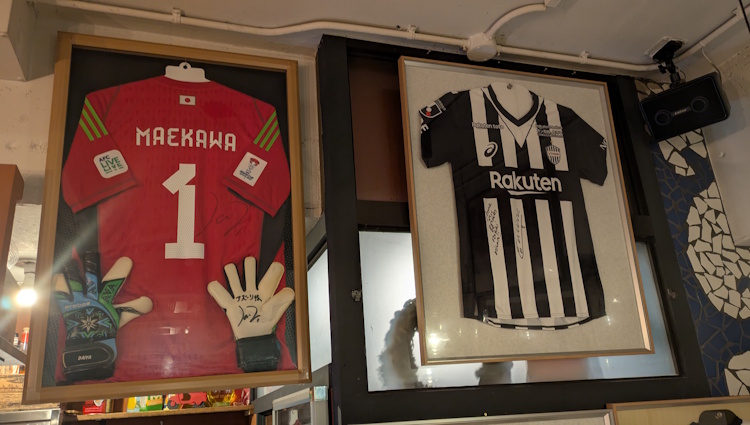
Inside, the decor has been layered-on; each cm of the walls is covered in posters and framed sports jerseys (Maekawa, #1, apparently a goalie).

“Vissel Kobe.”

Not a huge place, but a busy place. Seats 20+ patrons, tightly packed – and has a staff of maybe seven. On a Saturday night; two young girls serving, and maybe five guys in the kitchen.

To state what should be obvious; I loved it. I was so happy to be there, having an absolutely marvelous pizza experience. As the Pizza Czar of the Japan, that is what I want to see.

I lingered. I took my time. I had two beers, and sank into my seat. Sated and satisfied. My meal of fish, and pizza, an beer at Azzurri was a perfect celebration after a hard day.

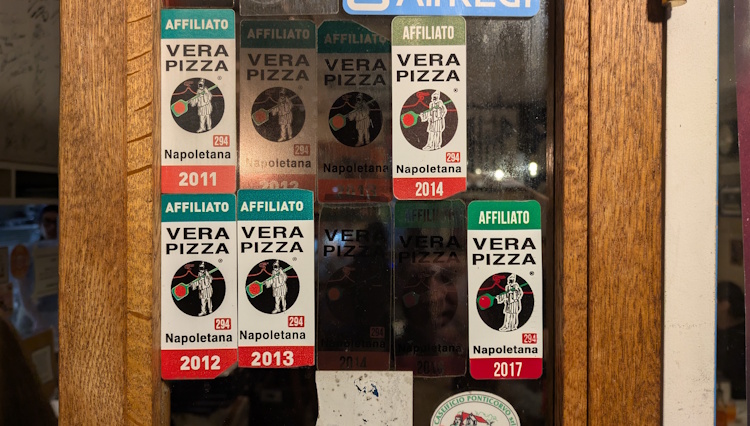
And I will add: Pizzeria Azzurri in Kobe is one of my first good “Vera Pizza” experiences.

When I spotted the heavy “Vera Pizza” branding, I took the following note: “AVPN – not a good sign, but I think this going to be great pizza.”

This Associazione Vera Pizza Napoletana is an “accreditation” for pizzerias “that respect the tradition of the art of Neapolitan pizza making” (per the standards of the organization). It has been my experience that the presence of the “certification” mostly means you will have a generic, mediocre experience; the very best pizzas I’ve had in Japan almost never have this designation (while many of the most ordinary boast of their “Vera Pizza” status).

AVPN is a good example of why the phrase “you shall know them by their fruit” cuts both ways; I have come to associate AVPN pizzerias with “averageness” (or worse). Often a strong appeal to accreditation is a red flag.

However, Azzurri is an example of the rare pizza restaurant in Japan that drags around the AVPN albatross and manages to rise above it, and deliver something extraordinary. When they talk about the best pizzas in Japan, Azzurri has earned a place in that conversation along with the Pizza Bar on 38th and Marumo Pizza.

I loved my Pizza Normanna. I would eagerly head back to Kobe’s Azzurri Pizzeria again. I would love the opportunity to sample some other pizza from their menu, and I’m certain it would be good stuff.

Hot. Hot pizza desu. The sauce, sweet relief. The crust, a burnt sweet melody. I loved the crust. I used the last bite to sop up some sauce and oil scarpetta style.

Perhaps a little expensive. I think an app, two beers, and a pizza was about 8000 JPY. But… in my experience, worth the price in every way.

Fantastic.

Bravo. Highly recommended.

Pizza Restaurants in Kobe

— Excellent Napolitana pizza at Elefante Pizza in Chuo-ku, Kobe
— Get more NY-style pizza slices at Jesus Pizza in Chuo-ku, Kobe
Chicago pizza at BrewPub Starboard Pizza in Chuo-ku, Kobe
— Simple, neighborhood Napoletana pizza at Pizzeria Allocco in Kunikadori in Chuo-ku, Kobe
— Amazing NYC-style pizza slices at 2 Bro’s Pizza at Sannomiya Station in Chuo-ku, Kobe

Popular Tourist Attractions in Kobe, Japan

As a resource for visitors to Kobe, this article will explore the most popular attractions visited by tourists in Kobe, Japan. Below is a list of famous locations where tourists and visitors can enjoy spending time with friends and family in Kobe City.

Places to visit in Kobe

Famous Tourists Attractions in Kobe, Japan
Zoos in Kobe / Aquarium in Kobe
Best Museums in Kobe
Best Places for Shopping in Kobe
Shrines and Temples in Kobe
Best Parks and Gardens in Kobe
Kobe Onsen
Famouse Festivals in Kobe

== Famous Tourists Attractions in Kobe, Japan

Kobe Chinatown Nankin-machi

Address: 1-3-18 Sakaemachidori, Chuo Ward, Kobe City, Hyogo 650-0023
Website: https://www.nankinmachi.or.jp/

Nankin-machi is one of the famous Chinatown neighborhoods in Japan (following Yokohama and Nagasaki). There are 88 shops and restaurants where you can enjoy Chinese food, ingredients, and other products from China. Moreover, the Chinese New Year celebration and Mid-Autumn Festival are held here every year.

Kobe Brick Warehouse

Address: 1-5-5 Higashikawasakicho, Chuo Ward, Kobe City, Hyogo 650-0044
Website: https://kobe-renga.jp/

Kobe Brick Warehouse was built in the late 1890s in the English bond style and was originally used to store cargo arriving at Kobe Port. Two houses from that period remain by the seaside, and have been renovated. Today those structures are used as photo studios, restaurants, and as shops.

Kobe Kitano Ijinkan-Gai

Address: Kitanocho, Chuo Ward, Kobe City, Hyogo 650-0002
Admission Fee: Depends on the Ijinkan you visit
Website: https://www.kobeijinkan.com/

Following the opening of Kobe Port, the number of foreign residents increased, leading to the creation of the Ijinkan (foreigners’ residence) town. Despite the fact that many of the 200 original Ijinkan were destroyed during and after World War II, some remain due to the city’s preservation efforts.

There are 16 Ijinkan to visit, each offering unique exhibitions and hands-on craft experiences reflecting their country of origin. In addition to the Ijinkan, there are bakeries, cafés, and rental shops offering traditional Japanese clothing, so you can enjoy dressing up and going around the town.

== Zoos in Kobe / Aquarium in Kobe

Kobe Animal Kingdom

Address: 7 Chome-1-9 Minatojima Minamimachi, Chuo Ward, Kobe City, Hyogo 650-0047
Admission Fee: Adults 2,200JPY, 6-12yo 1,200JPY, Children 500JPY, Over 65yo 1,600JPY
Website: https://www.kobe-oukoku.com/en

Kobe Animal Kingdom is located on Port Island, between Kobe Airport and Kobe city. It is more than just a zoo, offering activities such as free-flight bird shows, camel rides, and opportunities to feed the animals.

Kobe Ōji Zoo

Address: 3 Chome-1 Ojicho, Nada-ku, Kobe City, Hyogo 657-0838
Admission Fee: Adults 600JPY, Children Free
Website: https://www.kobe-ojizoo.jp/guide/fl/

Kobe Oji Zoo is a popular attraction for both children and adults. The zoo features an animal section, an animal science section, a theme park, and restaurants.

Átoa

Address: 7-2 Shinkocho, Chuo Ward, Kobe City, Hyogo 650-0041
Admission Fee: Adults 2,800JPY, 13-18yo 2,400JPY, 6-12yo 1,600JPY, 3-6yo Free entry for one child per adult
Website: https://atoa-kobe.jp/

Átoa is the aquarium in Kobe, featuring live fish and other attractions. Known for its photogenic displays, the aquarium attracts visitors from Japan and around the world.

== Best Museums in Kobe

There are several wonderful museums in Kobe where visitors can learn and enjoy while in Kobe City. Here is a selection of the top museums for a variety of tastes.

Hyogo Prefectural Museum of Art

Address: 1 Chome-1-1 Wakinohamakaigandori, Chuo Ward, Kobe, Hyogo 651-0073
Admission Fee: Adults: 550JPY, University students: 400JPY, High school students and younger: Free
Website: https://www.artm.pref.hyogo.jp/

Hyogo Prefectural Museum of Art has collected around 13,000 works since its days as the former Museum of Modern Art.

Kobe Anpanman Children’s Museum & Mall

Address: 1-6-2 Higashikawasakicho, Chuo Ward, Kobe City, Hyogo 650-0044
Admission Fee: 2,000JPY ~ 2,500JPY
Website: https://www.kobe-anpanman.jp/

Kobe Anpanman Children’s Museum & Mall is popular with children and their parents. The Anpanman museum is at the end of a outdoor shopping mall called Mosaic. Children and their parents can enjoy the museum, parents can have fun at the attached shopping mall. There is also an outdoor train ride, and a ferris wheel, located next to the museum.

The Takenaka Carpentry Tools Museum

Address: 7-5-1, Kumochicho, Chuo Ward, Kobe, Hyogo, 651-0056
Admission Fee: Adults: 700JPY, Seniors: 500JPY, Students: 500JPY, Children: Free
Website: https://en.dougukan.jp/

The Takenaka Carpentry Tools Museum is located near Shin-Kobe Station. It is the only museum in Japan that aims to collect and preserve vanishing carpentry tools as part of the national heritage, and pass them on to future generations through research and exhibitions.

While in the same neighborhood, visitors might also want to see the Nunobiki Herb Gardens & Ropeway (located a short walk away).

== Kobe best shopping places/malls

There are several high-end department stores in Kobe, as well as some Kobe shopping malls, that are popular with both locals and tourists. For more information, see our guide to shopping in Kobe.

Daimaru Kobe

Address: 40 Akashi-cho, Chuo-ku, Kobe, Hyogo 650-0037
Station: Motomachi Station
Website: https://www.daimaru.co.jp/kobe/

Daimaru became Japan’s top-selling department store and earned a reputation as one of the nation’s top department stores. Daimaru operates nine stores in Japan, mainly around the Kansai area (where Kobe is located). There is a beautiful Daimaru located in the Akashimachi district of Chuo Ward, near Chinatown.

Kobe Sanda Premium Outlets

Address: 7-3 Kozudai, Kita Ward, Kobe, Hyogo 651-1515
Station: Take a bust from Sanda Station
Website: https://www.premiumoutlets.co.jp/kobesanda/

Kobe-Sanda Premium Outlets is one of Japan’s best outlet malls, featuring around 220 shops, including restaurants. The architecture is inspired by Pasadena, a luxurious residential area in Los Angeles.

Kōbe Hankyū

Address: 8 Chome-1-8 Onoedori, Chuo-ku, Kobe, Hyogo 651-8511
Station: Kobe-Sannomiya Station
Website: https://global.hankyu-hanshin-dept.co.jp/store/kobe/

Kobe Hankyu is one of several excellent department stores in Kobe. Hankyu Department Store was the first in the world to open directly connected to a railway station; this store is located next to Kobe-Sannomiya Station. Today, the Hankyu company operates 12 stores (mainly in the Kansai region), with additional locations in the Kanto and Kyushu regions. For example, the Hankyu department store in Osaka is the most popular department store in that city.

Umie

Address: 1-7-2 Higashikawasakicho, Chuo Ward, Kobe, Hyogo 650-0044
Station: Harborland Station
Website: https://umie.jp/

Umie is a shopping mall that has approximately 200 shops. Some restaurants are open until 10 PM so that you can enjoy the night view after dinner.

== Best Shrines and Temples in Kobe

Visitors can enjoy Japanese tradition by going to shrines and temples in Kobe.

Ikuta Shrine

Address: 1 Chome-2-1 Shimoyamatedori, Chuo Ward, Kobe City, Hyogo 650-0011
Website: https://ikutajinja.or.jp/

Ikuta Shrine is an ancient shrine with a history of over 1,800 years. The name “Kobe” originated from the “Kanbe,” the families who protected the deity of Ikuta. The word “Ikuta” meaning a place brimming with vibrant life force.

Sumadera Temple

Address: 4 Chome-6-8 Sumaderacho, Suma Ward, Kobe City, Hyogo 654-0071,
Website: https://sumadera.or.jp/english/

The temple is nationally renowned as an ancient site connected to the Genpei War, featuring numerous treasures and historical landmarks. It also contains many sites associated with The Tale of Genji, making it a destination rich in historical significance and cultural heritage.

== Best Parks and Gardens in Kobe

In this section, we will recommend three of the best parks and gardens in Kobe, which are Meriken Park, Nunobiki, and Mt.Rokko.

Meriken park

Meriken Park is located near Harborland, and is home to the famous “BE KOBE” monument. Many attractions, such as Átoa, Kobe Anpanman Children’s Museum & Mall, and Kobe Brick Warehouse, are near the Meriken Park area. There is also a tower called Kobe Port Tower that allows tourist to see the view of Kobe.

Kobe Port Tower
Address: 5-5 Hatoba-cho, Chuo Ward, Kobe City, Hyogo, 650-0042
Admission Fee: Adults: 1,200 JPY, Children: 500 JPY, Toddlers: Free
Website: https://www.kobe-port-tower.com/

Kobe Port Tower was built in 1963, offers panoramic views of the city and its port.

Kobe Nunobiki Herb Gardens & Ropeway

Address: 1-chōme-4-3 Kitanochō, Chuo Ward, Kobe City, Hyogo 650-0002
Admission Fee: Adults: 2,000 JPY, Children (elementary to Junior high school students): 1,000 JPY, Pre school: Free
Website: https://www.kobeherb.com/

Kobe Nunobiki Herb Gardens & Ropeway has the biggest scenic garden in Japan, as well as four waterfalls on the way to the garden from the foot of the mountain.

There are 12 themed gardens featuring different flowers and plants that change with the seasons. A ropeway operates from the foot of the mountain to take visitors to the Herb Gardens.

For visitors that don’t want to take the ropeway, you can walk from the entrance up the hill to see the gardens and waterfalls.

Mt. Rokko

Mt. Rokko is a popular tourist destination known for offering one of Japan’s “Three Great Night Views.”

Observation Deck
Address: 1-32 Ichigatani, Rokkocho, Nada Ward, Kobe City, Hyogo 657-0101
Admission Fee: Adults: 500 JPY, Children: 200 JPY, Under 3 years old: Free
Website: https://www.rokkosan.com/tenrandai/

In commemoration of Emperor Showa’s visit on May 25, 1981, this spot was named Tenrandai, meaning “the place where the Emperor views.”

Rokko Garden Terrace
Address: 1877-9 Rokkosancho, Nada Ward, Kobe City, Hyogo 657-0101
Admission Fee: Entrance fee: free (Inside facilities require an additional fee)
Website: https://www.rokkosan.com/gt/

Rokko Garden Terrace is one of Japan’s top scenic viewpoints, offering panoramic views from the Akashi Strait to Kansai International Airport. Within the terrace, several lookout spots provide different perspectives and atmospheres depending on the angle and time of day.

Mt. Rokkō Snow Park
Address: 4512-98 Kitarokko, Rokkosan-cho, Nada Ward, Kobe CIty, Hyogo 657-0101
Admission Fee: Adults: 2,500 JPY, Children: 1,300 JPY (Excluding a rental fee)
Website: https://www.rokkosan.com/ski/

Rokko Snow Park is an artificial snow theme park offering not only skiing and snowboarding but also sledding and snow play. The gentle slopes of the main run are perfect for beginners, and a full range of rental equipment makes it easy for anyone to join in the fun.

Rokko Alpine Botanical Garden
Address: 4512-150 Kitarokko, Rokkosancho, Nada Ward, Kobe City, Hyogo 657-0101
Admission Fee: Adults: 900 JPY, Children: 450 JPY
Website: https://www.rokkosan.com/hana/

This botanical garden cultivates around 1,500 species of alpine and cold-climate plants in a natural setting. Visitors can enjoy seasonal highlights such as spring flowers, summer greenery, and brilliant autumn foliage, along with a plant-themed shop and a cozy café.

== Best Onsen in Kobe

Kobe is one of the top destinations for hot springs in Japan. There are onsen and sento located within Kobe’s downtown area, as well as the famous onsen in Arima (located in the mountains outside of downtown Kobe). For more information, see our guide to hot springs in Kobe.

Arima Onsen

Address: Kita Ward, Kobe City, Hyogo 651-1401
Website: https://www.arima-onsen.com/

Arima onsen is one of the most famous onsen towns in Japan. There are many onsen (featuring natural mineral water) that are open to the public for day use. There are also many hotels that have their own onsen. The Arima onsen town offers a variety of cafés, restaurants, and souvenir shops for visitors to enjoy.

== Famous Festivals in Kobe

Below we feature two of the the most famous festivals in Kobe. For more information, see our articles about events in Kobe City and Kobe festivals.

Danjiri Festival

Date: 3rd to 5th of May
Time: Depends on the area
Location: Higashinada Ward
Website: https://www.uhara-danjiri.jp/

The Danjiri Festival refers to a general term for festivals in which people pull dashi (festival floats) used in shrine ceremonies to pray for a good harvest of grains. Kobe has a unique Danjiri style as people dance on the top of the floats while putting on make-up.

Kobe Festival and Parade

Date: The third Saturday of May
Time: 11:00 – 17:00
Location: Sannomiya area
Website: https://kobe-matsuri.com/

The Kobe Festival takes place in the streets around Sannomiya Station. People enjoy seeing performances including parades with singing, dancing, and costumes.

See Also

Population of Kobe
Neighborhoods in Kobe, Japan
Shopping places in Kobe, Japan
Department stores in Kobe, Japan
Major train stations in Kobe, Japan
Kobe Airport in Kobe city, Japan
Bay Shuttle Ferry in Kobe, Japan
Train Lines, Shinkansen and Subway in Kobe, Japan
Kobe foreign settlement
Temples and Shrines in Kobe, Japan
Festivals in Kobe, Japan
Events in Kobe, Japan
Hot springs and onsen in Kobe, Japan
Popular museums in Kobe, Japan
Parks and gardens in Kobe, Japan
Public swimming pools in Kobe
Japanese language schools in Kobe, Japan
Colleges and Universities in Kobe, Japan
International schools in Kobe
English speaking immigration lawyers in Kobe
Co-working spaces in Kobe
Tax specialists that speak English in Kobe

See also:
Nagoya tourist attractions